Spray Foam vs Mineral Wool: Which Is the Better Insulation Material?
Comparing spray foam and mineral wool to determine the better insulation material for thermal resistance, moisture control, and acoustics.

The Core Contenders: Closed-Cell SPF vs. Stone Wool
When architects, builders, and homeowners debate which is the better insulation material for high-performance building envelopes, the conversation inevitably narrows down to two heavyweights: 2.0 lb closed-cell spray polyurethane foam (ccSPF) and high-density stone wool (mineral wool) batts. Both materials represent the premium tier of the insulation market, but they achieve their performance through fundamentally different physical mechanisms.
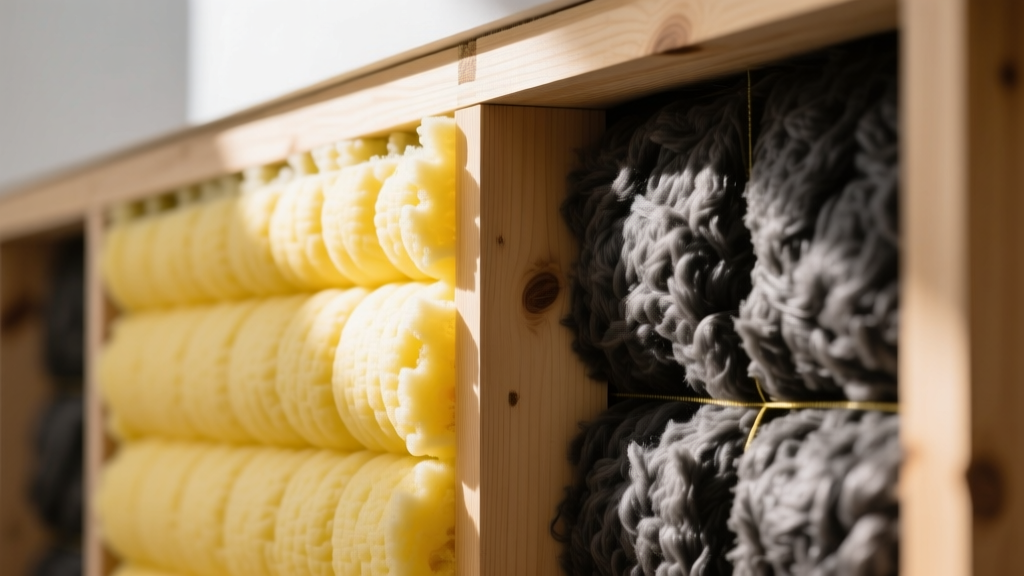
Closed-cell SPF is a rigid, cellular plastic that expands to fill cavities, providing both insulation and an air barrier in a single application. Mineral wool, manufactured by spinning molten basalt rock and slag into dense fibers, relies on trapped air within its matrix to resist heat flow while offering exceptional fire and acoustic properties. According to the U.S. Department of Energy, selecting between these materials requires looking beyond basic R-value to evaluate moisture dynamics, structural contributions, and long-term durability.
- Choose Closed-Cell SPF if: You need maximum R-value in shallow cavities, require a built-in vapor retarder, or want to add structural racking strength to shear walls.
- Choose Mineral Wool if: Fire resistance is paramount, you are building in a mixed-humid climate requiring vapor-permeable drying, or you need superior sound attenuation between interior partitions.
Thermal Resistance and Long-Term R-Value Degradation
The most common metric for comparing insulation is the R-value per inch. However, evaluating the better insulation material requires understanding how these values age and perform in real-world framing assemblies.
| Material | Nominal R-Value / Inch | Aged R-Value / Inch | Air Permeability | Blowing Agent (2026) |
|---|---|---|---|---|
| 2.0 lb ccSPF | R-6.5 to R-7.0 | R-6.0 to R-6.5 | Zero (Air Impermeable) | HFO (<1 GWP) |
| Stone Wool Batts | R-4.2 to R-4.3 | R-4.2 to R-4.3 (Stable) | High (Air Permeable) | N/A (Trapped Air) |
The Blowing Agent Shift
A critical update for 2026 builds is the transition in spray foam chemistry. Modern ccSPF products (such as Huntsman Heatlok H2 or BASF Walltite Eco) now utilize hydrofluoroolefin (HFO) blowing agents. These next-generation agents have a Global Warming Potential (GWP) of less than 1, effectively eliminating the environmental penalty associated with older HFC-245fa foams. Mineral wool, requiring no chemical blowing agents, maintains a perfectly stable R-value over its lifespan, as its thermal resistance relies entirely on the physical structure of the rock fibers.
Air Sealing, Moisture Dynamics, and Vapor Retarders
Thermal performance is irrelevant if the wall assembly fails due to moisture accumulation. This is where the two materials diverge sharply in building science applications.
Closed-Cell SPF: The Monolithic Barrier
At a thickness of 1.5 inches or greater, 2.0 lb closed-cell foam qualifies as a Class II vapor retarder. It completely seals the cavity, preventing warm, moist indoor air from reaching the cold exterior sheathing in winter. This eliminates the risk of interstitial condensation on the back of the drywall. However, this impermeability means the wall cannot dry to the interior. If bulk water enters the wall from a roof leak or window flashing failure, the moisture is trapped against the exterior sheathing, potentially leading to concealed rot.
Mineral Wool: The Breathable Sponge
Stone wool is entirely vapor-permeable and hydrophobic. It will not absorb liquid water, and if it gets wet, it drains rapidly and dries out without losing its structural integrity or R-value. According to research published by the Building Science Corporation, vapor-permeable assemblies are often preferred in mixed-humid climates because they allow the wall to dry in both directions (inward and outward) depending on the seasonal vapor drive. Because mineral wool is air-permeable, it must be paired with a dedicated air barrier (such as taped exterior sheathing or an interior airtight drywall approach) to prevent convective heat loss and moisture-laden air infiltration.
Fire Safety and Acoustic Dampening
If the metric for the better insulation material shifts from thermal resistance to life safety and acoustics, mineral wool is the undisputed champion.
- Fire Resistance: Stone wool is inherently non-combustible, withstanding temperatures exceeding 2,000°F (1,093°C) without melting. It is frequently used as fire-stopping material in commercial penetration seals. Conversely, polyurethane spray foam is a petroleum-based plastic. While it is treated with flame retardants to meet ASTM E84 Class 1 surface burning characteristics, it will combust if exposed to sustained fire and requires a 15-minute thermal barrier (like 1/2-inch drywall) for interior code compliance.
- Acoustic Performance: The dense, randomized fiber matrix of mineral wool acts as an exceptional sound absorber. Products like Rockwool Safe'n'Sound are specifically engineered for interior partition walls to achieve high Noise Reduction Coefficients (NRC) and Sound Transmission Class (STC) ratings. Spray foam, being a rigid cellular structure, actually transmits low-frequency structural vibrations and offers minimal acoustic isolation between stud bays.
Amateur Mistake Alert: Do not use Rockwool Safe'n'Sound in exterior walls expecting high thermal performance. It is less dense than Comfortbatt and is not rated for exterior R-value. Always use high-density thermal batts for the exterior envelope.
2026 Cost Breakdown and Installation Variables
Budget constraints often dictate the final material selection. Pricing below reflects national averages for professional installation in early 2026.
Closed-Cell SPF
Material & Labor: $1.60 - $2.50 per board foot.
Wall Cavity Cost (2x6): $8.80 - $13.75 per sq. ft.
Hidden Costs: Requires certified installers, specialized PPE during curing, and site evacuation for 24 hours.
Mineral Wool Batts
Material Only: $1.20 - $1.80 per sq. ft.
Installed Cost: $2.80 - $4.20 per sq. ft.
Hidden Costs: Requires separate air-sealing labor (caulking, canned foam) and vapor retarder installation in cold climates.
Common Failure Modes and Edge Cases
Understanding how these materials fail in the field is crucial for quality assurance.
Spray Foam: The Off-Ratio Disaster
The most catastrophic failure mode for ccSPF is an off-ratio chemical mix. If the installer's equipment is poorly calibrated, or if the ambient temperature of the chemical drums is not strictly maintained, the isocyanate and polyol resin will not cure properly. This results in a sticky, foul-smelling foam that continuously off-gasses volatile organic compounds (VOCs) and fails to achieve its rated R-value. Remediation requires complete physical removal of the foam, which can cost tens of thousands of dollars. The Environmental Protection Agency (EPA) strictly outlines the respiratory and dermal hazards associated with uncured isocyanates, making installer certification non-negotiable.
Mineral Wool: The Compression Penalty
Mineral wool batts are friction-fit and highly resilient, but they are vulnerable to compression. If a framer installs plumbing or electrical wiring that bows the batt, or if a 5.5-inch batt is forcefully shoved into a 4.5-inch cavity, the trapped air pockets are squeezed out. Compressing a fiberglass or mineral wool batt by even 20% can reduce its effective R-value by 15% to 25%. Proper detailing around mechanical rough-ins is mandatory to maintain the thermal envelope.
Climate Zone Decision Matrix
To determine the better insulation material for your specific project, cross-reference your IECC Climate Zone with the assembly requirements below:
| Climate Zone | Primary Recommendation | Assembly Strategy |
|---|---|---|
| Zones 1-3 (Hot/Humid) | Mineral Wool or Hybrid | Use vapor-permeable mineral wool to allow outward drying. Avoid interior vapor retarders. |
| Zones 4-5 (Mixed) | Flash and Batt | 1.5 inches of ccSPF against sheathing (for dew point control) filled with mineral wool for cost-effective R-value. |
| Zones 6-8 (Cold) | Closed-Cell SPF | Full cavity ccSPF to maximize R-value in thick walls and act as an interior vapor retarder against extreme cold. |
Ultimately, there is no universal 'better insulation material' in a vacuum. Closed-cell spray foam offers unmatched air-sealing and volumetric thermal efficiency, making it ideal for complex geometries and extreme cold climates. Mineral wool provides superior fire safety, acoustic control, and vapor permeability, making it the smarter choice for mixed climates and interior partitions. The highest-performing modern buildings frequently utilize both, leveraging a 'flash and batt' hybrid approach to capture the unique physics of each material.
Written by
Marcus ChenMarcus Chen is a licensed structural engineer (PE) and building materials analyst with over 12 years of experience across residential, commercial, and industrial construction. He holds a Master of Science in Civil Engineering from UC Berkeley and spent six years at Thornton Tomasetti before transitioning to independent consulting and technical writing. Marcus specializes in material selection for seismic-prone regions, concrete reinforcement strategies, and lifecycle cost analysis. His work has been cited by the American Concrete Institute (ACI) and the Structural Engineers Association of California (SEAOC). When he is not on a job site or at his desk, you will find him hiking the Sierra Nevada or restoring a 1920s craftsman bungalow in Oakland, CA.
More from Marcus Chen
View all
Construction Cost
How Much Did the Eiffel Tower Cost to Build?
How much did the Eiffel Tower cost to build in 1889? We adjust for inflation and compare its budget to modern skyscraper construction.
Aug 4, 2026

Fire Resistance
What Is a Fire Resistant Material? Testing & Certification Guide
Discover what is a fire resistant material through ASTM and UL testing. Learn how fire ratings, certifications, and assemblies work in construction.
Aug 4, 2026

Construction Cost
How Much Did the Burj Khalifa Cost to Build?
How much did the Burj Khalifa cost to build? We break down the $1.5B project and extract 5 money-saving strategies for your next build.
Jul 30, 2026