Rigid Insulation Specs: R-Values, Fire Ratings, and ASTM Standards
Compare rigid insulation performance specs including R-values, ASTM fire ratings, and compressive strength for EPS, XPS, and polyiso boards.
The Core Metrics: LTTR and the Reality of Thermal Drift
Specifying rigid insulation based solely on the nominal R-value printed on the packaging is a critical engineering error. The true metric for long-term thermal resistance (LTTR) accounts for the diffusion of blowing agents over time and the impact of temperature fluctuations on cellular structure. According to the U.S. Department of Energy, understanding how different foam chemistries age is mandatory for accurate energy modeling.
Polyisocyanurate (Polyiso) achieves an impressive R-6.0 to R-6.5 per inch at 75°F. However, the blowing agents used in its manufacturing condense at lower temperatures. In winter conditions (below 40°F), the R-value of Polyiso can drop by 15% to 20%. For cold-climate roof assemblies, always model Polyiso using its cold-weather R-value, or hybridize the assembly with a top layer of XPS to maintain thermal continuity.
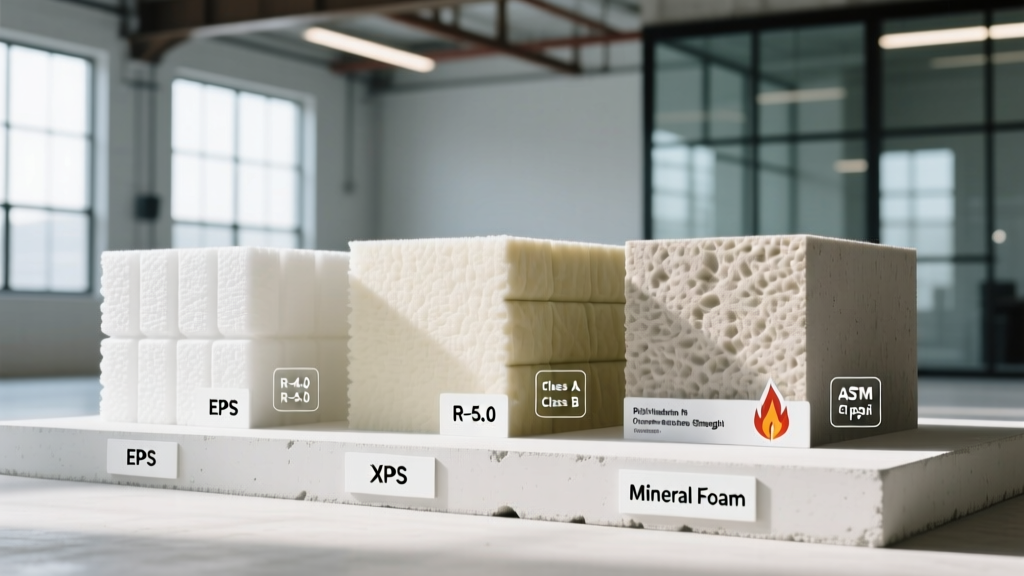
Extruded Polystyrene (XPS) has largely transitioned to Hydrofluoroolefin (HFO) blowing agents, such as those used in Owens Corning FOAMULAR NGX. This shift eliminated the historical thermal drift associated with older HFC blowing agents, locking XPS into a stable LTTR of R-5.0 per inch across all temperature ranges while reducing Global Warming Potential (GWP) by 99%. Expanded Polystyrene (EPS) uses air as its ultimate blowing agent, meaning its R-value (typically R-3.6 to R-4.2 per inch, depending on density) does not drift over time.
Material Matrix: EPS, XPS, and Polyiso Specifications
The Extruded Polystyrene Foam Association (XPSA) and the Polyisocyanurate Insulation Manufacturers Association (PIMA) govern the manufacturing tolerances for these materials. The table below outlines the baseline ASTM specifications required for commercial submittals.
| Material | ASTM Standard | LTTR R-Value (per inch) | Compressive Strength | Water Absorption |
|---|---|---|---|---|
| EPS (Type II) | ASTM C578 | R-3.8 | 15 psi (103 kPa) | 3.0% max |
| EPS (Type IX) | ASTM C578 | R-4.0 | 25 psi (172 kPa) | 2.0% max |
| XPS (Type IV) | ASTM C578 | R-5.0 | 25 psi (172 kPa) | 0.3% max |
| XPS (Type V) | ASTM C578 | R-5.0 | 60 psi (414 kPa) | 0.3% max |
| Polyiso (Type I) | ASTM C1289 | R-6.0 (at 75°F) | 20 psi (138 kPa) | 1.5% max |
Fire Performance and ASTM E84 Classifications
Rigid foam boards are inherently combustible organic materials. Their fire performance is evaluated using ASTM E84 (Standard Test Method for Surface Burning Characteristics of Building Materials), which measures the Flame Spread Index (FSI) and Smoke Developed Index (SDI).
To achieve a Class A rating under ASTM E84, a material must demonstrate an FSI of 25 or less and an SDI of 450 or less. Polyiso boards with foil facers routinely achieve Class A. Unfaced XPS and EPS typically yield an FSI of 75-150 (Class B or C) and require a thermal barrier, such as 1/2-inch USG Sheetrock, to be used in interior plenums or occupied spaces.
For exterior wall assemblies, the International Building Code (IBC) mandates NFPA 285 testing if the wall contains combustible components (like foam insulation) and is of Type I, II, III, or IV construction. Specifiers must ensure the exact assembly—including the specific brand of rigid insulation, the weather-resistive barrier (WRB), and the exterior cladding—has a passed NFPA 285 report. Substituting a foil-faced Polyiso for a glass-mat-faced Polyiso in a tested assembly will void the fire rating.
Compressive Strength and Load-Bearing Limits
Compressive strength is the defining metric for below-grade, plaza deck, and heavy-duty roofing applications. However, the ultimate compressive strength printed on the data sheet (e.g., 60 psi for XPS Type V) is the point of 10% deformation, not the safe working load.
The 20% Creep Rule for Static Loads
When rigid insulation is subjected to long-term static loading (such as soil backfill, concrete slabs, or heavy rooftop HVAC equipment), it is susceptible to creep. Industry standards dictate that the design load must not exceed 20% of the material's ultimate compressive strength.
- XPS Type V (60 psi): Safe long-term design load = 12 psi (1,728 psf).
- EPS Type IX (25 psi): Safe long-term design load = 5 psi (720 psf).
- Polyiso (20 psi): Safe long-term design load = 4 psi (576 psf). Rarely used for heavy structural loading.
Real-World Failure Modes and Specification Fixes
Even perfectly specified rigid insulation will fail if installation parameters ignore the chemical and physical vulnerabilities of the foam.
1. Solvent Incompatibility and Adhesive Melting
EPS and XPS are highly vulnerable to volatile organic compounds (VOCs) and petroleum-based solvents. Applying a solvent-based contact adhesive or an asphalt cutback mastic directly to the foam will dissolve the cellular structure, creating voids and destroying the R-value. Fix: Specify only VOC-compliant, water-based acrylic adhesives or two-part polyurethane foam adhesives (e.g., Dow Weathermate or Henkel Instastik) for bonding rigid boards to substrates.
2. UV Degradation on Job Sites
The cellular matrix of XPS and Polyiso breaks down when exposed to ultraviolet light, resulting in a chalky, degraded surface that compromises adhesion for subsequent membranes or stucco basecoats. Fix: Contract documents must mandate that exposed rigid insulation be covered within 30 days (for XPS) or 60 days (for Polyiso). If delays occur, require the contractor to use opaque, UV-resistant temporary tarps, not clear polyethylene.
3. Below-Grade Moisture Trapping
While XPS has an exceptionally low water absorption rate (0.3%), placing it directly against a below-grade foundation wall without a drainage mechanism traps hydrostatic pressure against the concrete, leading to interior leaks. Fix: Always specify a dimpled drainage mat (e.g., Cosella-Dörken Delta-MS) installed between the foundation wall and the XPS insulation to channel water to the footing drain.
Sourcing and Pricing Benchmarks
Material costs for rigid insulation fluctuate based on petrochemical pricing and blowing-agent supply chains. The following benchmarks reflect early 2026 wholesale pricing for standard 4x8 foot boards, excluding freight and contractor markup.
| Material Type | Thickness | Cost per Board Foot | Cost per 4x8 Sheet |
|---|---|---|---|
| EPS (Type II, 15 psi) | 2.0" | $0.45 - $0.55 | $14.40 - $17.60 |
| XPS (Type IV, HFO) | 2.0" | $0.95 - $1.15 | $30.40 - $36.80 |
| Polyiso (Foil-Faced) | 2.5" | $1.05 - $1.30 | $33.60 - $41.60 |
By anchoring specifications to LTTR values, strict ASTM fire testing, and the 20% creep rule for structural loading, architects and builders can eliminate the most common thermal and structural failures associated with rigid foam insulation.