Choosing the Right Attic Insulation Material for Sound Control
Discover the best attic insulation material for soundproofing. Compare STC ratings, costs, and installation tips for mineral wool, fiberglass, and cellulose.

The Physics of Attic Noise Transfer
When homeowners think of attic insulation, thermal resistance (R-value) usually dominates the conversation. However, the attic is also a primary conduit for airborne and impact noise. Rain striking the roof deck, HVAC air handlers vibrating on trusses, and footsteps from upper-level bonus rooms all generate acoustic energy that travels directly into the living spaces below. According to the National Institute of Building Sciences, controlling this noise requires addressing both sound absorption (dampening echoes within the cavity) and sound transmission (blocking noise from passing through the floor/ceiling assembly).
A standard 1/2-inch drywall ceiling nailed directly to wooden trusses yields a Sound Transmission Class (STC) rating of roughly 33. This blocks normal speech but allows loud music, mechanical hums, and impact noise to pass through easily. Selecting the correct attic insulation material is the first critical step in increasing that STC rating and decoupling the acoustic path.
Evaluating the Best Attic Insulation Material for Acoustics
Not all insulation handles sound equally. Acoustic performance is heavily dictated by material density, fiber structure, and mass. Below is an analysis of the top materials used for attic sound control in 2026.
Mineral Wool Batts (The Heavyweight Champion)
Mineral wool (specifically stone wool) is the undisputed leader for residential soundproofing. Products like ROCKWOOL Safe'n'Sound are engineered specifically for acoustic dampening rather than just thermal resistance. Stone wool fibers are randomly oriented and highly dense (typically 2.5 lbs/ft³), which creates immense internal friction that converts acoustic energy into trace amounts of heat. A 3-inch batt of mineral wool can improve a standard ceiling assembly's STC rating from 33 to 45 or higher when paired with resilient channels. Furthermore, it boasts a Noise Reduction Coefficient (NRC) of 1.05, meaning it absorbs over 100% of the sound energy that strikes it within specific frequency bands due to edge diffraction.
High-Density Fiberglass (The Budget Alternative)
Standard pink or yellow fiberglass batts are highly porous and lightweight (around 0.8 lbs/ft³), making them poor sound blockers on their own. However, acoustic-specific fiberglass, such as Owens Corning QuietZone, is manufactured with a tighter fiber matrix and higher density (approx. 1.2 lbs/ft³). While it will not match the low-frequency blocking power of stone wool, it provides a respectable NRC of 0.90 to 1.00 and is highly effective at absorbing mid-to-high frequency airborne noise, such as voices and television sounds, at a lower price point.
Blown-In Cellulose (The Irregular Cavity Filler)
For attics with irregular joist spacing, cross-bracing, or extensive wiring, blown-in cellulose (like Applegate Stabilized Cellulose) is an exceptional choice. Made from recycled paper treated with borates, cellulose is dense and heavy. When blown to a depth of 10-12 inches, it achieves a density of 3.0 to 3.5 lbs/ft³. This mass acts as a highly effective sound barrier, particularly for damping the structural resonance of wooden floor joists. It effectively eliminates the "drum effect" that occurs when sound waves cause drywall and subflooring to vibrate.
Spray Polyurethane Foam (The Acoustic Trap)
Many contractors mistakenly recommend closed-cell spray foam for soundproofing. This is a critical error. Closed-cell foam (2.0 lbs/ft³) cures into a rigid, structural plastic. While it provides immense thermal insulation and air sealing, it rigidly couples the roof deck to the attic framing, actually increasing the transmission of low-frequency impact noise (like rain or hail). Open-cell spray foam (0.5 lbs/ft³) is softer and absorbs some sound, but its low density makes it a poor sound blocker, and its high cost per STC point makes it an inefficient choice for dedicated acoustic control.
2026 Acoustic Insulation Comparison Matrix
| Material Type | Specific Product Example | Density (lbs/ft³) | STC Improvement (Standard Assembly) | 2026 Material Cost (per sq ft) | Best Acoustic Use Case |
|---|---|---|---|---|---|
| Stone Wool Batts | ROCKWOOL Safe'n'Sound | 2.5 | +12 to +15 STC | $1.45 - $1.65 | Blocking HVAC noise, home theaters below attics |
| Acoustic Fiberglass | Owens Corning QuietZone | 1.2 | +6 to +9 STC | $0.75 - $0.95 | Absorbing airborne speech/TV noise on a budget |
| Blown-In Cellulose | Applegate Stabilized | 3.0 - 3.5 | +10 to +13 STC | $0.90 - $1.20 | Dampening structural resonance in irregular cavities |
| Open-Cell Foam | Icynene ProSeal Eco | 0.5 | +3 to +5 STC | $1.80 - $2.20 | Air sealing with minor high-frequency absorption |
Critical Installation Protocols for Sound Decoupling
Purchasing the right attic insulation material is only half the battle. Acoustic energy behaves like water; it will find the path of least resistance. To achieve the rated STC performance, you must follow strict installation protocols.
- Seal All Penetrations First: Before laying any insulation, use an acoustical sealant (such as Tremco Acoustical Sealant or OSI SC-175) to seal the perimeters of all top plates, plumbing vents, and electrical penetrations. A 1/8-inch gap around a pipe can reduce the STC rating of an entire ceiling by up to 5 points.
- Decouple the Ceiling Drywall: If you have access to the ceiling below the attic (e.g., during a remodel), install resilient channels or sound isolation clips (like Kinetics IsoMax) to the joists before hanging the drywall. This mechanical decoupling prevents sound vibrations from traveling directly from the joists into the drywall.
- Wrap the Ductwork: Attics house HVAC supply and return ducts, which act as massive megaphones for mechanical noise. Wrap all exposed metal ductwork with 1-inch or 2-inch elastomeric duct wrap (such as K-FLEX INSUL-SHEET) and secure it with foil-backed acoustic tape. This dampens the vibration of the metal and blocks airflow noise.
- Avoid Compression: Never compress mineral wool or fiberglass batts to make them fit into shallow cavities. Compressing a 3.5-inch batt into a 2-inch space increases its density but drastically reduces its overall mass and thickness, destroying its low-frequency sound absorption capabilities. If your joists are shallow, use layered acoustic mats instead.
Warning: The Recessed Lighting Flanking Path
Recessed can lights (especially non-IC rated models) are acoustic nightmares. They punch massive holes in your ceiling drywall, completely bypassing the attic insulation material above them. If you must use recessed lighting in a room below an attic, specify IC-rated, airtight (IC-AT) LED wafer lights. These ultra-thin fixtures require no bulky metal cans, allowing you to maintain a continuous layer of acoustic insulation directly over the fixture.
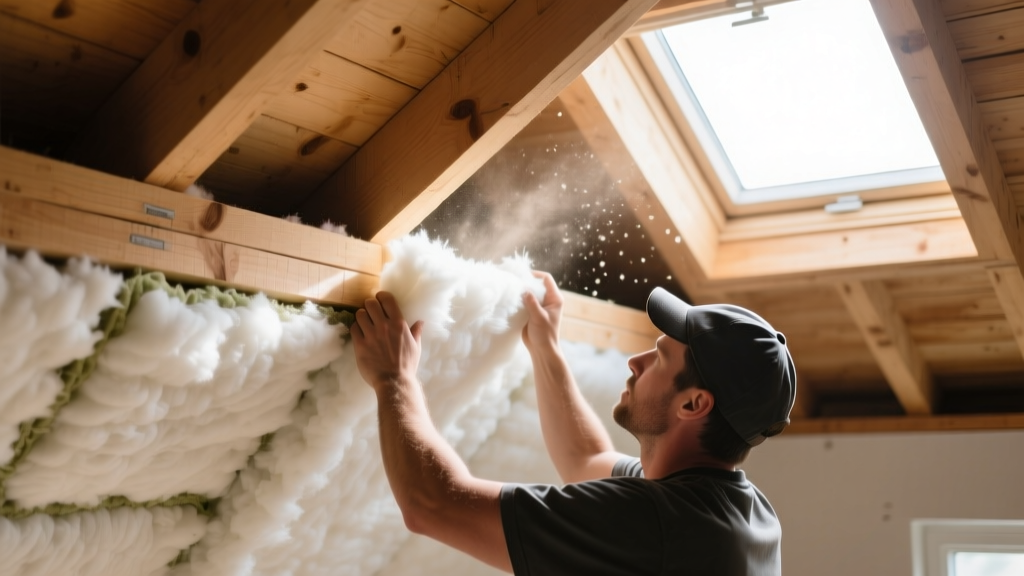
Addressing Thermal vs. Acoustic Code Requirements
It is vital to remember that acoustic insulation does not always satisfy thermal building codes. The U.S. Department of Energy recommends attic thermal insulation levels between R-38 and R-60 depending on your climate zone. A 3-inch batt of ROCKWOOL Safe'n'Sound only provides an R-value of roughly R-12. Therefore, in most climate zones, acoustic batts must be paired with additional thermal insulation. The most effective hybrid approach is to install the acoustic mineral wool directly against the ceiling drywall (between the joists) and then blow 12 to 15 inches of cellulose or standard fiberglass over the top of the joists to achieve the required R-49 or R-60 thermal rating. This layered approach provides maximum mass for sound blocking and maximum trapped air for thermal resistance.
Frequently Asked Questions
Does adding more layers of standard drywall help more than insulation?
Adding a second layer of 5/8-inch drywall with Green Glue damping compound in between will increase the STC rating more effectively than insulation alone. However, this adds significant weight to the ceiling trusses and reduces headroom. Insulation is the necessary first step to absorb cavity resonance; decoupling and mass (drywall) are the secondary steps.
Can I use acoustic insulation for the attic roof deck?
Insulating the underside of the roof deck (the rafters) only helps if the attic itself is a conditioned, finished living space. If you have an unconditioned vented attic, the acoustic insulation must be installed on the attic floor (the ceiling joists of the room below) to stop noise from entering the living space.
Will soundproofing the attic stop rain noise?
Rain noise is primarily impact noise transmitted through the roof sheathing and trusses. While dense mineral wool on the attic floor will muffle the airborne "hiss" of the rain, stopping the deep structural thud requires decoupling the ceiling drywall below using resilient channels, combined with the mass of the insulation.
Written by
Marcus ChenMarcus Chen is a licensed structural engineer (PE) and building materials analyst with over 12 years of experience across residential, commercial, and industrial construction. He holds a Master of Science in Civil Engineering from UC Berkeley and spent six years at Thornton Tomasetti before transitioning to independent consulting and technical writing. Marcus specializes in material selection for seismic-prone regions, concrete reinforcement strategies, and lifecycle cost analysis. His work has been cited by the American Concrete Institute (ACI) and the Structural Engineers Association of California (SEAOC). When he is not on a job site or at his desk, you will find him hiking the Sierra Nevada or restoring a 1920s craftsman bungalow in Oakland, CA.
More from Marcus Chen
View all
Construction Cost
How Much Did the Eiffel Tower Cost to Build?
How much did the Eiffel Tower cost to build in 1889? We adjust for inflation and compare its budget to modern skyscraper construction.
Aug 4, 2026

Fire Resistance
What Is a Fire Resistant Material? Testing & Certification Guide
Discover what is a fire resistant material through ASTM and UL testing. Learn how fire ratings, certifications, and assemblies work in construction.
Aug 4, 2026

Construction Cost
How Much Did the Burj Khalifa Cost to Build?
How much did the Burj Khalifa cost to build? We break down the $1.5B project and extract 5 money-saving strategies for your next build.
Jul 30, 2026