Soundproofing Panels Cost Calculator & Pricing Guide 2026
Calculate exact costs for soundproofing panels in 2026. Includes quantity formulas, material matrices, STC ratings, and hidden labor estimates.
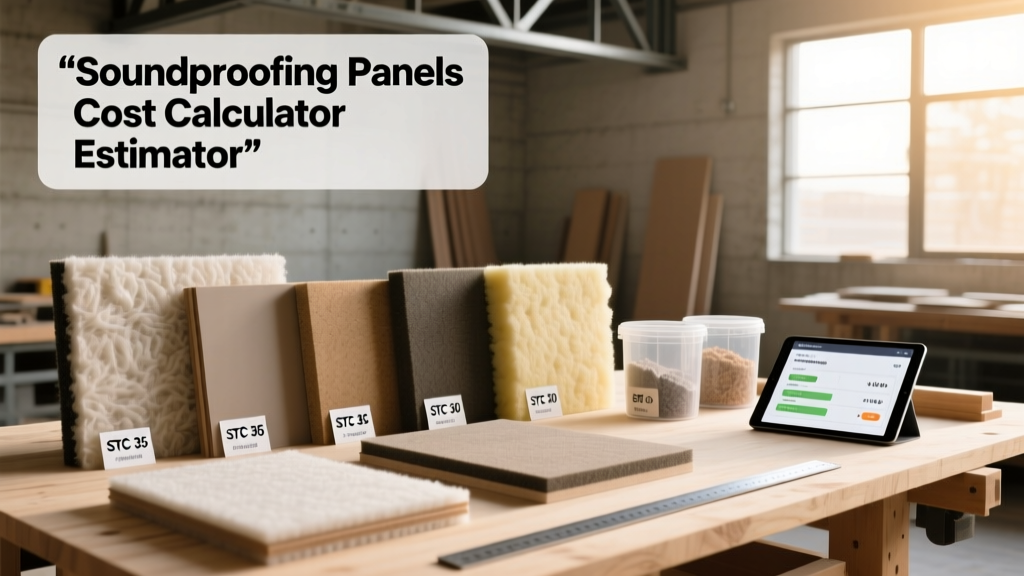
The Core Distinction: Soundproofing vs. Acoustic Treatment
Before calculating material quantities, you must define your acoustic goal. The term 'soundproofing panels' is frequently misused in the building materials market, leading to severe budget miscalculations and project failures. According to the Building Science Corporation, acoustic control requires two entirely different material strategies:
Acoustic Treatment (Sound Absorption): Measured by Noise Reduction Coefficient (NRC). The goal is to eliminate echo and reverberation inside the room. These are the fabric-wrapped fiberglass or PET felt panels typically sold online as 'soundproofing panels.' They do zero to block sound transmission between rooms.
This cost estimator covers both categories, but separates them in the material matrix so you can accurately budget for your specific structural needs.
The Soundproofing Panels Quantity Formula
Accurate estimation prevents mid-project material shortages, which are particularly costly when dealing with specialized acoustic composites. Use the following step-by-step calculation for wall and ceiling assemblies:
- Calculate Gross Area: Measure the total width and height of the target wall or ceiling (Width × Height = Gross Sq Ft).
- Subtract Openings: Measure all doors, windows, and HVAC registers. Subtract their total area from the Gross Area to find the Net Coverage Area.
- Apply the Waste Factor: Acoustic panels, especially pre-damped drywall and MLV composites, require precise cutting to maintain airtight seals. Add a 12% waste factor for standard rectangular rooms, or 18% for rooms with irregular angles, bay windows, or complex ceiling soffits.
- Determine Panel Yield: Divide the Total Required Area by the square footage of your chosen panel size (e.g., a standard 4x8 panel yields 32 sq ft).
Calculation Example: A 10ft x 8ft bedroom wall (80 sq ft) with one 3x7 closet door (21 sq ft) equals 59 sq ft of net coverage. Adding a 12% waste factor (7.08 sq ft) brings the total required material to 66.08 sq ft. Using 4x8 (32 sq ft) composite panels, you must purchase 3 panels (96 sq ft total yield).
2026 Material Cost Matrix: Types of Acoustic Panels
Pricing for specialized acoustic materials has stabilized in 2026 following the supply chain corrections of previous years, though high-density polymers and specialized damping compounds remain premium products. The North American Insulation Manufacturers Association (NAIMA) notes that mineral wool remains the most cost-effective cavity solution for broadband noise absorption.
| Material Type & Brand Example | Primary Function | Acoustic Rating | 2026 Cost / Sq Ft |
|---|---|---|---|
| Pre-Damped Drywall (QuietRock 545) | Sound Isolation (STC) | STC 56 | $4.20 - $5.50 |
| Mass Loaded Vinyl Composite (Soundproof Cow MLV) | Sound Isolation (STC) | STC 27 (Layer) | $2.80 - $3.90 |
| High-Density Mineral Wool (Rockwool Safe'n'Sound) | Cavity Absorption (NRC) | NRC 1.05 | $1.10 - $1.45 |
| Fabric-Wrapped Fiberglass (Owens Corning 703/705) | Surface Treatment (NRC) | NRC 0.85 - 1.00 | $12.00 - $18.50 |
| PET Felt Baffles & Panels (EchoControl) | Surface Treatment (NRC) | NRC 0.70 - 0.80 | $4.50 - $7.20 |
Labor Estimation & Hidden Structural Costs
Material costs typically represent only 40% to 50% of a total soundproofing project budget. True sound isolation requires structural modifications that standard drywall contractors may not execute correctly. Improper installation, such as failing to seal perimeter gaps with acoustic caulk, can reduce a wall's STC rating by up to 50%, rendering expensive panels useless.
Specialized Labor Rates
- Standard Drywall Installation: $1.50 - $2.50 per sq ft. (Not recommended for STC 50+ assemblies due to lack of acoustic sealant training).
- Certified Acoustic Contractor: $3.50 - $6.00 per sq ft. Includes resilient channel installation, acoustic putty on electrical boxes, and perimeter isolation.
- Acoustic Consulting & Testing: $800 - $1,500 flat fee for pre-construction STC modeling and post-construction ASTM E90 field testing.
According to the Environmental Protection Agency (EPA) guidelines on noise control, sound travels through the path of least resistance. If you spend $4,000 soundproofing a shared bedroom wall with premium composite panels but leave the shared HVAC ductwork untreated, or fail to isolate the ceiling joists, the noise will simply flank around your expensive wall. Always budget 15% of your wall/ceiling panel cost for acoustic mastic, putty pads for electrical boxes, and HVAC duct liners.
Real-World Project Scenarios (2026 Pricing)
To provide actionable budgeting frameworks, below are two distinct project profiles illustrating how material selection drastically alters the final estimate.
Scenario A: 10x12 Urban Bedroom (Airborne Traffic Noise Blocking)
Goal: Block exterior traffic noise (low-frequency rumble) and neighbor voices from entering through one exterior-facing 10x8 wall and a shared party wall of 12x8. Strategy: Decouple and add mass. The homeowner cannot lose 6 inches of room space, so traditional stud-framing decoupling is rejected in favor of surface-applied composite panels.
- Target Area: 176 sq ft (Net after window/door deductions).
- Materials: 1 layer of 1/2" MLV ($3.20/sq ft) glued directly to existing drywall, topped with 1 layer of QuietRock 545 ($4.80/sq ft).
- Material Cost: 176 sq ft × $8.00/sq ft = $1,408 (plus 12% waste = $1,577).
- Accessories: Acoustic caulk, green glue compound, and putty pads = $280.
- Labor (Acoustic Specialist): 176 sq ft × $4.50 = $792.
- Total Estimated Cost: $2,649 ($15.05 per sq ft of treated space).
Scenario B: 15x20 Basement Home Studio (Full Isolation & Treatment)
Goal: Prevent drum and bass frequencies from reaching the upstairs living area, while eliminating internal flutter echo for accurate audio mixing. Strategy: Full room-in-room decoupling for isolation, followed by strategic surface treatment for internal acoustics.
- Isolation Area (Walls & Ceiling): 700 sq ft. Framed with resilient channels, filled with Rockwool Safe'n'Sound ($1.25/sq ft), and finished with two layers of 5/8" Type X drywall with Green Glue ($3.10/sq ft for the sandwich).
- Isolation Material & Labor: ~$5,800.
- Treatment Area (Surface Panels): 20% wall coverage (100 sq ft) using 2-inch thick fabric-wrapped Owens Corning 703 panels ($14.50/sq ft) to manage mid/high frequencies, plus 4 bass traps in corners ($180 each).
- Treatment Material Cost: $1,450 (panels) + $720 (traps) = $2,170.
- Flanking & HVAC: Acoustic duct liner and solid core door with automatic door bottom = $950.
- Total Estimated Cost: $8,920 (Comprehensive isolation and treatment).
Common Estimation Mistakes to Avoid
When running your own calculations, watch for these frequent budget-killers:
- Ignoring the Floor: In multi-story buildings, impact noise (footsteps) transmits through the floor joists. Wall panels will not fix impact noise. Budget for acoustic underlayment (e.g., rubberized cork or MLV floor mats) at $2.50 - $4.00 per sq ft.
- Over-treating for NRC: Covering 100% of a room's walls with acoustic absorption panels will result in a 'dead' room that sounds unnatural and fatiguing to the ear. For acoustic treatment, calculate for 15% to 25% surface coverage, strategically placed at first reflection points.
- Using Standard Drywall Screws: When installing soundproofing panels over resilient channels, using standard screws that penetrate too deeply and hit the underlying structural studs will create a rigid mechanical bridge, completely bypassing the decoupling mechanism. Always use specified fine-thread acoustic screws and depth-sensitive collars.