Underground Pipe Insulation Material Selection Framework
Choose the right underground pipe insulation material with our expert framework. Compare R-values, moisture resistance, and compressive strength.

The Subgrade Insulation Selection Framework
Selecting the correct underground pipe insulation material requires moving beyond simple R-value comparisons. Subgrade environments subject insulation to hydrostatic pressure, soil acidity, shifting backfill, and varying live loads from surface traffic. According to the Whole Building Design Guide, improper material selection in below-grade applications is the leading cause of premature thermal degradation and Corrosion Under Insulation (CUI).
To engineer a reliable buried piping system, facility managers and mechanical engineers must evaluate materials through a four-pillar framework:
- Operating Temperature Profile: Continuous service temperature and thermal shock potential.
- Hydrological Conditions: Water table elevation, soil drainage, and hydrostatic pressure.
- Mechanical Loading: Burial depth, soil density, and surface live loads (e.g., H-20 highway loading).
- Chemical Exposure: Soil pH, presence of sulfates, and hydrocarbon contamination.
Standard polyurethane (PUR) foams are highly susceptible to hydrolysis when exposed to continuous moisture and temperatures above 150°F (65°C). If the outer jacket is breached in a high-water-table environment, PUR foam will chemically break down, losing up to 60% of its thermal resistance within 24 months and trapping corrosive moisture against the pipe wall.
Material Performance Matrix
The table below contrasts the primary subgrade insulation materials available in 2026, highlighting their physical properties and optimal use cases.
| Material Type | R-Value (per inch) | Max Temp | Compressive Strength | Moisture Resistance |
|---|---|---|---|---|
| Rigid Polyurethane (PUR) | 6.5 | 250°F (121°C) | 40 - 60 psi | Moderate (Closed-cell) |
| Polyisocyanurate (PIR) | 6.0 | 300°F (149°C) | 45 - 65 psi | Moderate (Closed-cell) |
| Cellular Glass (FOAMGLAS) | 4.5 | 900°F (482°C) | 100 - 160 psi | Absolute (Zero permeability) |
| Elastomeric (Armaflex) | 4.6 | 220°F (104°C) | 10 - 15 psi | High (Closed-cell) |
| Aerogel Blankets (Pyrogel) | 10.3 | 1200°F (650°C) | 10 psi (Flexible) | High (Hydrophobic) |
Decision Tree: Matching Material to Site Conditions
Use the following environmental parameters to dictate your material selection.
Scenario A: High Water Table & Hydrostatic Pressure
When pipes are submerged or subject to constant capillary action, Cellular Glass is the undisputed choice. Because it is manufactured from hermetically sealed glass cells, it possesses a water vapor permeability of zero. Unlike rigid foams, cellular glass will not wick moisture if the outer jacket is compromised during backfilling. For high-temperature steam lines in wet soils, cellular glass prevents the catastrophic CUI failures documented extensively by the Building Science Corporation.
Scenario B: Deep Burial & Heavy Live Loads
Pipes buried under roadways or heavy equipment zones require high compressive strength to prevent the insulation from crushing, which thins the thermal barrier and creates a pathway for water ingress.
- Standard PUR/PIR: Adequate for pedestrian zones or shallow landscaping (up to 3 feet deep).
- High-Density PIR or Cellular Glass: Mandatory for depths exceeding 4 feet or beneath H-20 highway loading zones. FOAMGLAS F160 offers 160 psi compressive strength, easily supporting deep earth loads without structural deflection.
Scenario C: Chilled Water Lines in Tight Trenches
For district cooling or chilled water lines (35°F to 55°F), preventing condensation is the primary goal. Elastomeric foam (e.g., Armaflex) or Aerogel blankets are ideal. Aerogel provides R-10 per inch, allowing engineers to achieve target R-values in extremely narrow trench widths, reducing excavation and concrete encasement costs.
When using low-compressive-strength materials like elastomeric foam or aerogel underground, the trench must be bedded with a minimum of 4 inches of compacted, sharp-grained sand. Never use native soil with rocks or debris directly against the jacket, as soil shifting will puncture the moisture barrier.
Jacketing Systems: The Second Line of Defense
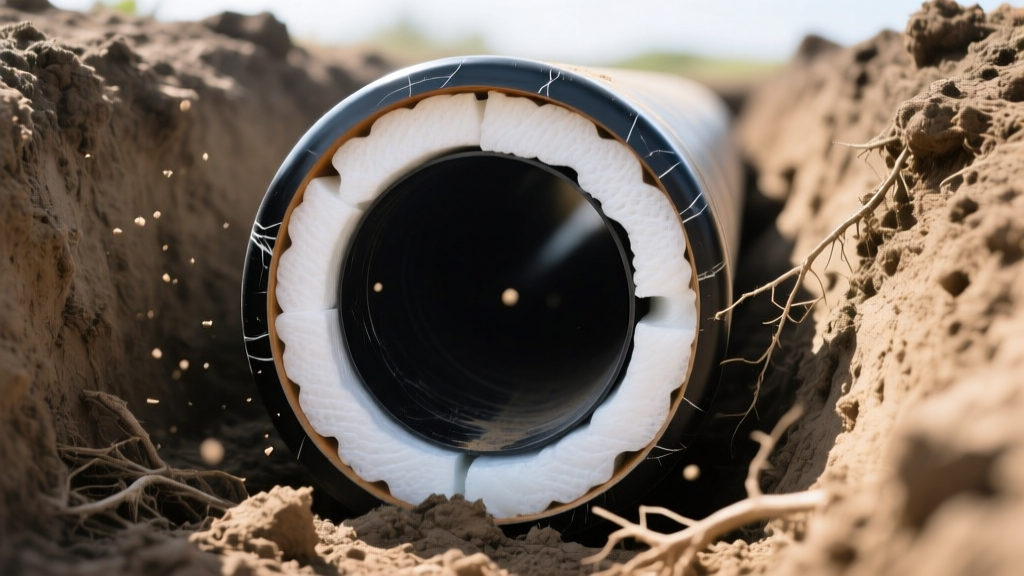
Insulation material is only as effective as its outer jacket. In subgrade applications, the jacket must resist soil chemicals, root penetration, and mechanical abrasion.
- High-Density Polyethylene (HDPE): The industry standard for pre-insulated underground pipes. A minimum thickness of 3mm to 5mm is required for direct burial. HDPE is highly resistant to soil acids and alkalis but can be vulnerable to certain hydrocarbons.
- PVC Jacketing: Cost-effective for shallow, low-temperature chilled water lines. PVC becomes brittle in freezing soils and is not recommended for deep burial or high-temperature steam lines.
- Fiberglass Reinforced Plastic (FRP): Used for high-temperature steam lines where the jacket must withstand the thermal expansion and contraction of the carrier pipe without cracking. FRP provides superior mechanical strength compared to HDPE.
Economic & Lifecycle Considerations
While Cellular Glass and Aerogel blankets carry a 40% to 60% higher upfront material cost compared to standard Polyurethane, the lifecycle economics heavily favor premium materials in high-risk environments. Excavating a buried street to repair a failed PUR insulation system and treat CUI on the carrier pipe can cost upwards of $1,500 to $2,500 per linear foot.
When evaluating bids, specify a 30-year lifecycle cost analysis that factors in the probability of jacket breach. If the soil survey indicates a high water table or corrosive clay, the ROI on cellular glass is typically realized within the first 15 years of operation simply by avoiding a single major excavation event.
Final Specification Checklist
- Verify carrier pipe operating temperature against the insulation's continuous service limit.
- Pull a geotechnical soil report to confirm water table depth and soil pH.
- Calculate dead and live loads to specify minimum compressive strength (psi).
- Mandate HDPE or FRP jacketing with a minimum 3mm thickness for direct burial.
- Specify a 4-inch compacted sand bedding layer for all flexible or low-density insulation systems.
Written by
Priya KapoorPriya Kapoor is a real estate market analyst and construction economics researcher with expertise in housing affordability, development feasibility, and infrastructure investment. She holds a Master of Regional Planning from Cornell University and previously worked as a senior analyst at CBRE's Investment Properties group, where she modeled returns for $4B in mixed-use development pipelines. Priya now runs an independent research practice advising developers, municipalities, and REITs on construction cost forecasting and market timing. She publishes the quarterly "BuildMat Market Pulse" report tracking material price indices across 12 commodity categories. Based in Austin, TX, Priya serves on the board of Habitat for Humanity Austin and is a marathon runner.
More from Priya Kapoor
View all
Construction Cost
Cost to Build a 1600 Sq Ft Home in 2026: Full Breakdown
Accurate 2026 cost to build a 1600 sq ft home—material, labor, and regional pricing breakdowns included. Plan your budget with real-time estimates.
Aug 11, 2026

Wood & Lumber
Name the Types of Wood for Pressure Treatment and Preservation
Learn how to name the types of wood best suited for pressure treatment. Compare species treatability, chemical retention levels, and 2026 preservation costs.
Aug 4, 2026

Stone & Masonry
Stone Veneer Suppliers Lindenhurst: 2026 Cost Analysis
Analyze 2026 stone veneer costs in Lindenhurst, NY. Compare local supplier pricing, delivery fees, and Suffolk County installation labor rates.
Aug 4, 2026