Thermal Insulation Material for Sound Control: STC Guide
Discover how standard thermal insulation material performs for sound control. Compare STC and NRC ratings of fiberglass, mineral wool, and spray foam.
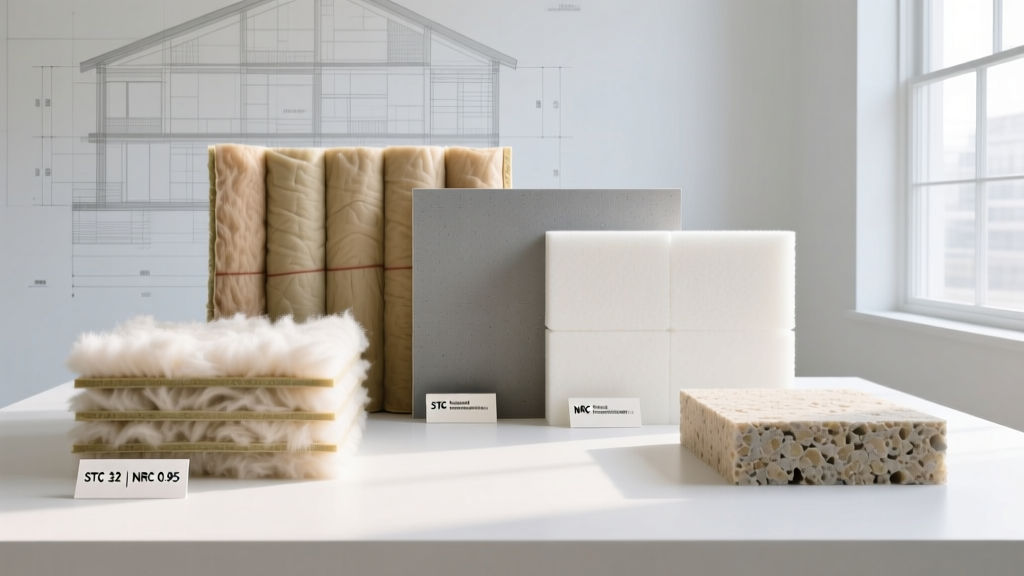
The Thermal vs. Acoustic Insulation Misconception
When architects and contractors select a thermal insulation material, the primary focus is almost exclusively on R-value—the measure of resistance to conductive heat flow. However, a persistent and costly misconception in modern construction is the assumption that high thermal resistance automatically translates to effective sound attenuation. In reality, the physical properties that make a material an excellent thermal barrier often have little to do with its ability to block airborne or impact noise.
According to the National Institute of Building Sciences (NIBS), achieving true acoustic comfort requires addressing both sound absorption within a cavity and sound transmission through the structural assembly. While stuffing a wall cavity with any fibrous material will slightly improve acoustics compared to an empty cavity, relying on a standard thermal insulation material for critical sound control frequently results in failed acoustic tests, tenant complaints, and expensive post-construction remediation.
Never use R-value as a proxy for acoustic performance. A 2-inch layer of closed-cell spray foam boasts an impressive R-14 thermal rating but can actually degrade the Sound Transmission Class (STC) of a partition by rigidly coupling the drywall to the framing, creating a direct path for structure-borne vibrations.
Decoding the Metrics: STC vs. NRC
To evaluate any thermal insulation material for acoustic applications, you must look beyond thermal metrics and focus on two distinct acoustic measurements:
- Sound Transmission Class (STC): An integer rating of how well a building partition attenuates airborne sound. A standard interior wall has an STC of 33. A well-insulated and decoupled wall can reach STC 55 or higher, rendering loud speech inaudible.
- Noise Reduction Coefficient (NRC): A scalar value from 0.0 to 1.0 that indicates the percentage of sound energy a material absorbs rather than reflects. An NRC of 0.90 means the material absorbs 90% of the acoustic energy that strikes it.
The National Research Council Canada (NRC) provides extensive testing data demonstrating that density, flow resistivity, and thickness are the primary drivers of a material's NRC, which in turn influences the overall STC of the wall assembly when combined with mass and decoupling.
Material Comparison Matrix: Thermal vs. Acoustic Performance
The table below compares common insulation products available on the market as of 2026, contrasting their thermal efficiency with their acoustic capabilities and installed costs.
| Material Type | Thermal R-Value (per inch) | Acoustic NRC | Wall STC Contribution | Avg. Cost (per sq. ft.) |
|---|---|---|---|---|
| Mineral Wool Batts (e.g., ROCKWOOL Safe'n'Sound) | R-4.2 | 0.95 - 1.05 | +8 to +12 STC | $1.15 - $1.45 |
| Fiberglass Batts (e.g., Owens Corning Pink Next Gen) | R-3.1 - R-3.4 | 0.80 - 0.95 | +5 to +8 STC | $0.45 - $0.70 |
| Open-Cell Spray Foam (e.g., Demilec Sealection 500) | R-3.5 - R-3.8 | 0.70 - 0.85 | +4 to +6 STC | $1.20 - $1.60 |
| Closed-Cell Spray Foam | R-6.0 - R-7.0 | 0.10 - 0.20 | -1 to +2 STC | $2.50 - $3.20 |
| Rigid XPS/EPS Boards | R-3.8 - R-5.0 | 0.05 - 0.15 | Negligible | $0.80 - $1.30 |

Material Deep Dive: Evaluating the Contenders
1. Mineral Wool: The Dual-Purpose Champion
If your project requires a single thermal insulation material that excels in both temperature regulation and sound attenuation, mineral wool (specifically rock wool or slag wool) is the undisputed leader. Manufactured by spinning molten rock into dense, interlocking fibers, mineral wool batts typically feature a density of 2.5 to 8.0 lbs/ft³, compared to the 0.5 to 1.2 lbs/ft³ density of standard fiberglass. This high flow resistivity forces sound waves to navigate a tortuous path through the fibers, converting acoustic energy into trace amounts of heat. Products like ROCKWOOL Safe'n'Sound are explicitly engineered for interior partitions, achieving an NRC of 1.05 at 3 inches thick, effectively eliminating cavity resonance.
2. Fiberglass Batts: The Budget Compromise
Standard fiberglass is the most ubiquitous thermal insulation material in North America, primarily due to its low cost and ease of installation. Acoustically, it performs adequately in broadband noise absorption, provided it is installed correctly. The critical failure point with fiberglass is compression. If a contractor forces a 5.5-inch R-21 batt into a 3.5-inch 2x4 wall cavity, the material's thermal R-value drops significantly, and its acoustic absorption profile shifts, losing effectiveness in the crucial low-to-mid frequency ranges where human speech and HVAC rumble reside. For acoustic applications, unfaced, high-density fiberglass boards (like Owens Corning 703) are vastly superior to standard faced batts.
3. Spray Polyurethane Foam (SPF): The Flanking Risk
Spray foam is highly valued for its air-sealing properties and high R-values. However, its acoustic performance is highly dependent on the cell structure. Open-cell spray foam (half-pound density) is relatively soft and porous, offering decent sound absorption (NRC ~0.80) and acting as a mild damping agent. Closed-cell spray foam (two-pound density), conversely, cures into a rigid, structural plastic. While it provides exceptional thermal resistance and moisture control, its rigidity creates a mechanical bridge between the drywall and the framing. This coupling facilitates the transmission of structure-borne impact noise and low-frequency vibrations, effectively lowering the overall STC of the partition.
No thermal insulation material can fix a wall that lacks mass or decoupling. Filling a standard 2x4 stud cavity with the best mineral wool on the market will only yield an STC of roughly 39. To achieve STC 50+, you must combine the cavity fill with decoupling (resilient channels or staggered studs) and increased mass (dual layers of 5/8-inch Type X gypsum board with a viscoelastic damping compound like Green Glue).
Step-by-Step: Upgrading a Partition for Dual Performance
When designing an interior partition that requires both strict thermal boundaries (such as walls adjacent to unconditioned spaces) and high acoustic privacy (like home theaters or multi-family bedrooms), follow this optimized assembly sequence:
- Frame with Decoupling in Mind: Use staggered 2x4 studs on a 2x6 plate, or standard 2x4 studs with 25-gauge RC-1 resilient channels attached horizontally every 24 inches. This breaks the direct mechanical path for vibrations.
- Fill the Cavity Completely: Install 3-inch mineral wool batts (e.g., ROCKWOOL Safe'n'Sound) friction-fit between the studs. Ensure there are no gaps at the top or bottom plates, and do not compress the material behind electrical boxes.
- Seal Penetrations: Use acoustic putty pads over all electrical boxes. Seal the perimeter of the drywall and all plumbing penetrations with a high-grade, non-hardening acoustic sealant (e.g., Tremco Acoustical Sealant).
- Apply the First Layer of Mass: Install a base layer of 5/8-inch Type X gypsum board, screwing it only to the resilient channels or the decoupled studs, ensuring it does not touch the floor or ceiling (leave a 1/4-inch gap).
- Apply Damping Compound: Trowel or tube a continuous layer of viscoelastic damping compound (like Green Glue Compound) across the entire face of the first drywall layer.
- Install the Second Layer: Apply the second layer of 5/8-inch drywall, staggering the seams from the first layer. Screw it directly into the first layer, sandwiching the damping compound, which converts sound vibrations into microscopic heat.
Common Installation Failures That Ruin Acoustic Performance
Even the most advanced thermal insulation material will fail to deliver promised STC ratings if the installation is compromised by field errors. The U.S. Department of Energy notes that poor installation can reduce insulation effectiveness by up to 50%, and the same holds true for acoustics.
- Flanking Paths: Sound behaves like water; it will find the path of least resistance. If the drywall is hard-screwed to the top and bottom plates without an acoustic sealant gap, sound will flank over the wall, rendering the cavity insulation useless.
- Back-to-Back Electrical Boxes: Placing electrical outlets directly opposite each other on a shared partition wall creates a massive acoustic short-circuit. Always stagger boxes by at least 24 inches and wrap them in acoustic putty.
- Compression of Batts: Forcing thick thermal batts into shallow cavities increases the material's density beyond its engineered flow resistivity, causing it to reflect mid-frequency sound rather than absorb it.
- Debris in the Cavity: Leaving wood scraps, drywall offcuts, or hardened spray foam in the bottom plate of a stud cavity creates rigid bridges that transmit impact noise directly to the drywall.
Expert Verdict: Specifying for 2026 and Beyond
The days of treating acoustic comfort as an afterthought in building design are over. As building codes tighten regarding energy efficiency and occupant wellness, the intersection of thermal and acoustic performance is critical. If your primary goal is maximum thermal resistance in a shallow cavity, closed-cell spray foam remains the superior thermal insulation material. However, if the partition separates living spaces, home offices, or media rooms, mineral wool is the mandatory choice. By pairing high-density mineral wool with structural decoupling and constrained-layer damping, builders can achieve STC ratings above 55 without sacrificing the thermal envelope of the structure.
Written by
Marcus ChenMarcus Chen is a licensed structural engineer (PE) and building materials analyst with over 12 years of experience across residential, commercial, and industrial construction. He holds a Master of Science in Civil Engineering from UC Berkeley and spent six years at Thornton Tomasetti before transitioning to independent consulting and technical writing. Marcus specializes in material selection for seismic-prone regions, concrete reinforcement strategies, and lifecycle cost analysis. His work has been cited by the American Concrete Institute (ACI) and the Structural Engineers Association of California (SEAOC). When he is not on a job site or at his desk, you will find him hiking the Sierra Nevada or restoring a 1920s craftsman bungalow in Oakland, CA.
More from Marcus Chen
View all
Construction Cost
How Much Did the Eiffel Tower Cost to Build?
How much did the Eiffel Tower cost to build in 1889? We adjust for inflation and compare its budget to modern skyscraper construction.
Aug 4, 2026

Fire Resistance
What Is a Fire Resistant Material? Testing & Certification Guide
Discover what is a fire resistant material through ASTM and UL testing. Learn how fire ratings, certifications, and assemblies work in construction.
Aug 4, 2026

Construction Cost
How Much Did the Burj Khalifa Cost to Build?
How much did the Burj Khalifa cost to build? We break down the $1.5B project and extract 5 money-saving strategies for your next build.
Jul 30, 2026