Insulation Types for Walls: 2026 Cost Calculator & Pricing
Calculate exact costs for insulation types for walls in 2026. Compare fiberglass, spray foam, and mineral wool pricing per square foot and R-value.
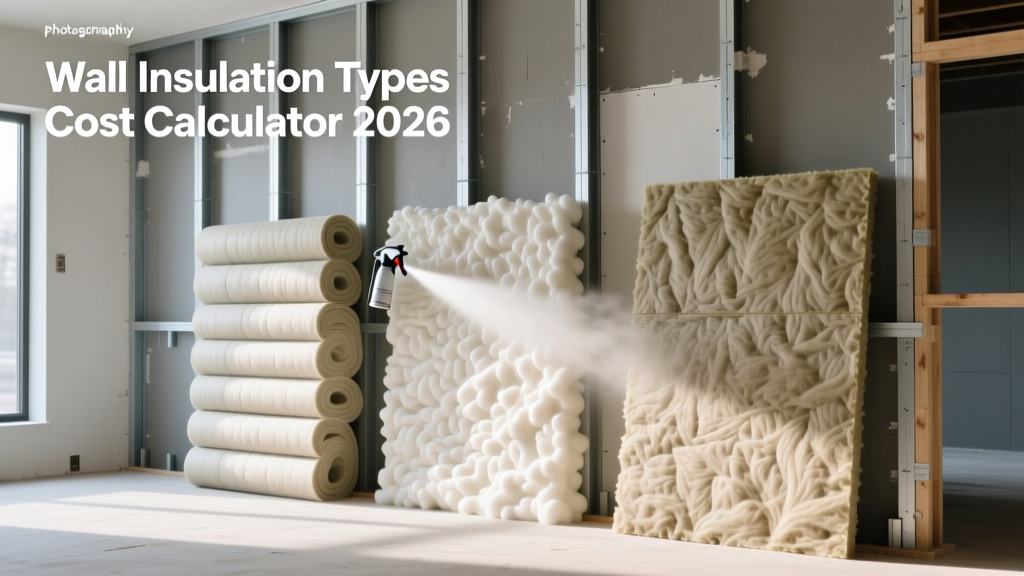
The 2026 Wall Insulation Cost & Performance Matrix
Accurately estimating the cost of insulation types for walls requires moving beyond generic square-foot averages. In 2026, material pricing has stabilized following supply chain shifts, but the divergence between basic cavity fills and high-performance air-sealing systems remains stark. The matrix below breaks down current material costs, installed costs, and thermal performance for standard 2x4 and 2x6 framed wall assemblies.
| Insulation Material | Common Application | R-Value per Inch | Material Cost (per sq ft) | Installed Cost (per sq ft) |
|---|---|---|---|---|
| Fiberglass Batts (Kraft-faced) | 2x4 / 2x6 Cavities | R-3.1 to R-3.4 | $0.65 - $0.95 | $1.10 - $1.60 |
| Mineral Wool Batts | 2x4 / 2x6 Cavities | R-4.2 to R-4.3 | $1.15 - $1.55 | $1.80 - $2.40 |
| Open-Cell Spray Foam | 2x6 Cavities (5.5") | R-3.5 to R-3.8 | N/A (Pro only) | $1.20 - $1.60 / board ft |
| Closed-Cell Spray Foam | 2x4 / 2x6 Cavities | R-6.5 to R-7.0 | N/A (Pro only) | $2.40 - $3.20 / board ft |
| XPS Rigid Foam Board | Exterior Continuous | R-5.0 | $0.80 - $1.20 | $1.50 - $2.10 |
| Polyiso Rigid Foam Board | Exterior Continuous | R-6.0 to R-6.5 | $0.95 - $1.40 | $1.70 - $2.50 |
Note: Installed costs for spray foam are calculated per board foot (1 sq ft x 1 inch thick). A standard 2x6 wall cavity requires 5.5 board feet per square foot of wall area.
The Professional Quantity Calculator: Batts vs. Spray Foam
The most common error in insulation estimation is treating all materials with the same geometric formula. Cavity batts and sprayed polyurethane foam (SPF) require entirely different calculation methodologies due to waste factors and framing displacement.
Step 1: Calculate Gross vs. Net Wall Area
Measure the total exterior perimeter of the building and multiply by the interior ceiling height to find the Gross Wall Area. Next, subtract the exact square footage of all window and door rough openings to find the Net Cavity Area.
Wood studs, plates, and headers occupy 15% to 25% of a framed wall. When buying batts, you must purchase based on the Gross Wall Area minus major openings, because batts are cut and pieced around studs. When calculating spray foam, you calculate based on the Net Cavity Volume, as foam only fills the empty spaces between the lumber.
Step 2: Apply Material-Specific Waste Factors
- Fiberglass & Mineral Wool Batts: Add a 10% to 15% waste factor. Cutting around electrical boxes, plumbing stacks, and HVAC registers generates significant offcuts that cannot be reused in standard wall cavities.
- Closed-Cell Spray Foam: Add a 5% to 8% waste factor. This accounts for substrate irregularities, hose purging, and the necessary overfill that gets shaved down flush with the studs.
- Exterior Rigid Foam: Add a 12% waste factor. Rigid boards must be cut to fit around window returns, corner details, and structural shear panels, creating rigid waste that cannot be compressed or stuffed into gaps.
Material Deep-Dive: Exact Models and Edge Cases
When evaluating insulation types for walls, contractors and homeowners must look at specific product lines to lock in accurate 2026 budgets. Here is how the top-tier materials perform in real-world applications.
Fiberglass Batts: The Baseline Standard
Reference Product: Owens Corning Pink Next Gen (R-15 for 2x4, R-21 for 2x6).
Fiberglass remains the most cost-effective cavity fill. The Next Gen line features improved dust reduction and faster recovery from compression. However, fiberglass is highly susceptible to convective heat loss if the wall cavity is not perfectly air-sealed prior to installation. According to the U.S. Department of Energy, a batt installation with gaps or compressions can lose up to 30% of its rated R-value. Budget an additional $0.15 to $0.25 per square foot for a dedicated fluid-applied air barrier or meticulous APE (Air-sealing, Point-sealing, and Electrical-box sealing) tape protocols.
Mineral Wool: The Acoustic and Fire Upgrade
Reference Product: ROCKWOOL Comfortbatt (R-15 for 2x4, R-23 for 2x6).
Mineral wool costs roughly 40% to 60% more than fiberglass but offers distinct structural advantages. It is hydrophobic (will not absorb water if the building envelope leaks during construction) and provides superior sound dampening (STC ratings improve by 3-5 points over fiberglass). Edge Case: Mineral wool is highly friction-fit and requires a sharp serrated bread knife or specialized insulation blade for clean cuts. Standard utility knives will drag and tear the material, increasing installation time and labor costs by approximately 10%.
Closed-Cell Spray Foam: The Premium Envelope
Reference Product: BASF Walltite CM01 or Demilec Heatlok XT.
Closed-cell foam (2.0 lb density) provides an R-value of roughly R-7 per inch and acts as its own Class II vapor retarder at 1.5 inches of thickness. For a 2x6 wall, spraying 4 inches yields R-28, leaving a 1.5-inch gap for plumbing and electrical runs. Budget Reality: Spray foam pricing is heavily dependent on regional chemical supply chains and crew mobilization fees. For homes under 2,500 square feet, expect a 10% to 15% premium on the per-board-foot rate due to minimum mobilization charges.
Rigid Foam Board: Continuous Exterior Insulation
Reference Product: Owens Corning FOAMULAR NGX (XPS) or Huber ZIP System R-Sheathing.
Modern energy codes, heavily influenced by RESNET and IECC standards, increasingly mandate continuous exterior insulation to mitigate thermal bridging through wood studs. XPS (Extruded Polystyrene) is being phased down due to HFC blowing agent regulations, making Polyiso (Polyisocyanurate) and EPS (Expanded Polystyrene) the dominant choices for 2026. Polyiso offers the highest R-value per inch (R-6.5) but requires careful detailing to prevent moisture trapping against the exterior sheathing in cold climates.
Hidden Budget Killers: Labor, Air Sealing, and Code Compliance
A materials-only calculator will leave your budget exposed. Factor in these secondary costs when finalizing your wall insulation estimate:
- Vapor Retarder Requirements: In Climate Zones 5 and higher, interior vapor retarders are often required. If your chosen insulation (like unfaced mineral wool) lacks a kraft facing, you must budget for 4-mil or 6-mil polyethylene sheeting, or a smart vapor retarder like Membrain, adding $0.20 to $0.45 per square foot.
- Inspection & HERS Rating: If you are building to ENERGY STAR or DOE Zero Energy Ready Home standards, a third-party HERS rater must verify the insulation installation grade. A Grade I installation requires perfect fit with no gaps. Expect to pay $400 to $800 for the rater's rough-inspection fee.
- Shaving and Cleanup (Spray Foam): Closed-cell foam expands past the stud face and must be shaved flush. This generates dense, sticky waste that requires specialized disposal. Ensure your contractor's bid includes debris removal; otherwise, dumpster fees for foam waste can add $300 to $500 to the project.
Climate Zone Decision Framework
Selecting the right insulation type is dictated by your local IECC Climate Zone. Use this framework to align your budget with code minimums and optimal performance:
- Zones 1-3 (Hot/Humid & Hot/Dry): Standard 2x4 framing with R-13 fiberglass or open-cell spray foam is typically sufficient. Focus your budget on exterior radiant barriers and high-performance window glazing rather than extreme wall R-values.
- Zones 4-5 (Mixed & Cool): 2x6 framing is the standard. Target R-20 cavity fill (fiberglass or mineral wool) plus R-5 to R-7.5 continuous exterior rigid foam to prevent interior condensation on the sheathing during winter months.
- Zones 6-8 (Cold & Subarctic): Double-stud walls or 2x6 framing with 2 to 3 inches of exterior Polyiso (R-12 to R-20 continuous) paired with dense-packed cellulose or closed-cell foam in the cavity. Budgets here must prioritize eliminating thermal bridging entirely.
By calculating net cavity volumes accurately, applying the correct material-specific waste factors, and budgeting for mandatory air-sealing prep, you can lock in a precise 2026 estimate that prevents mid-construction change orders and ensures long-term thermal performance.