Lifespan and Durability Analysis of Rigid Foam Boards for Insulation
Analyze the long-term durability and lifespan of rigid foam boards for insulation, comparing EPS, XPS, and polyiso degradation rates and R-value retention.
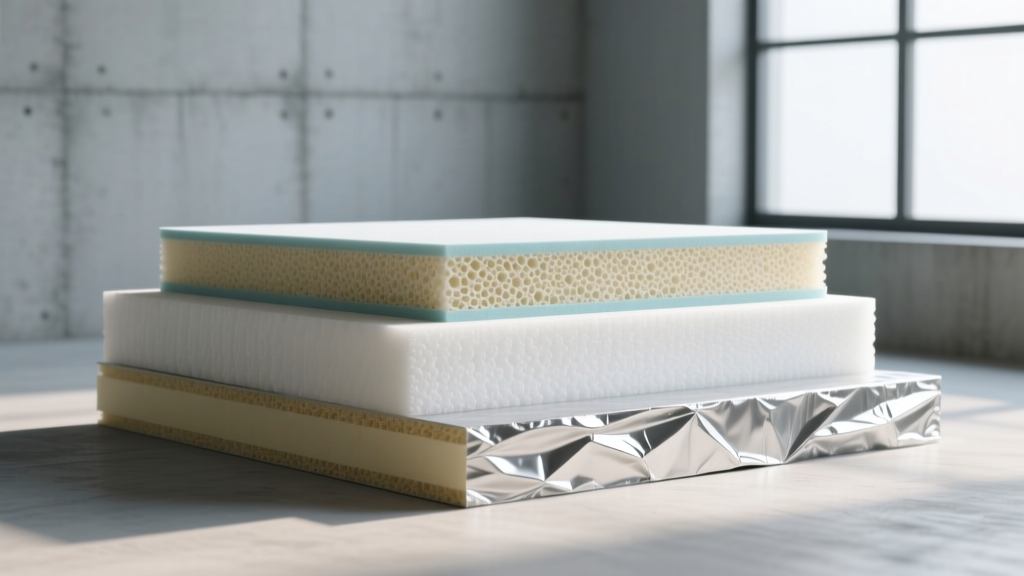
The Reality of Rigid Foam Degradation
Rigid foam boards for insulation provide exceptional thermal resistance and structural utility, but their long-term durability is frequently misunderstood by both contractors and homeowners. Unlike mineral wool or fiberglass batts, which maintain their R-value indefinitely because they rely on trapped air within a stable matrix, rigid foams undergo continuous chemical and physical changes over decades. The blowing agents trapped within the closed-cell structures slowly diffuse out, while ambient air diffuses in. Furthermore, exposure to moisture, ultraviolet (UV) radiation, and sustained compressive loads can drastically alter their physical integrity.
According to the U.S. Department of Energy, while insulation materials can last for the life of a building, rigid foams require specific environmental protections to achieve a 50-year lifespan. Understanding the exact failure modes of Expanded Polystyrene (EPS), Extruded Polystyrene (XPS), and Polyisocyanurate (Polyiso) is critical for specifying the correct material for below-grade, roofing, and continuous exterior wall applications.
Baseline Lifespans and Material Degradation Rates
The lifespan of rigid foam boards for insulation is not a single metric; it is a combination of physical survivability and thermal retention. A board may remain physically intact for 60 years while losing 20% of its thermal resistance in the first decade.
| Material | Expected Physical Lifespan | Initial R-Value (per inch) | Aged R-Value (per inch) | Primary Degradation Vector |
|---|---|---|---|---|
| EPS (Expanded Polystyrene) | 50+ Years | 3.6 - 4.2 | 3.6 - 4.2 | Moisture absorption, UV degradation |
| XPS (Extruded Polystyrene) | 40 - 50 Years | 5.0 | 4.5 - 4.7 | Thermal drift, solvent melting |
| Polyiso (Polyisocyanurate) | 30 - 40 Years | 6.0 - 6.5 | 5.6 - 5.8 | Thermal drift, cold-temp R-value drop |
The HFO Transition and Thermal Drift Dynamics
Thermal drift is the most significant lifespan factor for XPS and Polyiso. Historically, these boards utilized Hydrofluorocarbon (HFC) blowing agents, which provided high initial R-values but slowly escaped the cellular structure over 10 to 15 years, replaced by ambient air. This resulted in a permanent loss of thermal resistance.
As of 2026, the industry has largely transitioned to Hydrofluoroolefin (HFO) blowing agents, such as Solstice LBA, driven by the AIM Act and global Kigali Amendment mandates to reduce Global Warming Potential (GWP). According to the Extruded Polystyrene Foam Association (XPSA), modern HFO-blown XPS boards (like Owens Corning FOAMULAR NGX) exhibit a slightly different thermal drift profile. While HFOs have a vastly superior environmental profile (GWP of 1 compared to HFC-134a's GWP of 1430), the long-term aged R-value of HFO XPS stabilizes around R-4.5 to R-4.7 per inch. Specifiers must use the aged R-value, not the initial R-value, when calculating code compliance for continuous insulation (ci) under IRC Section N1102.
The Polyiso Cold-Temperature Anomaly
Polyisocyanurate suffers from a unique durability issue that impacts its effective lifespan in cold climates: the condensation of blowing agents. At temperatures below 40°F (4°C), the blowing agents within the polyiso cells begin to condense into a liquid state. This removes the insulating gas from the cell void, causing the R-value to plummet from R-6.0 down to approximately R-4.5 per inch. For buildings in Climate Zones 5 through 8, relying solely on polyiso for exterior continuous insulation can result in severe thermal bridging and condensation risks during winter months. The standard mitigation is to use a hybrid wall assembly, pairing polyiso with a layer of mineral wool or EPS to buffer the temperature swing.
Moisture Ingress and Compressive Creep Failures
Water is the ultimate enemy of rigid foam boards for insulation. When foam absorbs water, the thermal conductivity of the water (which is roughly 24 times higher than that of still air) rapidly destroys the board's R-value. Furthermore, freeze-thaw cycles can cause the cellular walls to rupture, leading to irreversible physical degradation.
- XPS Moisture Resistance: Tested under ASTM C272, XPS absorbs less than 0.3% water by volume. Its extruded, tightly packed closed-cell structure makes it the undisputed choice for below-grade applications, under-slab insulation, and inverted roof membranes (IRMA).
- EPS Moisture Vulnerability: Standard EPS can absorb between 2.0% and 4.0% water by volume. If used below grade, it must be specified with a waterproof facer or a specialized drainage mat. However, EPS is highly breathable, allowing it to dry out more effectively than XPS if exposed to intermittent moisture in above-grade wall cavities.
- Polyiso Moisture Sensitivity: Polyiso acts like a sponge if the facers are compromised. It should never be used in below-grade applications or in direct contact with concrete. Even high-humidity environments can cause the foam core to swell and delaminate from its facers over time.
Compressive Creep Under Sustained Loads
When rigid foam boards for insulation are placed under concrete slabs or heavy plaza decks, they are subjected to sustained dead loads. Unlike a short-term compressive strength test (ASTM D1621), which measures resistance at 10% deformation, long-term 'creep' can cause the foam to compress by 2% to 5% over decades. For heavy-load applications, specify XPS with a minimum compressive strength of 60 psi (e.g., Owens Corning FOAMULAR 600) or 100 psi (FOAMULAR 1000). Using standard 15 psi or 25 psi boards under a structural slab will result in slab settlement and cracking within 5 to 10 years.
UV Degradation and Facers: Protecting the Core
Unfaced rigid foam degrades rapidly when exposed to ultraviolet (UV) radiation. Within weeks of direct sun exposure, the surface of EPS and XPS will begin to chalk, turn yellow, and form a brittle dust that compromises the structural integrity of the board's face. If left exposed for more than 30 days during construction, the degraded surface must be sanded or removed before applying stucco, siding, or adhesives.
To extend the lifespan of polyiso, manufacturers apply facers. The Polyisocyanurate Insulation Manufacturers Association (PIMA) notes that the choice of facer dictates the board's application lifespan:
1. Aluminum Foil Facers: Provide the highest R-value and act as a Class I vapor retarder. However, they are highly susceptible to tearing during installation and degrade rapidly if exposed to the alkaline environment of fresh concrete or stucco.
2. Coated Glass Fiber (CGF) Facers: The industry standard for roofing and exterior walls (e.g., Carlisle Securock, Johns Manville ENRGY 3). They offer superior tear resistance, UV tolerance, and alkaline resistance, significantly extending the physical lifespan of the board in harsh environments.
Decision Matrix: Selecting Boards by Environmental Stress
To maximize the lifespan of your insulation investment, match the specific environmental stressors of your project to the correct rigid foam chemistry.
| Application Environment | Primary Stressor | Recommended Material | Required Specification Details |
|---|---|---|---|
| Below-Grade Foundation Walls | Hydrostatic pressure, moisture, soil chemicals | XPS | Min 40 psi compressive strength, un-faced or specialized drainage facer. |
| Under-Slab (Heated Basement) | Sustained dead load, concrete alkalinity | XPS or High-Density EPS | Min 60 psi compressive strength, poly vapor barrier over foam. |
| Exterior Continuous Wall (ci) | UV exposure, fastener shear, weather | Polyiso (CGF faced) or EPS | CGF facers for weather resistance; tape seams with acrylic tape. |
| Low-Slope Commercial Roofing | Ponding water, membrane adhesion, wind uplift | Polyiso (CGF faced) | Use multiple staggered layers to prevent thermal bridging at joints. |
| Cold Storage / Freezers | Extreme temperature differentials, vapor drive | XPS or Polyiso | Multiple layers with offset joints; strict vapor retarder on warm side. |
Conclusion: Designing for the 50-Year Mark
The durability of rigid foam boards for insulation relies entirely on respecting the chemical and physical limitations of the chosen material. EPS offers the most stable long-term R-value but requires rigorous moisture management. XPS provides unmatched below-grade survivability and compressive strength, though specifiers must account for HFO thermal drift. Polyiso delivers the highest initial thermal resistance per inch but demands protection from cold-temperature condensation and liquid water. By specifying the correct facers, calculating loads based on long-term creep rather than short-term yield, and designing hybrid assemblies to mitigate thermal drift, builders can ensure their rigid foam insulation performs flawlessly for the entire lifespan of the structure.