What Material Is the Best Insulator? The Complete Guide
Discover what material is the best insulator for your building. Compare R-values, costs, and applications of spray foam, fiberglass, and mineral wool.
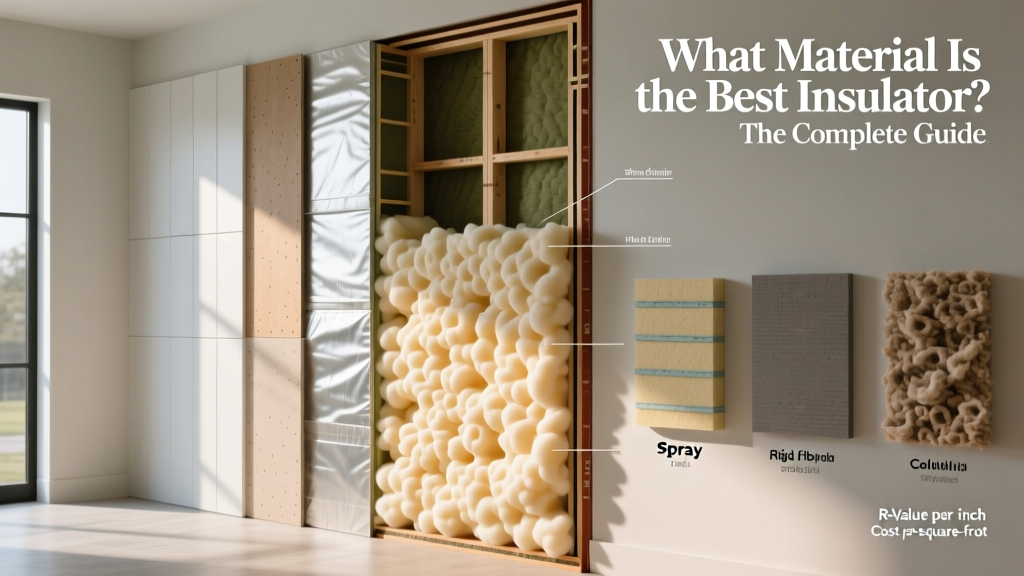
The Short Answer: Defining "Best" by Application
When builders, architects, and homeowners ask what material is the best insulator, the answer depends entirely on the metric used to define "best." If the sole metric is thermal resistance per inch of thickness, Aerogel blankets and Vacuum Insulation Panels (VIPs) are the undisputed champions, offering R-values between R-10 and R-50 per inch. However, if "best" is defined by the optimal balance of air sealing, moisture management, structural rigidity, and cost-effectiveness for standard residential and commercial construction, Closed-Cell Spray Polyurethane Foam (ccSPF) takes the top spot.
The U.S. Department of Energy categorizes insulation not just by its raw R-value, but by its ability to act as a continuous thermal barrier. A material with a lower R-value that perfectly seals air leaks will consistently outperform a higher R-value material installed with gaps, compression, or convective looping. Below, we break down the physics, the economics, and the real-world failure modes of the top insulating materials on the market.
Material Comparison Matrix: Thermal Resistance & Economics
The following matrix compares the most common building insulation materials based on their nominal R-value per inch, average installed cost per board foot (as of current market rates), and primary functional benefits.
| Insulation Material | R-Value Per Inch | Installed Cost (per bd ft) | Best Application | Air & Vapor Control |
|---|---|---|---|---|
| Closed-Cell Spray Foam (ccSPF) | R-6.5 to R-7.0 | $1.50 - $3.00 | Rooflines, crawlspaces, rim joists | Class II Vapor Retarder, Air Barrier |
| Polyisocyanurate (Polyiso) Board | R-6.0 to R-6.5 | $0.90 - $1.60 | Continuous exterior, flat roofs | Class I Vapor Retarder (with foil) |
| Extruded Polystyrene (XPS) | R-5.0 | $0.80 - $1.30 | Below-grade, under-slab | Class II Vapor Retarder |
| Mineral Wool (Rockwool) | R-4.2 to R-4.3 | $0.90 - $1.40 | Fire-stopping, exterior sheathing | Vapor Permeable |
| Fiberglass Batts (High-Density) | R-3.7 to R-4.3 | $0.50 - $0.90 | Standard 2x4 / 2x6 wall cavities | Vapor Permeable |
| Aerogel Blanket (e.g., Spaceloft) | R-10.3 | $3.50 - $5.50 | Historic retrofits, space-constrained | Vapor Permeable |
The Contenders: Deep Dive into Top Insulating Materials
Closed-Cell Spray Polyurethane Foam (ccSPF): The Practical Champion
Product Spotlight: Demilec Heatlok Soya HFO or Icynene ProSeal Eco. These HFO-blown foams have a Global Warming Potential (GWP) of less than 1, replacing older HFC-blown foams that were phased down due to environmental regulations.
Why it wins: ccSPF expands to fill every micro-cavity, adhering directly to wood, concrete, and steel. At 2 inches thick, it provides approximately R-13 and acts as a code-compliant air barrier and Class II vapor retarder. It also adds structural racking strength to wall assemblies, increasing shear strength by up to 300% according to tests by the National Association of Home Builders.
Edge Case / Failure Mode: Improper mixing ratios or applying foam to cold substrates (below 60°F) can result in "shrink-back" or delamination from the framing, creating hidden air channels.
Polyisocyanurate (Polyiso): The Commercial & Roofing King
Polyiso is the most widely used rigid foam board in commercial construction and continuous exterior insulation (ci). Products like Johns Manville ENRGY 3 or Carlisle SecurShield feature foil facers that push the initial R-value to R-6.5 per inch. It is highly fire-resistant compared to EPS or XPS, often achieving a Class A flame spread rating without additional thermal barriers.
However, polyiso requires meticulous detailing. The joints must be taped with high-quality acrylic or butyl tapes (such as 3M All Weather Flashing Tape) to prevent thermal bridging and air infiltration through the board seams. If left untaped, the theoretical R-value of the wall assembly drops significantly due to convective heat loss at the joints.
Aerogel and Vacuum Insulation Panels (VIPs): The Extreme Space-Savers
When answering what material is the best insulator for extreme space constraints, Aerogel (like Aspen Aerogels' Spaceloft) and VIPs (like Kingspan Kooltherm VIP) are the only solutions. Aerogel is a silica-based nanoporous solid that is 95% air, yielding an R-10.3 per inch. VIPs feature a hermetically sealed core evacuated of air, achieving R-25 to R-50 per inch.
The Catch: VIPs are incredibly fragile; a single puncture during installation ruins the vacuum, dropping the R-value to that of standard foam (R-5). Aerogel is highly expensive and compressible, meaning it cannot bear structural loads. These are reserved for specialized applications like historic masonry retrofits where adding 4 inches of interior wall thickness is architecturally unacceptable.
The "Thermal Drift" Phenomenon: A Critical Edge Case
One of the most misunderstood phenomena in building science is thermal drift (or cold-weather performance degradation) in polyiso and XPS foams. According to research highlighted by Building Science Corporation, the blowing agents used in polyiso and XPS condense at freezing temperatures.
While a polyiso board may be rated at R-6.5 per inch at 75°F (24°C), its thermal resistance can drop to R-5.0 or lower when the exterior temperature falls to 25°F (-4°C). This means that in Climate Zones 6, 7, and 8, the winter performance of polyiso is notably lower than its label claims.
Expert Fix: To mitigate thermal drift in cold climates, designers should use a hybrid approach. Place a layer of mineral wool (which maintains a stable R-4.2 regardless of temperature) on the exterior, or use Expanded Polystyrene (EPS), which actually increases slightly in R-value as temperatures drop because its blowing agent (pentane) remains a gas at much lower temperatures.
Climate Zone Decision Framework
Choosing the right insulator requires aligning the material's properties with your specific IECC Climate Zone. Use this framework to guide your specification:
- Climate Zones 1-3 (Hot/Humid & Hot/Dry): Focus on radiant barriers and open-cell spray foam (R-3.5/inch) for rooflines to allow inward drying. Use polyiso continuous insulation on the exterior to keep the sheathing above the dew point, preventing interior condensation on AC-cooled surfaces.
- Climate Zones 4-5 (Mixed): The "Goldilocks" zones. High-density fiberglass (R-3.8/inch) or mineral wool (R-4.2/inch) in the cavity, combined with 1 to 1.5 inches of exterior XPS or unfaced polyiso to control thermal bridging and manage the dew point.
- Climate Zones 6-8 (Cold & Subarctic): Prioritize ccSPF for complex geometries (rim joists, dormers) to guarantee an airtight seal against freezing winds. For wall cavities, use mineral wool for its fire resistance and stable cold-weather R-value, paired with a thick layer of exterior EPS or unfaced polyiso to push the condensing surface far outside the structural sheathing.

Hidden Installation Failures: Beyond the Material
Even if you select the material with the highest theoretical R-value, poor installation will render it useless. The North American Insulation Manufacturers Association (NAIMA) notes that fiberglass batts are frequently compromised by three common installer errors:
- Compression: Stuffing an R-19 (6.25-inch) batt into a 5.5-inch 2x6 wall cavity does not yield R-19. The compression increases the density but reduces the trapped air pockets, dropping the effective R-value to approximately R-17 or R-18.
- Convective Looping: In attics, if fiberglass batts are not perfectly sealed at the top plate, warm interior air rises, cools against the roof deck, and sinks back into the insulation, creating a convective loop that bypasses the material's thermal resistance entirely.
- Missing Air Sealing: Insulation is not an air barrier (unless specifically rated and installed as one, like ccSPF). Failing to caulk or foam the top and bottom plates before installing batts allows up to 30% of a home's conditioned air to escape via the stack effect.
Expert Verdict: So, What Material Is the Best Insulator?
If budget is no object and you are insulating a space-constrained historic building or a specialized commercial freezer, Aerogel and VIPs are the best insulators in existence.
However, for 95% of modern residential and commercial construction, Closed-Cell Spray Polyurethane Foam (ccSPF) is the best overall insulator. It provides the highest practical R-value per inch (R-7), eliminates air infiltration, acts as its own vapor retarder, and resists bulk water intrusion. For those seeking a more budget-friendly or environmentally low-impact alternative, a hybrid assembly utilizing Mineral Wool cavity insulation paired with EPS or Polyiso continuous exterior insulation offers the best balance of thermal performance, fire safety, and long-term durability across varying climate zones.
Written by
David NakamuraDavid Nakamura is a licensed architect (AIA) and construction technology writer focused on sustainable building methods, mass timber engineering, and high-performance building envelopes. He holds a Master of Architecture from the University of Washington and is a certified Passive House Consultant (CPHC). David spent eight years at the Seattle firm Mithun, where he led the design of three LEED Platinum projects, before founding his own practice specializing in net-zero residential design. He serves on the editorial advisory board of GreenBuilder Magazine and has authored peer-reviewed papers on cross-laminated timber (CLT) connections for the Journal of Structural Engineering. In his spare time, David teaches woodworking at Pratt Fine Arts Center and kayaks the Puget Sound.
More from David Nakamura
View all
Construction Cost
Labor Cost to Build a Deck Per Sq Ft: 2026 Installation Guide
Discover the exact labor cost to build a deck per sq ft in 2026. This installation guide breaks down contractor rates, complexity factors, and hidden fees.
Aug 4, 2026

Construction Cost
How Much Does It Cost to Build a 3 Bedroom House? Financing Guide
Learn exactly how much it costs to build a 3 bedroom house and explore 2026 financing options, construction loan types, and budget frameworks for your build.
Aug 4, 2026

Construction Cost
Cost to Build a Tennis Court: 2026 Guide
How much does it cost to build a tennis court in 2026? Breakdowns for asphalt, concrete, and synthetic surfaces plus fencing and lighting.
Jul 30, 2026