Top Car Heat Insulation Material Options for Maximum R-Value
Compare the best car heat insulation material options. Analyze R-value, radiant heat blocking, weight, and cost for vehicles, RVs, and mobile builds.

Why Standard Building Insulation Fails in Automotive Applications
When evaluating a car heat insulation material, professionals often make the critical mistake of applying residential building logic to mobile environments. In a standard home, thermal transfer is primarily conductive, and thick batts of fiberglass or mineral wool perform exceptionally well. In a vehicle, however, the thermal dynamics are entirely different. A car's metal shell acts as a massive thermal conductor, while the primary source of heat gain is solar radiation striking the roof, windshield, and doors. Furthermore, vehicles are subject to constant vibration, extreme temperature cycling, and severe space constraints. Traditional porous insulation materials absorb moisture, trap condensation against bare metal (leading to rapid oxidation), and compress under interior panels, destroying their stated R-value. To achieve genuine thermal management in automotive and mobile builds, you must decouple conductive resistance from radiant reflectivity and prioritize closed-cell, impermeable structures.
The R-Value Myth: Conductive vs. Radiant Heat Transfer
The R-value metric strictly measures a material's resistance to conductive heat flow. According to the U.S. Department of Energy, radiant barriers and reflective insulation systems work differently; they reflect radiant heat away from the living space rather than resisting conductive flow. In a parked vehicle exposed to direct sunlight, up to 75% of the cabin heat load is radiant energy penetrating the glass and metal. Therefore, a car heat insulation material with a high conductive R-value but low emissivity will still result in an unbearably hot interior. The highest-performing automotive thermal systems utilize a hybrid approach: a highly reflective outer layer to bounce solar radiation, paired with a low-conductivity closed-cell core to stop engine and exhaust heat transfer.
Top Car Heat Insulation Materials Ranked by Performance
1. Closed-Cell Elastomeric Foam (e.g., Armacell Armaflex)
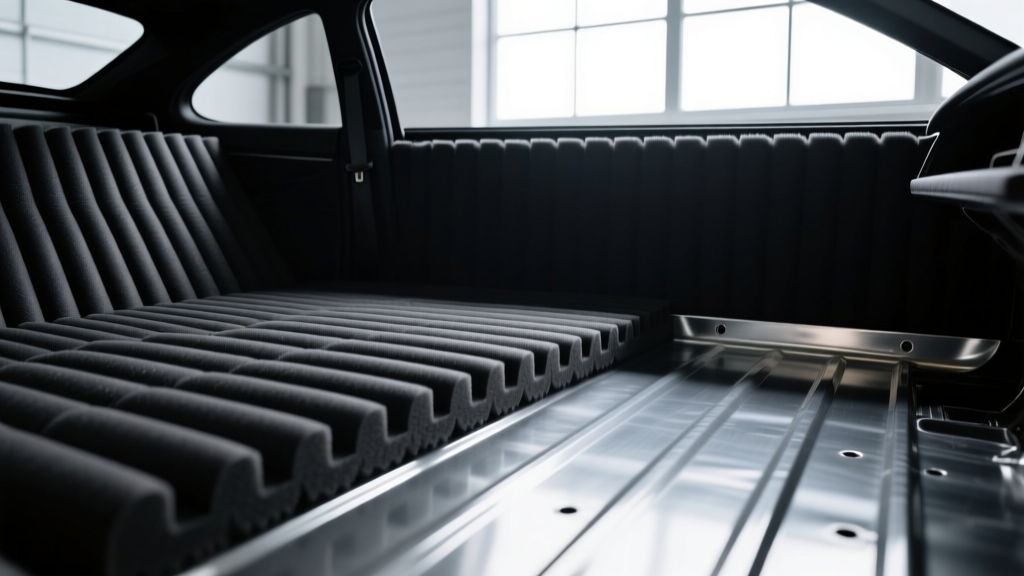
Originally engineered for HVAC and marine applications, closed-cell elastomeric foam is the gold standard for automotive and van conversion thermal management. Armacell's Armaflex offers a verified R-value of R-4.2 per inch. Because the cells are completely sealed, it acts as a built-in vapor barrier, preventing condensation from forming on the vehicle's interior metal skin—a common failure point in DIY camper builds. It is highly flexible, allowing it to conform to the complex curves of wheel wells and door cavities without losing structural integrity.
2. Aerogel Blankets (e.g., Aspen Spaceloft)
When space is at an absolute premium, silica aerogel blankets are unmatched. Aspen Aerogels Spaceloft delivers an astonishing R-10.3 per inch at just 10mm thick. This allows builders to achieve the thermal resistance of a 2.5-inch foam board in a fraction of the space, preserving crucial interior cabin volume. The primary drawback is cost; aerogel blankets typically run between $15 and $22 per square foot, making them a specialized solution for high-end custom builds or targeted applications like engine firewall separation.
3. Multi-Layer Radiant Barriers (e.g., Double-Bubble Foil)
Products like Reflectix or generic double-bubble foil consist of polyethylene bubble cores sandwiched between aluminum foil facers. Conductively, they offer a negligible R-1.1. However, their aluminum surfaces reflect up to 97% of radiant heat. To function correctly in a vehicle, a radiant barrier must have a minimum 3/4-inch dead air gap on at least one side. If you glue a radiant barrier directly flat against a van's metal roof panel, you eliminate the air gap, reducing its performance to mere conductive resistance, effectively rendering it useless against solar loading.
4. Spray-Applied Ceramic Thermal Coatings (e.g., LizardSkin)
Ceramic coatings are sprayed directly onto bare metal using a specialized hopper gun. While they do not carry a traditional R-value rating (typically applied at just 40-60 mils thick), the microscopic ceramic spheres create a thermal break that reduces surface metal temperatures by 30°F to 40°F. They are ideal for complex geometries like transmission tunnels and tight firewall corners where adhering foam sheets is impossible.
Material Performance & Specification Matrix
| Material Type | Conductive R-Value (per inch) | Radiant Reflectivity | Weight (oz/sq ft) | Avg. Cost (per sq ft) | Vapor Barrier? |
|---|---|---|---|---|---|
| Closed-Cell Elastomeric Foam | R-4.2 | Low (unless foil-faced) | 2.5 oz | $2.50 - $4.00 | Yes |
| Silica Aerogel Blanket | R-10.3 | Low | 1.8 oz | $15.00 - $22.00 | Yes |
| Double-Bubble Foil Barrier | R-1.1 | 97% (Requires air gap) | 1.2 oz | $0.80 - $1.50 | Yes |
| Ceramic Thermal Coating | N/A (Thermal break) | Moderate | 3.0 oz (cured) | $6.00 - $9.00 | No |
| Mass Loaded Vinyl (MLV) + Foam | R-2.0 (1/4 inch composite) | Low | 16.0 oz (1lb MLV) | $3.50 - $5.50 | Yes |
Real-World Installation: Avoiding Thermal Bridging and Delamination
The highest-performing car heat insulation material will fail entirely if installed incorrectly. Automotive environments introduce severe vibration and thermal expansion. Follow these strict installation protocols:
- Surface Preparation: Bare metal must be stripped of factory cosmoline, oils, and dust. Wipe all panels with acetone or a dedicated automotive prep solvent before applying any adhesive. Failure to do so will result in delamination within the first summer heat cycle.
- Adhesive Selection: Never use standard construction adhesives or asphalt-based sound deadeners (like peel-and-stick roofing membrane) in a vehicle cabin. Asphalt-based products melt at 140°F, off-gassing toxic volatile organic compounds (VOCs) and sliding off vertical panels. Always specify butyl-rubber-based adhesives (e.g., Kilmat, Dynamat Xtreme), which remain stable up to 250°F.
- Sealing the Seams: Insulation is only as good as its weakest seam. Thermal bridging occurs where metal is exposed between foam panels. Seal all butt joints of closed-cell foam with 2-inch wide aluminum foil HVAC tape. Do not use standard fabric duct tape, which dries out and peels under high heat.
- The Air Gap Rule: If utilizing a radiant foil barrier over your primary foam layer, use furring strips or self-adhesive foam spacers (minimum 1/2 inch thick) to create a dead air cavity between the foil and the interior trim panel.
When selecting any car heat insulation material for an enclosed cabin, verify that the product passes FMVSS 302 (Federal Motor Vehicle Safety Standard for flammability of interior materials). Many cheap, imported closed-cell foams and radiant barriers lack fire retardants and will rapidly propagate a flash fire. Always demand a technical data sheet (TDS) from the manufacturer confirming FMVSS 302 or SAE J369 compliance before installing in a passenger compartment.
Cost vs. Performance ROI for Mobile Builds
Budgeting for automotive insulation requires calculating the total square footage of the vehicle's metal envelope, not just the floor area. A standard mid-size sedan requires approximately 60 to 80 square feet of coverage for the doors, roof, and floor. A high-roof extended wheelbase van (like a Mercedes Sprinter or Ford Transit) requires 250 to 320 square feet.
For a budget-conscious daily driver, a butyl-based sound deadener applied to 25% of the flat metal panels (to stop resonance), combined with a double-bubble radiant barrier on the roof and doors, will cost roughly $120 to $180 in materials and yield a noticeable 10°F to 15°F drop in cabin ambient temperature when parked in the sun.
For a climate-controlled camper van requiring year-round thermal retention, the optimal ROI is achieved using 1/2-inch Armaflex closed-cell foam (approx. $850 for 300 sq ft) covering 100% of the metal skin, followed by a 1/4-inch layer of MLV for acoustic dampening, and finished with a radiant barrier separated by an air gap. This hybrid system costs roughly $1,500 to $2,200 in raw materials but prevents the costly retrofitting required when condensation and mold inevitably destroy poorly insulated builds.
Expert Decision Framework: Which Material Should You Choose?
Use this diagnostic framework to specify the correct car heat insulation material for your exact scenario:
- Scenario A: Space is severely restricted (e.g., sports car firewall, tight door cavities).
Choose Aerogel Blankets. The R-10.3 per inch rating allows maximum thermal resistance without interfering with window mechanisms or pedal boxes. - Scenario B: High moisture environment (e.g., marine vessels, camper vans with human respiration loads).
Choose Closed-Cell Elastomeric Foam. Its impermeable cellular structure guarantees zero water absorption, protecting the structural steel from rust. - Scenario C: Budget build focused purely on solar heat rejection.
Choose Double-Bubble Radiant Foil, but strictly enforce the 3/4-inch air gap requirement using foam spacers behind the interior trim. - Scenario D: Complex, ribbed surfaces (e.g., corrugated van floors, transmission tunnels).
Choose Spray-Applied Ceramic Coating. It encapsulates the irregular geometry perfectly, eliminating the air pockets that cause condensation under rigid foam boards.
Written by
Marcus ChenMarcus Chen is a licensed structural engineer (PE) and building materials analyst with over 12 years of experience across residential, commercial, and industrial construction. He holds a Master of Science in Civil Engineering from UC Berkeley and spent six years at Thornton Tomasetti before transitioning to independent consulting and technical writing. Marcus specializes in material selection for seismic-prone regions, concrete reinforcement strategies, and lifecycle cost analysis. His work has been cited by the American Concrete Institute (ACI) and the Structural Engineers Association of California (SEAOC). When he is not on a job site or at his desk, you will find him hiking the Sierra Nevada or restoring a 1920s craftsman bungalow in Oakland, CA.
More from Marcus Chen
View all
Construction Cost
How Much Did the Eiffel Tower Cost to Build?
How much did the Eiffel Tower cost to build in 1889? We adjust for inflation and compare its budget to modern skyscraper construction.
Aug 4, 2026

Fire Resistance
What Is a Fire Resistant Material? Testing & Certification Guide
Discover what is a fire resistant material through ASTM and UL testing. Learn how fire ratings, certifications, and assemblies work in construction.
Aug 4, 2026

Construction Cost
How Much Did the Burj Khalifa Cost to Build?
How much did the Burj Khalifa cost to build? We break down the $1.5B project and extract 5 money-saving strategies for your next build.
Jul 30, 2026