Brick Stain Durability: Lifespan, Failure Modes, and Maintenance
Analyze brick stain durability, comparing silicate and acrylic lifespans. Discover failure modes, breathability impacts, and 2026 maintenance costs.
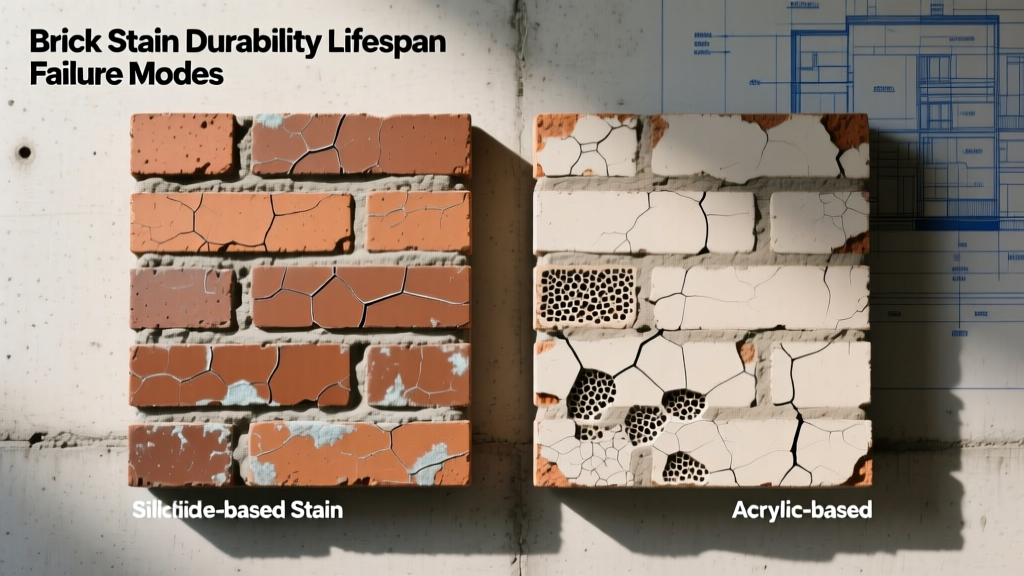
The Chemistry of Brick Stain vs. Paint
Brick stain alters the aesthetic of masonry without compromising its vapor permeability, but its lifespan is strictly dictated by chemical composition and substrate preparation. Unlike latex or elastomeric paints that form a superficial film over the clay substrate, true brick stains penetrate the porous capillary network of the fired clay. According to the Brick Industry Association (BIA) Technical Notes, maintaining the breathability of brick is paramount to preventing moisture entrapment, which leads to freeze-thaw spalling. Stains achieve this by depositing pigments deep within the pores while leaving the capillary pathways open for vapor transmission.
The durability of a stained brick facade hinges entirely on the binder used to suspend the pigment. In 2026, the market is dominated by two primary chemical families: mineral silicates (potassium silicate) and water-based penetrating acrylics. Mineral silicates undergo a process called petrification, chemically bonding with the silica and alumina in the clay to become a permanent part of the brick matrix. Acrylic stains, conversely, rely on microscopic polymer chains that lodge within the pores but remain mechanically bound rather than chemically fused.
Never confuse "solid acrylic stain" with true penetrating stain. Some budget products marketed as stains contain high levels of acrylic resins that form a micro-film. If applied to a below-grade retaining wall or a solid masonry wall without a cavity, these products can reduce vapor transmission by up to 40%, trapping hydrostatic pressure and causing the brick face to delaminate during winter freeze-thaw cycles.
Expected Lifespan: Data by Stain Formulation
The longevity of brick stain is not a single metric; it varies wildly based on the chemical base and the environmental exposure of the facade. Below is a comparative analysis of the primary stain types available to contractors and homeowners.
| Stain Type | Chemical Base | Expected Lifespan | Vapor Permeability | UV Resistance |
|---|---|---|---|---|
| Mineral Silicate (e.g., Nawkaw, Keim) | Potassium Silicate | 25 - 50+ Years | 100% (No reduction) | Exceptional (Inorganic pigments) |
| Penetrating Water-Based (e.g., Dyebrick) | Acrylic Polymer Emulsion | 10 - 15 Years | 90% - 95% | Good (Fades slightly after decade) |
| Solvent-Based Masonry Dye | Xylene/Toluene Solvents | 5 - 8 Years | 85% - 90% | Poor (Rapid UV degradation) |
Mineral silicate stains represent the gold standard for permanent color alteration. Because the potassium silicate binder reacts with the masonry substrate to form calcium silicate hydrate, the pigment is essentially locked into the brick's crystalline structure. As noted in Masonry Magazine Restoration Archives, silicate stains will only fade when the brick itself physically erodes, making them the preferred choice for historical restorations and high-UV environments like the American Southwest.
Primary Failure Modes and Edge Cases
Even the most advanced nano-silicate formulations will fail prematurely if applied outside their narrow environmental tolerances. Understanding these failure modes is critical for accurate lifespan forecasting.
1. Efflorescence Sub-Strata Blistering
Efflorescence occurs when water-soluble salts migrate to the brick surface and crystallize. If a penetrating stain is applied to a wall with active moisture intrusion, the salt crystals will form beneath the stained layer. As the crystals expand, they create localized hydrostatic pressure that pushes the pigment out of the capillary network, resulting in a mottled, chalky appearance. Diagnostic metric: A moisture meter reading above 15% or visible salt deposits dictate that the wall must be treated with a dedicated efflorescence remover and allowed to dry for a minimum of 14 days before staining.
2. Alkaline Burn and Saponification
Newly laid brick and fresh mortar joints exhibit high alkalinity, often registering a pH between 12 and 13. Mineral silicate stains actually require this high alkalinity to catalyze the petrification process. However, water-based acrylic stains are highly susceptible to alkaline burn (saponification), where the high pH breaks down the polymer chains, turning the binder into a water-soluble soap. This causes the stain to wash away during the first heavy rainstorm. Rule of thumb: Acrylic stains require a 30-to-60-day curing period for new mortar, followed by a mild acid wash to neutralize the surface pH to roughly 8.0 before application.
3. UV Degradation of Organic Pigments
While the binder dictates structural adhesion, the pigment dictates colorfastness. Budget masonry dyes often utilize organic carbon-based pigments to achieve deep blacks and rich browns. These organic molecules are highly susceptible to ultraviolet photodegradation. Within 3 to 5 years of direct southern exposure, organic pigments will break down, leaving the brick with a washed-out, grayish hue. Always verify that the product specification sheet explicitly lists "inorganic iron oxide pigments" for colors intended for exterior, sun-exposed facades.
Application Variables That Dictate Longevity
The difference between a 5-year lifespan and a 30-year lifespan often comes down to the micro-climate conditions during the 48-hour application and curing window.
- Substrate Temperature: The brick surface temperature must be between 50°F and 90°F. Applying silicate stain to sun-baked brick (surface temps exceeding 110°F) causes the liquid carrier to flash-evaporate before the pigment can penetrate the capillary network, leaving a weak, dusty residue on the surface.
- Wind Velocity: Spraying stain in winds exceeding 12 mph not only causes overspray waste but accelerates surface drying, preventing deep pore penetration. Low-pressure pump sprayers (40-60 PSI) with a fan-tip nozzle are required for controlled application.
- Saturation Technique: True durability requires a "wet-on-wet" flood coat. The brick must be saturated to the point of visual runoff, ensuring the stain penetrates at least 1/8 to 1/4 inch into the clay matrix. A single light mist coat will wear away from rain abrasion within 24 months.
- Rainfall Proximity: The wall must remain completely dry for a minimum of 12 hours post-application. Silicate stains require a complex chemical reaction that is easily interrupted by water dilution during the initial cross-linking phase.
Cost vs. Longevity Framework (2026 Pricing)
When evaluating the return on investment for brick staining versus brick replacement or painting, the lifecycle cost heavily favors mineral silicate stains despite their higher upfront material cost.
Material Costs: High-end mineral silicate stains (such as Nawkaw or Keim) cost between $85 and $140 per gallon, covering approximately 150 to 200 square feet per coat. Water-based penetrating acrylics are cheaper, averaging $45 to $65 per gallon with similar coverage rates.
Labor and Total Project Costs: As of 2026, professional masonry staining contractors charge between $3.50 and $6.00 per square foot for a complete two-coat silicate application, which includes power washing, efflorescence treatment, and masking. DIY application reduces the cost to $0.75 to $1.25 per square foot, but introduces significant risk regarding uneven saturation and lap marks.
The ROI Calculation: Replacing a brick facade costs $15 to $30 per square foot. Painting costs $2.50 to $4.50 per square foot but requires repainting every 5 to 7 years due to peeling and moisture trapping. A $5.00/sq ft silicate stain application that lasts 40 years yields an annualized cost of just $0.12 per square foot, making it the most economically sound aesthetic intervention for structurally sound, but visually dated, masonry.
Expert Verdict: When to Stain and When to Replace
Brick stain is a highly durable, permanent solution, but it is not a structural fix. If the brick is exhibiting advanced spalling, deep mortar joint deterioration (requiring tuckpointing), or active hydrostatic weeping, staining will only mask the symptoms while accelerating the structural decay. Stain should only be deployed on structurally sound masonry where the sole objective is aesthetic modernization or historical color matching. When executed with inorganic silicate chemistry and rigorous substrate preparation, stained brick will easily outlast the mortgage on the building it protects.