Cost Calculator and Material Guide for a Studio Brick Wall Background
Calculate exact material quantities and 2026 costs for building a studio brick wall background, including thin veneer, mortar, and acoustic treatments.
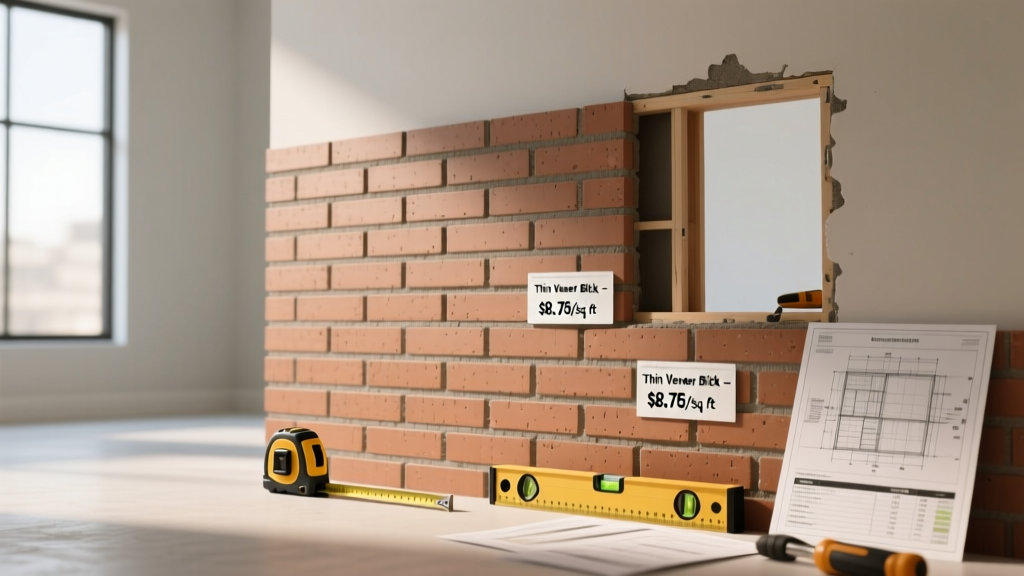
The Economics of a Physical Brick Wall Background
Building a physical brick wall background for a podcast studio, photography set, or retail display requires a different estimation approach than standard structural masonry. Unlike exterior load-bearing walls, a studio background is typically an interior, single-wythe (one brick thick) or thin-brick veneer application. However, because it serves as a visual and acoustic focal point, the material selection, lighting requirements, and acoustic treatments introduce unique cost variables that standard masonry calculators ignore.
This guide provides exact quantity formulas, 2026 pricing matrices, and studio-specific hidden cost frameworks to help you accurately estimate a brick wall background project from framing to final acoustic treatment.
The Quantity Calculator: Formulas for Brick and Mortar
To calculate the exact number of bricks and volume of mortar required, you must first determine the gross square footage of your background wall and subtract any areas dedicated to built-in shelving, doorways, or large acoustic baffles.
Dimensions: 7 5/8" L x 3 5/8" W x 2 1/4" H
Coverage with 3/8" mortar joint: 4.5 bricks per square foot
Mortar yield (Type N): 0.15 cubic feet of mortar per square foot of wall
Waste factor for studio cuts (outlets, light mounts): 10%
Calculation Framework
- Total Bricks Needed: (Wall Width in ft × Wall Height in ft) × 4.5 × 1.10 (waste factor)
- Mortar Volume (Bags): (Total Sq Ft × 0.15) ÷ 0.85 (yield of one 80lb bag of Type N mortar)
- Thin Brick Veneer Alternative: If using 1/2" thin brick, eliminate mortar calculations. Instead, calculate polymer-modified thinset (ANSI A118.4) at a rate of 0.35 lbs per square foot, requiring roughly one 50lb bag per 140 square feet.
2026 Material Cost Breakdown (80 Sq. Ft. Studio Wall)
The following table breaks down the material costs for a standard 10 ft × 8 ft brick wall background. Prices reflect early 2026 national averages for interior-grade materials.
| Material Category | Product Specification | Unit Cost (2026) | Total for 80 Sq Ft |
|---|---|---|---|
| New Face Brick (Modular) | Extruded red clay, interior grade | $4.50 - $6.50 / sq ft | $360 - $520 |
| Reclaimed Antique Brick | Sliced salvaged Chicago common | $9.00 - $14.00 / sq ft | $720 - $1,120 |
| Thin Brick Veneer | Glen-Gery or similar, 1/2" thick | $6.00 - $10.00 / sq ft | $480 - $800 |
| Mortar / Adhesive | Type N Mortar or Laticrete 254 | $0.60 - $1.20 / sq ft | $48 - $96 |
| Sealer (Matte) | Water-based acrylic (dust control) | $0.40 / sq ft | $32 |
| Total Materials | Excluding framing and acoustic treatments | $520 - $1,968 | |
Note: Professional masonry labor for interior veneer installation typically adds $18 to $32 per square foot in 2026, bringing the installed cost of an 80 sq ft wall to between $1,960 and $4,528.
Studio-Specific Hidden Costs: Acoustics, Lighting, and Rigging
When estimating a brick wall background, standard construction calculators fail to account for the environmental physics of a studio. Brick introduces three major hidden costs that must be budgeted during the planning phase.
1. The Acoustic Penalty (Slapback Echo)
According to acoustic engineering standards referenced by the Brick Industry Association, unsealed brick masonry has a Noise Reduction Coefficient (NRC) of approximately 0.02 to 0.05. This means it reflects nearly 98% of high-frequency sound waves back into the room. For a podcast or video studio, this creates severe 'slapback' echo, ruining audio quality.
You cannot use a bare brick wall as your only background in an audio environment. You must budget for off-camera acoustic absorption (e.g., 2-inch thick Owens Corning 703 fiberglass panels wrapped in Guilford of Maine acoustic fabric) on the opposing walls, or integrate decorative wooden acoustic baffles directly over the brick. Add $12 to $25 per square foot of opposing wall space to your total project estimate to mitigate the brick's reflectivity.
2. Lighting Absorption and Wattage Bumps
Dark red or reclaimed brick absorbs a massive amount of light. While a matte white studio wall reflects roughly 80% of incident light, a dark red brick wall background reflects only 10% to 15%. To achieve the same f-stop exposure and depth-of-field separation on a brick background as you would on a painted wall, you must increase your background lighting output by 400% to 500%.
Cost Impact: Upgrading from a standard 60W COB LED background light ($150) to a 200W-300W fixture (e.g., Aputure 300x or Amaran 300c) with a large softbox to wash the brick evenly will add $600 to $1,200 to your studio lighting budget.
3. Rigging and Load-Bearing Limitations
If you plan to mount heavy studio equipment (C-stands, boom arms, or practical wall sconces) directly to the brick wall background, the installation method dictates your hardware costs. Thin brick veneer applied over drywall cannot support dynamic loads. You must install structural blocking (2x6 or 3/4" plywood) behind the drywall before the veneer is laid, or use heavy-duty masonry anchors if using full brick.
- Thin Brick over Drywall: Requires pre-installation of plywood blocking ($45 in materials + 1 hour framing labor).
- Full Brick Wythe: Requires Tapcon 3/16" × 1-3/4" masonry screws ($15/box) and a hammer drill with a carbide masonry bit ($35).
Decision Matrix: Thin Brick Veneer vs. Full Masonry Wythe
Choosing between thin veneer and full brick is the most critical cost decision for a background wall. Use this matrix to determine the right approach for your specific studio footprint.
| Criterion | Thin Brick Veneer (1/2") | Full Masonry Wythe (Single Brick) |
|---|---|---|
| Substrate Requirement | Cement backer board or primed drywall | Concrete slab or reinforced floor joists |
| Weight per Sq Ft | 6 - 9 lbs (Standard wall framing OK) | 35 - 45 lbs (Requires structural verification) |
| Installation Speed | Fast (Mastic/thinset application) | Slow (Requires mortar mixing, troweling, jointing) |
| Authenticity & Texture | Good, but lacks deep mortar joint shadows | Excellent, deep 3/8" joints catch studio rim lighting |
| Best Use Case | Upper floors, tight spaces, DIY studio builds | Ground floor commercial sets, high-end retail |
Step-by-Step Estimation Example: 10x8 Podcast Set
To synthesize these variables, here is a complete cost estimation for a professional 10 ft × 8 ft (80 sq ft) podcast studio brick wall background using reclaimed thin brick veneer, including the necessary studio-specific modifications.
- Wall Prep & Blocking: Install 3/4" plywood blocking behind the drywall at monitor and light-mount heights. Cost: $120 (materials + labor).
- Substrate: Hang 1/2" cement backer board over the drywall to prevent moisture warping from the thinset. Cost: $95.
- Brick Material: 80 sq ft of reclaimed thin brick veneer at $11/sq ft, plus 10% waste (88 sq ft total). Cost: $968.
- Adhesive & Grout: Laticrete 254 Platinum thinset and sanded grout for 1/2" joints. Cost: $110.
- Matte Sealer: Water-based pore sealer to prevent brick dust from contaminating sensitive studio microphones and camera sensors. Cost: $45.
- Acoustic Mitigation: Four 24" × 48" custom fabric-wrapped acoustic panels mounted on the opposing (off-camera) drywall to kill brick slapback. Cost: $380.
Total Project Estimate (Materials & Prep)
$1,718.00
Note: This excludes the physical labor of laying the brick (approx. $1,400 for a professional mason) and the upgraded background lighting fixtures required to properly expose the dark reclaimed clay.
By utilizing these specific formulas and accounting for the acoustic and lighting realities of studio environments, you can accurately forecast the true cost of a brick wall background. For further technical specifications on thin brick adhesion standards and substrate preparation, refer to the latest technical notes published by Masonry Magazine and the Brick Industry Association.