Brick Facade Repair: Bricks and Minifigs Beaverton OR Storefront
Guide to repairing commercial brick storefronts in Beaverton, OR, focusing on PNW weatherproofing, tuckpointing, and mortar selection for retail facades.

The Pacific Northwest Climate Toll on Retail Brick Facades
Commercial masonry in the Pacific Northwest faces a unique set of environmental stressors. When maintaining a high-visibility retail location like the Bricks and Minifigs Beaverton OR storefront, property managers must balance aesthetic preservation with rigorous structural defense against the region's climate. Beaverton experiences heavy seasonal rainfall, prolonged dampness, and distinct freeze-thaw cycles that aggressively target brick veneers and mortar joints.
Unlike residential masonry, commercial storefronts endure additional mechanical stressors: heavy foot traffic, door vibration, and sidewalk splashback. Water intrusion in these environments rarely stays localized. Once moisture breaches the brick's fire skin or degrades the mortar, it migrates to the cavity wall, threatening the steel lintels and structural sheathing behind the facade. Effective repair requires moving beyond cosmetic patching and addressing the hygrothermal dynamics of the wall system.
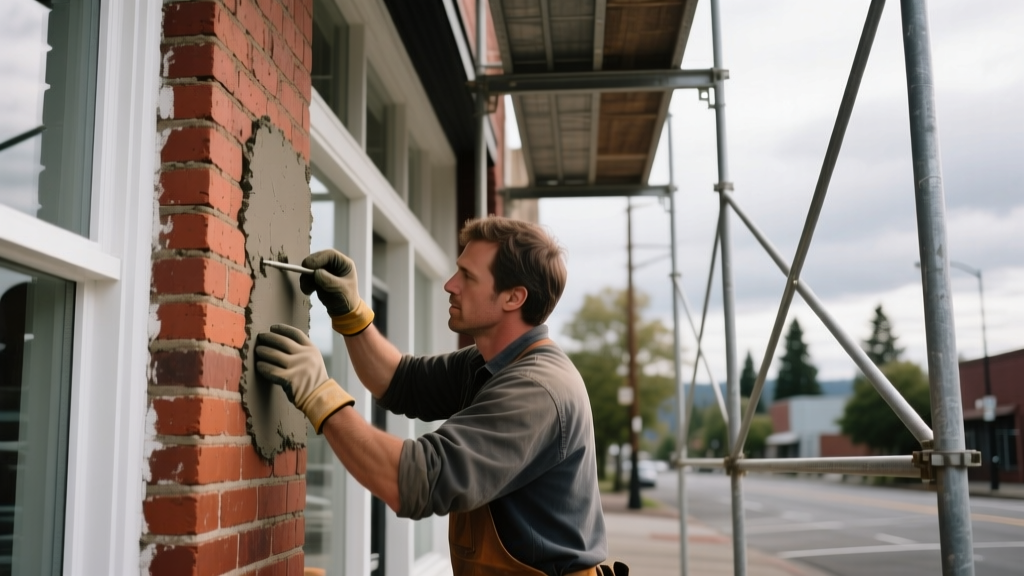
Diagnostic Matrix: Identifying Storefront Brick Failures
Before any tuckpointing or brick replacement begins, a thorough diagnostic assessment is mandatory. The following matrix outlines common failure modes specific to PNW retail facades and their underlying causes.
| Symptom | Primary Cause | Required Intervention |
|---|---|---|
| Efflorescence (white powdery deposits) | Water migrating through the wall, dissolving soluble salts, and evaporating on the surface. | Identify water entry point; apply penetrating silane/siloxane sealer after masonry dries. |
| Spalling (flaking or peeling brick face) | Freeze-thaw expansion combined with the use of impermeable acrylic sealers or hard mortar. | Replace individual spalled bricks; remove film-forming sealers; repoint with Type N or O mortar. |
| Mortar Erosion (recessed joints) | Decades of wind-driven rain and acidic pollutants degrading the lime matrix in historic mortars. | Rake joints to 2.5x the joint width and tuckpoint with ASTM C270 compliant mortar. |
| Biological Growth (moss, algae, lichen) | Prolonged shade and high humidity typical of Beaverton's winter months. | Low-pressure chemical wash using D/2 Biological Solution; improve site drainage and sunlight exposure. |
| Step Cracking (stair-step fissures) | Differential settlement or thermal expansion without adequate control joints. | Install helical ties; repoint cracks with flexible polyurethane masonry sealant; consult structural engineer. |
Mortar Selection: Why Harder Isn't Better
A critical mistake in commercial brick repair is specifying a mortar that is harder and less permeable than the brick itself. For mid-century and older retail buildings in Beaverton, the clay bricks are relatively soft and porous. If a mason uses a high-strength Type S or Type M mortar (rich in Portland cement), the mortar will not absorb the thermal expansion and moisture movement of the wall. Instead, the rigid mortar forces the softer brick to absorb the stress, causing the brick faces to spall and crack during freeze-thaw events.
ASTM C270 Mortar Proportions (by Volume)
- Type O (Low Compressive Strength): 1 part Portland cement, 2 parts hydrated lime, 9 parts sand. Ideal for historic, soft clay bricks and interior/non-load-bearing repairs.
- Type N (Medium Compressive Strength): 1 part Portland cement, 1 part hydrated lime, 6 parts sand. The standard for most modern exterior brick veneers and commercial storefronts in the PNW.
- Type S (High Compressive Strength): 1 part Portland cement, 0.5 parts lime, 4.5 parts sand. Avoid on standard brick veneers; reserve for below-grade foundations or structural reinforced masonry.
For detailed specifications on mortar selection and mixing protocols, refer to the Brick Industry Association (BIA) Technical Note 8.
The Tuckpointing Protocol for Retail Facades
Proper tuckpointing is a meticulous process that restores the weather-tight seal of the masonry wall. For a busy storefront, this work must be executed with minimal disruption to retail operations while adhering to strict quality standards.
- Mortar Removal: Use a diamond-tipped masonry blade to carefully cut the center of the deteriorated mortar joint. Follow up with hand chisels to remove the remaining mortar to a depth of 2 to 2.5 times the joint width (typically 3/4 to 1 inch deep). Never use an angle grinder on the edges of the brick, as this will scar the historic fire skin.
- Joint Preparation: Flush the raked joints with clean, low-pressure water to remove dust and debris. The bricks must be damp (saturated surface dry) before applying new mortar to prevent the dry brick from sucking the moisture out of the fresh mortar, which weakens the cure.
- Application: Pack the mortar into the joint in 1/4-inch layers using a pointing trowel and jointer. Compact each layer firmly to eliminate air pockets and ensure a strong bond with the existing masonry.
- Tooling: Tool the joint to a concave or 'V' profile once the mortar has set sufficiently (usually 30 to 60 minutes, depending on humidity). A concave profile sheds water away from the horizontal bed joints, a crucial detail for Beaverton's heavy rainfalls.
Many commercial property managers attempt to clean brick facades using high-pressure water (>1,500 PSI). This destroys the brick's protective glaze and forces water deep into the cavity wall. According to BIA Technical Note 20 on Cleaning Brickwork, water pressure should never exceed 600 PSI, and chemical cleaners should be used to do the heavy lifting, not mechanical force.
2026 Cost Estimates for Beaverton Commercial Masonry Repair
Budgeting for commercial masonry maintenance requires an understanding of current Pacific Northwest labor rates and material logistics. The following table outlines the 2026 pricing landscape for commercial brick repair in the Beaverton area.
| Service Category | Unit of Measure | 2026 Estimated Cost Range |
|---|---|---|
| Diagnostic & Moisture Mapping | Per Facade | $450 - $850 |
| Mortar Raking & Tuckpointing | Per Linear Foot | $18 - $28 |
| Individual Brick Replacement | Per Brick | $45 - $75 |
| Chemical Cleaning (D/2 Solution) | Per Square Foot | $2.50 - $4.00 |
| Silane/Siloxane Sealer Application | Per Square Foot | $3.00 - $5.50 |
| Scaffolding / Boom Lift Rental | Per Day | $800 - $1,400 |
Note: Costs assume standard commercial accessibility. Facades requiring complex rigging, sidewalk closures, or historic preservation board approvals will incur premium labor rates.
Long-Term Sealant Strategies: Silane vs. Acrylic
Once the masonry is repaired and cleaned, applying a water repellent is critical for extending the lifespan of the facade in Oregon's wet climate. However, the type of sealer dictates the success of the treatment.
Why Film-Forming Sealers Fail
Acrylic and urethane-based sealers create a plastic-like film on the surface of the brick. While they initially repel water, they also trap water vapor inside the masonry. When Beaverton's temperatures drop below freezing, the trapped moisture expands, causing the brick face to pop off (spalling). The Portland Cement Association explicitly warns against using non-breathable coatings on exterior masonry.
The Solution: Penetrating Silane/Siloxane
For commercial storefronts, specify a penetrating silane or siloxane water repellent (such as PROSOCO Siloxane PD or MasonrySavers Vertical Seal). These chemicals react with the silica in the brick and mortar to form a hydrophobic resin within the pores. This blocks liquid water from entering while allowing water vapor to escape. A high-quality siloxane treatment will protect a retail facade for 7 to 10 years, significantly reducing the frequency of costly tuckpointing and efflorescence removal.
'The longevity of a commercial brick facade is not determined by the brick itself, but by the permeability of the mortar and the breathability of the sealants used to protect it.' — Masonry Conservation Guild
Summary: Protecting Retail Investments
Maintaining the masonry on a prominent retail space requires a proactive, scientifically grounded approach. By diagnosing moisture issues early, specifying ASTM-compliant Type N or Type O mortars, avoiding high-pressure cleaning, and utilizing breathable siloxane sealants, property managers can preserve the structural integrity and aesthetic appeal of their buildings. Whether managing the Bricks and Minifigs Beaverton OR location or any other commercial brick facade in the Pacific Northwest, adhering to these strict masonry conservation protocols ensures the building remains safe, dry, and visually striking for decades to come.
Written by
David NakamuraDavid Nakamura is a licensed architect (AIA) and construction technology writer focused on sustainable building methods, mass timber engineering, and high-performance building envelopes. He holds a Master of Architecture from the University of Washington and is a certified Passive House Consultant (CPHC). David spent eight years at the Seattle firm Mithun, where he led the design of three LEED Platinum projects, before founding his own practice specializing in net-zero residential design. He serves on the editorial advisory board of GreenBuilder Magazine and has authored peer-reviewed papers on cross-laminated timber (CLT) connections for the Journal of Structural Engineering. In his spare time, David teaches woodworking at Pratt Fine Arts Center and kayaks the Puget Sound.
More from David Nakamura
View all
Construction Cost
Labor Cost to Build a Deck Per Sq Ft: 2026 Installation Guide
Discover the exact labor cost to build a deck per sq ft in 2026. This installation guide breaks down contractor rates, complexity factors, and hidden fees.
Aug 4, 2026

Construction Cost
How Much Does It Cost to Build a 3 Bedroom House? Financing Guide
Learn exactly how much it costs to build a 3 bedroom house and explore 2026 financing options, construction loan types, and budget frameworks for your build.
Aug 4, 2026

Construction Cost
Cost to Build a Tennis Court: 2026 Guide
How much does it cost to build a tennis court in 2026? Breakdowns for asphalt, concrete, and synthetic surfaces plus fencing and lighting.
Jul 30, 2026