Artificial Stone Veneer vs Natural Stone: 2026 Comparison Review
Compare artificial stone veneer and natural stone for 2026 projects. Analyze costs, weight, installation, and long-term durability.

The Core Debate: Manufactured vs. Quarried Cladding
The specification of exterior and interior cladding often narrows down to a choice between quarried natural stone and artificial stone veneer (ASV). Historically dismissed as a budget alternative, modern ASV has evolved into a high-performance architectural product. In 2026, advancements in polyurethane mold-casting and iron-oxide pigment stabilization have narrowed the visual gap between manufactured and natural products. However, the physical properties, structural requirements, and moisture management protocols for these two materials diverge significantly. This review dissects the technical specifications, installation realities, and lifecycle costs to provide a definitive framework for builders and architects.
Material Composition and Manufacturing Tolerances
Artificial stone veneer is fundamentally a specialized concrete product. High-quality ASV (such as lines from Cultured Stone, Eldorado, and Dutch Quality Stone) is manufactured using a precise blend of Portland cement, lightweight aggregates like pumice or expanded shale, and iron-oxide pigments. The mixture is poured into molds cast directly from natural stone, then baked to cure.
Natural stone veneer, conversely, is sliced or split directly from quarried rock—such as limestone, slate, fieldstone, or granite. While natural stone offers unmatched geological variation and mineral depth, its density and irregularity introduce structural and logistical challenges that ASV is specifically engineered to bypass.
Head-to-Head Specification Matrix
| Feature | Artificial Stone Veneer (ASV) | Natural Stone Veneer |
|---|---|---|
| Weight | 10 – 14 lbs / sq. ft. | 25 – 40+ lbs / sq. ft. |
| Average Thickness | 1.5 to 2.5 inches | 2.0 to 4.5 inches |
| Material Cost (2026) | $8.50 – $15.00 / sq. ft. | $16.00 – $38.00 / sq. ft. |
| Installed Cost | $19.00 – $28.00 / sq. ft. | $35.00 – $60.00 / sq. ft. |
| Structural Footing | Not required (can hang from wall sheathing) | Required for most applications (brick ledge) |
| ASTM Standard | ASTM C1670 | ASTM C616 / C568 (varies by rock type) |
| Freeze-Thaw Durability | High (when properly sealed and drained) | Variable (porous stones like sandstone can spall) |
2026 Cost Analysis: Material and Installed Pricing
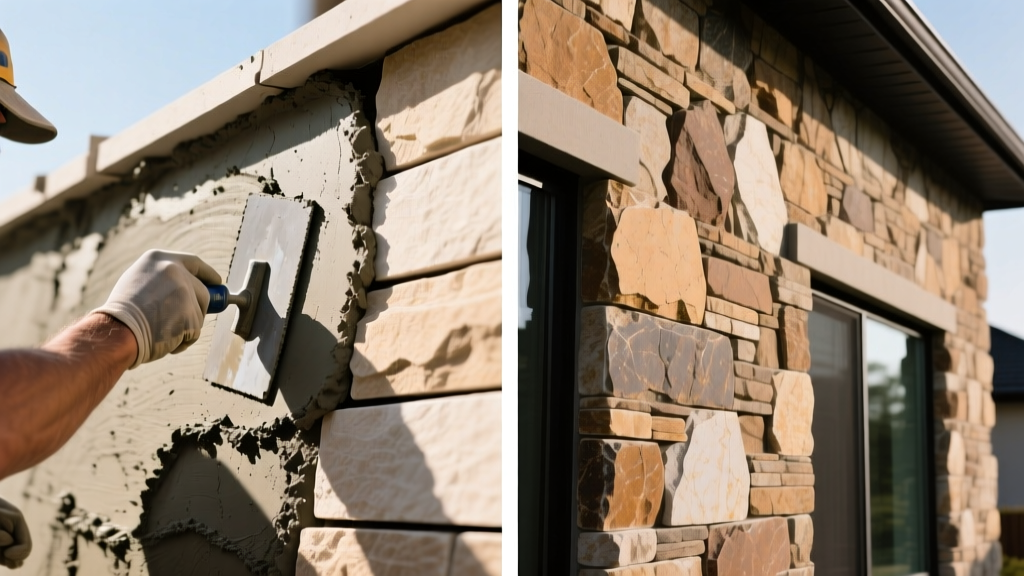
When evaluating project budgets, the divergence in labor costs often eclipses the material savings. Natural stone requires heavy-duty structural support, specialized masonry saws for cutting dense rock, and higher physical labor exertion. ASV can be cut with standard carbide-tipped blades and is significantly lighter to hoist and position.
- ASV Total Installed Cost: Expect to pay between $19.00 and $28.00 per square foot for premium manufactured stone, including weather-resistive barriers (WRB), metal lath, scratch coat, and Type S mortar.
- Natural Stone Total Installed Cost: Budget $35.00 to $60.00 per square foot. High-end granites or custom-cut ashlar limestone will push this figure well past $75.00 per square foot due to the need for structural brick ledges and slower installation times.
If your architectural plans do not include a poured concrete or reinforced block brick ledge, retrofitting one to support natural stone can add $4,000 to $8,000 to a standard residential foundation budget. ASV eliminates this requirement entirely, as its lightweight nature allows it to be anchored directly to properly prepared wood or steel stud framing.
Installation Realities and Critical Failure Modes
The most common point of failure for both ASV and natural stone is not the stone itself, but the moisture management system behind it. According to defect reports analyzed by the International Association of Certified Home Inspectors (InterNACHI), water intrusion behind stone veneer is a leading cause of catastrophic sheathing rot in modern construction.
The Moisture Trap: Efflorescence and Sheathing Rot
Because ASV is a cementitious product, it is inherently porous. If moisture becomes trapped behind the veneer, it migrates through the stone, carrying soluble salts to the surface. This results in efflorescence—a white, powdery residue that degrades the aesthetic. More critically, trapped moisture rots the OSB or plywood sheathing behind the lath.
The Expert Fix: Never install ASV directly over building paper or bare house wrap. You must incorporate a capillary break and drainage plane. Specify a dimpled drainage mat (such as Mortairvent or Keene DriWall) between the WRB and the metal lath. This creates a 1/4-inch air gap that allows hydrostatic pressure to drain downward to the weep screed, completely eliminating the moisture trap.
Flashing and Kick-Out Deficiencies
Where a stone veneer wall meets a roofline, standard step flashing is insufficient. Builders must install a kick-out flashing diverter to push water away from the cladding and into the gutter. Omitting this $15 piece of metal is the single most frequent cause of localized wall failure in stone veneer installations.
Decision Framework: When to Specify ASV vs. Natural
Use this field-tested framework to determine the correct specification for your project parameters:
Specify Artificial Stone Veneer (ASV) when:
- Weight restrictions apply: Multi-story wood-frame construction, interior feature walls, or existing foundations lacking a brick ledge.
- Budget is constrained: You need the aesthetic of high-end fieldstone or limestone but must keep cladding costs under $30 per installed square foot.
- Timeline is aggressive: ASV installs 30% to 40% faster than natural stone due to uniform thickness and lighter weight, accelerating the dry-in schedule.
Specify Natural Stone when:
- Geological authenticity is paramount: High-end luxury builds where clients demand the unique mineral veining, fossil inclusions, and tactile temperature variations of real quarried rock.
- The application is high-impact: Wainscoting in commercial corridors, retaining wall caps, or areas subject to heavy mechanical abrasion where the through-body density of natural granite or quartzite is required.
- Historical preservation is required: Restoring heritage properties where local zoning or historical societies mandate the use of indigenous, locally quarried materials.
Industry Standards and Code Compliance
When specifying artificial stone veneer, ensure the product complies with ASTM C1670, the standard specification for Manufactured Stone Masonry Veneer. This standard dictates rigorous testing for freeze-thaw resistance, flexural strength, and water absorption limits. Products meeting this standard are recognized by the International Building Code (IBC) as legitimate masonry veneers.
Furthermore, always reference the Masonry Veneer Manufacturers Association (MVMA) installation guidelines. The MVMA provides the definitive code-recognized details for weep screed placement, control joint spacing, and mortar mix ratios (always use Type S mortar for exterior ASV applications to ensure adequate bond strength and flexibility).
By prioritizing drainage planes, adhering to ASTM material standards, and selecting the cladding based on structural reality rather than just visual preference, builders can guarantee a stone facade that performs flawlessly for decades.
Written by
Priya KapoorPriya Kapoor is a real estate market analyst and construction economics researcher with expertise in housing affordability, development feasibility, and infrastructure investment. She holds a Master of Regional Planning from Cornell University and previously worked as a senior analyst at CBRE's Investment Properties group, where she modeled returns for $4B in mixed-use development pipelines. Priya now runs an independent research practice advising developers, municipalities, and REITs on construction cost forecasting and market timing. She publishes the quarterly "BuildMat Market Pulse" report tracking material price indices across 12 commodity categories. Based in Austin, TX, Priya serves on the board of Habitat for Humanity Austin and is a marathon runner.
More from Priya Kapoor
View all
Construction Cost
Cost to Build a 1600 Sq Ft Home in 2026: Full Breakdown
Accurate 2026 cost to build a 1600 sq ft home—material, labor, and regional pricing breakdowns included. Plan your budget with real-time estimates.
Aug 11, 2026

Wood & Lumber
Name the Types of Wood for Pressure Treatment and Preservation
Learn how to name the types of wood best suited for pressure treatment. Compare species treatability, chemical retention levels, and 2026 preservation costs.
Aug 4, 2026

Stone & Masonry
Stone Veneer Suppliers Lindenhurst: 2026 Cost Analysis
Analyze 2026 stone veneer costs in Lindenhurst, NY. Compare local supplier pricing, delivery fees, and Suffolk County installation labor rates.
Aug 4, 2026