Evolve Stone & National True Stone Veneer Non-Rated Reviews
Deep technical analysis of Evolve Stone non-rated mortarless veneer. Explore specs, installation tolerances, and real-world contractor reviews.

When analyzing search trends and contractor feedback, the aggregate data from Evolve Stone, National, True Stone veneer non-rated reviews highlights a fundamental split in the manufactured veneer market. Traditional Portland cement-based systems (like those offered by National and True Stone profiles) compete directly with advanced polymer composites (like Evolve Stone) for dominance in residential and light-commercial applications. While traditional masonry relies on weight, mortar adhesion, and lath, mortarless polymer systems rely on mechanical fastening, interlocking joinery, and precise thermal expansion management.
This technical review dissects the material science, dimensional tolerances, and field-performance data of non-rated mortarless polymer veneer assemblies, providing contractors and architects with the exact specifications required for code-compliant, durable installations.
Material Composition: High-Density Polyurethane vs. Portland Cement
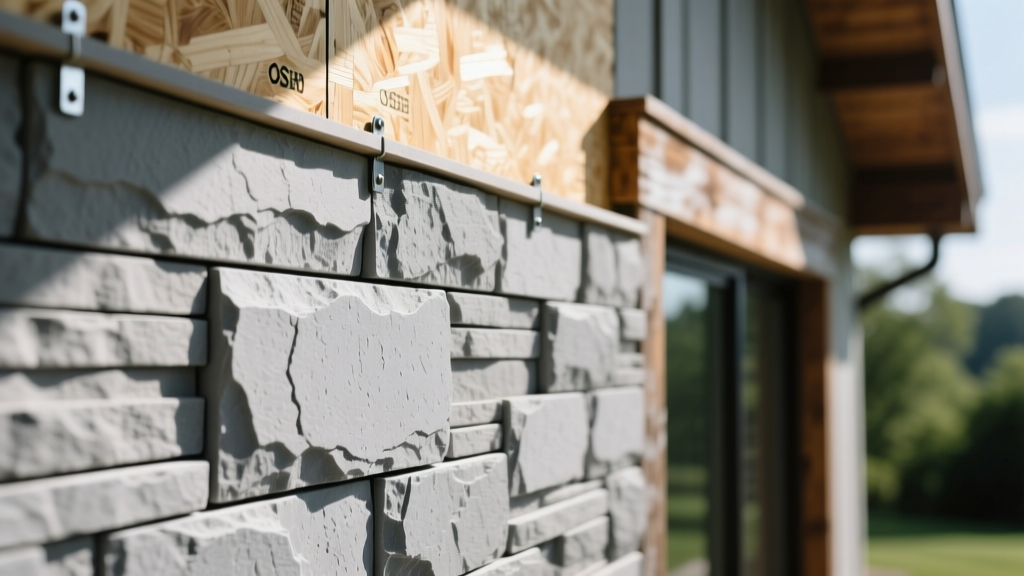
Evolve Stone and similar mortarless systems utilize a High-Density Polyurethane (HDPU) or advanced fiber-reinforced polymer matrix. Unlike traditional manufactured stone veneer (AMSV), which is a cast concrete product weighing between 10 and 14 pounds per square foot, HDPU veneer typically weighs between 1.2 and 1.5 pounds per square foot. This 90% reduction in dead load eliminates the need for structural reinforcement, masonry ties, or specialized footings in most Type V (wood-frame) residential construction.
The polymer is cast in molds taken from natural stone, then coated with a multi-stage acrylic-polyurethane UV-resistant topcoat. According to the ICC-ES Acceptance Criteria (AC380) for polyurethane exterior and interior decorative products, these materials must pass rigorous accelerated weathering, freeze-thaw, and flame-spread tests to be recognized for use in IBC-compliant assemblies.
Technical Callout: The 'Non-Rated' Assembly Distinction
In building code terminology, a 'non-rated' veneer assembly indicates that the product is not being used to contribute to a 1-hour or 2-hour fire-resistance-rated wall assembly (such as a firewall or egress corridor). Non-rated Evolve Stone assemblies are approved for standard exterior cladding and interior feature walls where the International Building Code (IBC) Section 1405 does not mandate a specific fire-resistance rating for the exterior wall covering. For commercial shaft walls or multi-family separation walls, contractors must specify the manufacturer's explicitly fire-rated assemblies, which include specific intumescent backings or gypsum board layers.
Dimensional Tolerances & Weight Specifications
Understanding the physical footprint of the material is critical for calculating dead loads and planning substrate sheathing. The following matrix compares the baseline specifications of mortarless polymer veneer against traditional AMSV.
| Parameter | Mortarless Polymer (Evolve Stone) | Traditional AMSV (National/True Stone) |
|---|---|---|
| Average Weight | 1.2 - 1.5 lbs / sq. ft. | 10.0 - 14.0 lbs / sq. ft. |
| Profile Thickness | 1.0' - 2.5' (Interlocking) | 2.0' - 4.0' (Variable) |
| Attachment Method | Mechanical Fasteners (Screws/Nails) | Type S Mortar + Metal Lath |
| Water Absorption | < 1% (Closed-cell polymer) | Up to 12% (Requires sealing) |
Substrate Requirements & Fastener Matrix
Because mortarless veneer relies entirely on mechanical fasteners, the substrate's shear strength and the fastener's withdrawal resistance are the primary failure points. Standard drywall screws are strictly prohibited for exterior applications due to poor shear strength and rapid corrosion. Contractors must utilize exterior-grade, polymer-coated or stainless-steel bugle-head screws.
Approved Substrate Matrix
- OSB / Plywood Sheathing: Minimum 7/16' thickness. Fasteners must be 1-1/4' to 1-5/8' exterior-grade screws. Refer to the APA - The Engineered Wood Association guidelines for fastener spacing on structural panels.
- Exterior Gypsum / Fiber-Cement: Minimum 1/2' thickness. Fasteners must penetrate the underlying wood or steel studs by at least 1'. Do not rely on the gypsum board for holding power.
- Interior Drywall: Minimum 1/2' thickness. Fasteners must hit the center of the wood or metal studs every 16' or 24' on center. Use 1-5/8' fine-thread drywall screws for interior-only, non-moisture environments.
Synthesizing Field Reviews: Thermal Expansion & UV Stability
The most common negative reviews for polymer-based veneers stem from improper management of thermal expansion. Unlike concrete, which has a relatively low Coefficient of Linear Thermal Expansion (CLTE), polyurethane and PVC-based materials expand and contract significantly with temperature fluctuations.
The CLTE for high-density polyurethane is approximately $3.0 \times 10^{-5}$ in/in/°F. To put this in practical terms: a 12-foot continuous run of mortarless stone veneer installed at 40°F will expand by roughly 0.25 inches when summer temperatures reach 100°F. If a contractor butts the panels tightly against corner trim, window casings, or each other without leaving the manufacturer-specified 1/8' expansion gap, the panels will buckle, warp, or pull the fasteners through the flanges.
UV Degradation and Color Fastness
Early generations of synthetic stone suffered from chalking and UV degradation. Modern iterations utilize advanced acrylic-polyurethane topcoats tested under ASTM G154 standards for fluorescent UV exposure. Field reviews from installations in high-UV environments (such as the American Southwest) indicate that premium polymer veneers maintain color integrity for 15 to 20 years before a 5% Delta-E color shift is measurable. However, contractors note that cutting the panels on-site exposes the uncoated polymer core. These cut edges must be meticulously touched up with the manufacturer's provided color-matched acrylic paint to prevent moisture ingress and UV breakdown at the joint lines.
Cost Analysis & Labor ROI
Evaluating the true cost of non-rated veneer requires separating material costs from installed costs. While traditional manufactured stone is cheaper per square foot at the lumberyard, the labor dynamics completely invert the ROI.
| Cost Factor | Mortarless Polymer System | Traditional AMSV System |
|---|---|---|
| Material Cost | $12.00 - $16.00 / sq. ft. | $6.00 - $9.00 / sq. ft. |
| Substrate Prep (Lath/Scratch) | $0.00 (Direct to sheathing) | $2.50 - $4.00 / sq. ft. |
| Installation Labor Rate | Carpenter / Handyman ($45-$65/hr) | Mason ($75-$120/hr) |
| Installation Speed | 40 - 60 sq. ft. / man-hour | 8 - 12 sq. ft. / man-hour |
| Total Installed Cost | $16.00 - $22.00 / sq. ft. | $24.00 - $38.00 / sq. ft. |
For general contractors managing tight schedules, the elimination of the masonry trade, the curing time for scratch coats, and the weather-dependency of mortar mixing makes the polymer system highly cost-effective on projects under 500 square feet.
Final Technical Verdict
Non-rated mortarless polymer veneer represents a highly engineered solution for residential cladding and interior accent walls where structural dead-load limits and labor availability are primary constraints. By adhering strictly to the IBC Chapter 14 guidelines for exterior veneer attachment, utilizing exterior-grade fasteners, and mathematically accounting for thermal expansion gaps, builders can achieve a zero-maintenance, high-fidelity stone aesthetic. However, for high-impact commercial zones, below-grade applications, or fire-rated separation walls, traditional Portland cement-based systems remain the mandatory specification.
Written by
Sarah WhitfieldSarah Whitfield is a chartered quantity surveyor (MRICS) and construction cost analyst with 15 years of experience in material pricing, procurement strategy, and project budgeting. She earned her degree in Construction Management from the University of Reading (UK) and has worked on projects ranging from $2M custom homes to $180M mixed-use developments across North America and Europe. Sarah currently leads cost estimating for BuildMat Insight, maintaining a proprietary database of 4,000+ material price points updated quarterly. She is a frequent contributor to RSMeans cost data panels and has presented at the International Cost Engineering Council (ICEC) congress. Based in Denver, CO, Sarah is an avid trail runner and volunteer mentor for Women in Construction.
More from Sarah Whitfield
View all
Wood & Lumber
What Are the Different Types of Wood? A Builder's Guide
Compare structural softwoods, finish hardwoods, and engineered lumber. Analyze Janka ratings, MOE values, and 2026 pricing for construction.
Aug 4, 2026

Walls & Panels
Steel Framing vs Wood Framing: Corrosion and Moisture Defense
Compare steel framing vs wood framing for moisture resistance. Learn about galvanized coatings, condensation risks, and corrosion protection strategies.
Jul 21, 2026

Stone & Masonry
How to Cut Stone Veneer: Wet Saw vs Grinder Comparison
Compare the best tools for cutting stone veneer. We review wet saws, angle grinders, and chop saws to help you achieve clean, chip-free cuts.
Jul 21, 2026