Best Stone Veneer for Fireplace: 2026 Cost & Buyer Guide
Compare the best stone veneer for fireplace projects in 2026. Detailed cost analysis, material breakdowns, and installation pricing per square foot.

The True Cost of Fireplace Stone Veneer in 2026
Upgrading a builder-grade brick or drywall fireplace surround with stone veneer remains one of the highest-ROI interior renovations. However, pricing varies wildly based on material composition, profile depth, and installation methodology. When calculating the budget for the best stone veneer for fireplace applications, homeowners must look beyond the per-square-foot material cost and account for substrate preparation, corner pieces, and specialized mortars.
In 2026, the national average for a complete professional stone veneer fireplace installation ranges from $32 to $58 per square foot. For a standard 50-square-foot fireplace face, expect total project costs between $1,600 and $2,900. Below is a granular breakdown of material costs before labor.
| Material Type | Avg. Material Cost (per Sq. Ft.) | Weight (per Sq. Ft.) | Heat Tolerance |
|---|---|---|---|
| Manufactured Stone Veneer (MSV) | $8.50 - $14.00 | 10 - 12 lbs | Non-combustible (ASTM E136) |
| Natural Thin Stone Veneer | $15.00 - $28.00 | 13 - 16 lbs | Non-combustible |
| Mortarless Interlocking Panels | $10.00 - $15.00 | 4 - 6 lbs | Varies (Check Adhesive Specs) |
Top Rated Stone Veneer Brands for Fireplaces
Not all manufactured stone is created equal. The best stone veneer for fireplace surrounds requires high-density concrete mixes that resist chipping during cutting and maintain color consistency through the entire thickness of the stone. Here are the top-performing product lines for 2026:
1. Eldorado Stone: Canyon Ridge & Fieldstone Profiles
Eldorado Stone remains the industry benchmark for architectural realism. Their Canyon Ridge profile mimics hand-laid limestone and sandstone, offering a dry-stack look without the deep shadow lines that collect soot and dust near a firebox. Material costs hover around $11.50 per square foot. Eldorado's color application uses iron-oxide pigments that are baked into the concrete matrix, ensuring that if a stone chips during installation, the underlying color matches the surface.
2. Cultured Stone: Dressed Fieldstone
A subsidiary of Boral, Cultured Stone offers the Dressed Fieldstone profile, which provides a more formal, tailored aesthetic compared to rugged ledgestones. Priced at approximately $12.50 per square foot, it is slightly heavier than Eldorado's offerings but features exceptional dimensional consistency, which reduces installation time and mortar waste. According to Eldorado Stone official installation guidelines and similar manufacturer specs, maintaining a 1/2-inch mortar joint is critical for these specific profiles to prevent efflorescence.
3. Real Stone Thin Veneer: Oklahoma Ledgestone (Natural)
For projects demanding authentic natural stone, Real Stone Thin Veneer offers genuine quarried stone sliced to a 1-inch thickness. The Oklahoma Ledgestone provides striking bands of rust, cream, and gray. At $18.00 to $22.00 per square foot, it is a premium investment. Natural stone requires a penetrating sealer (like Miracle Sealants 511 Impregnator) when used near wood-burning fireboxes to prevent soot from permanently staining the porous rock.
Installation Costs: Mortared vs. Mortarless Systems
Labor accounts for 50% to 65% of the total project cost. Professional masons typically charge between $14 and $22 per square foot for labor, but the chosen installation system drastically alters this baseline.
Traditional Mortared Installation
The gold standard for permanence. This requires applying a moisture barrier (if exterior, though rare for fireplaces), followed by 2.5 lb self-furring galvanized diamond mesh lath. A 1/2-inch scratch coat of Type S mortar is applied and scored, then left to cure for 24 to 48 hours. Finally, the stones are set using a polymer-modified veneer mortar like SPEC MIX ProMix. This method ensures a mechanical bond that will outlast the home itself. Professional labor for this multi-day process averages $18 per square foot.
Mortarless and Thin-Set Systems
Brands like AirStone or GenStone offer interlocking, mortarless systems designed for DIY installation. These adhere directly to rigid substrates using specialized construction adhesives (like Loctite PL Premium). While material costs are comparable to mid-tier MSV ($11 per square foot), you eliminate the $18 per square foot masonry labor cost. However, mortarless systems are generally limited to interior, non-high-heat applications. If you are cladding the immediate surround of a high-BTU gas insert or a wood-burning stove, traditional mortared installation is mandatory to prevent adhesive degradation from thermal cycling.
Hidden Costs: Corners, Prep, and Sealing
The most common budgeting error in fireplace veneer projects is miscalculating corner pieces and substrate preparation. Understanding these hidden costs is vital for an accurate 2026 budget.
- Corner Pieces (The Linear Foot Trap): Flat stone panels are sold by the square foot, but outside corners are sold by the linear foot. A standard 8-foot-tall fireplace with two outside corners requires 16 linear feet of corner pieces. Corner pieces typically cost 30% to 50% more per linear foot than flat pieces cost per square foot (averaging $14 to $20 per linear foot). Expect to add $225 to $320 to your material budget strictly for corners.
- Demolition and Substrate Prep: Removing existing builder-grade ceramic tile or painted brick costs $2.50 to $4.00 per square foot. If the existing brick is unpainted and in good condition, it can serve as a substrate, but it must be scarified and coated with a bonding agent before applying the scratch coat.
- Mantel Integration: If you are installing a new floating wood mantel, it must be anchored to the structural studs using lag screws before the stone veneer is laid. Retrofitting a mantel after the stone is installed requires cutting the veneer, which risks cracking the surrounding mortar joints.
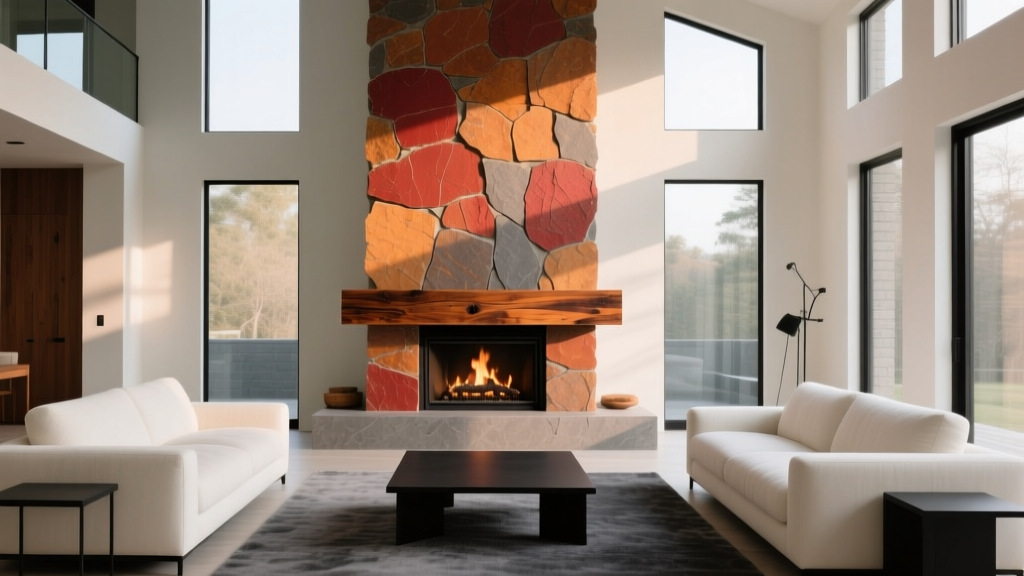
Natural vs. Manufactured: Decision Matrix
Choosing the best stone veneer for fireplace applications ultimately depends on your budget, structural constraints, and aesthetic demands. Use this framework to finalize your material selection:
Choose Manufactured Stone Veneer (MSV) if:
- Your budget is strictly between $30 and $45 per square foot (installed).
- You require a specific, uniform color palette that natural stone cannot guarantee.
- The existing fireplace framing cannot support the extra 4-6 lbs per square foot of natural stone weight (though most standard 2x4 framing can handle both).
Choose Natural Thin Stone Veneer if:
- You are building a custom luxury home where authentic material provenance adds to the appraisal value.
- You prefer the chaotic, unrepeatable color variations of real quarried limestone, slate, or granite.
- Your budget allows for $55+ per square foot (installed), including the cost of premium penetrating sealers.
Choose Mortarless Systems if:
- You are executing a DIY weekend remodel and lack masonry experience.
- The fireplace is purely decorative or uses a low-heat electric insert where thermal degradation of adhesives is not a concern.
- You need to minimize dust and mess in a finished living space, as mortarless systems eliminate the need for mixing and cutting wet mortar.
By accurately forecasting material weights, linear corner costs, and strict adherence to masonry prep standards, you can ensure your fireplace renovation delivers both immediate visual impact and long-term structural integrity. Always cross-reference your specific firebox insert manual for required clearances to combustible materials before finalizing your mantel and veneer layout.
Written by
Sarah WhitfieldSarah Whitfield is a chartered quantity surveyor (MRICS) and construction cost analyst with 15 years of experience in material pricing, procurement strategy, and project budgeting. She earned her degree in Construction Management from the University of Reading (UK) and has worked on projects ranging from $2M custom homes to $180M mixed-use developments across North America and Europe. Sarah currently leads cost estimating for BuildMat Insight, maintaining a proprietary database of 4,000+ material price points updated quarterly. She is a frequent contributor to RSMeans cost data panels and has presented at the International Cost Engineering Council (ICEC) congress. Based in Denver, CO, Sarah is an avid trail runner and volunteer mentor for Women in Construction.
More from Sarah Whitfield
View all
Wood & Lumber
What Are the Different Types of Wood? A Builder's Guide
Compare structural softwoods, finish hardwoods, and engineered lumber. Analyze Janka ratings, MOE values, and 2026 pricing for construction.
Aug 4, 2026

Walls & Panels
Steel Framing vs Wood Framing: Corrosion and Moisture Defense
Compare steel framing vs wood framing for moisture resistance. Learn about galvanized coatings, condensation risks, and corrosion protection strategies.
Jul 21, 2026

Stone & Masonry
How to Cut Stone Veneer: Wet Saw vs Grinder Comparison
Compare the best tools for cutting stone veneer. We review wet saws, angle grinders, and chop saws to help you achieve clean, chip-free cuts.
Jul 21, 2026