Adorn Stone Veneer Review: How It Compares to GenStone & AirStone
Is Adorn stone veneer the best mortarless cladding? We compare Adorn vs. GenStone and AirStone on cost, weight, installation, and moisture risks.
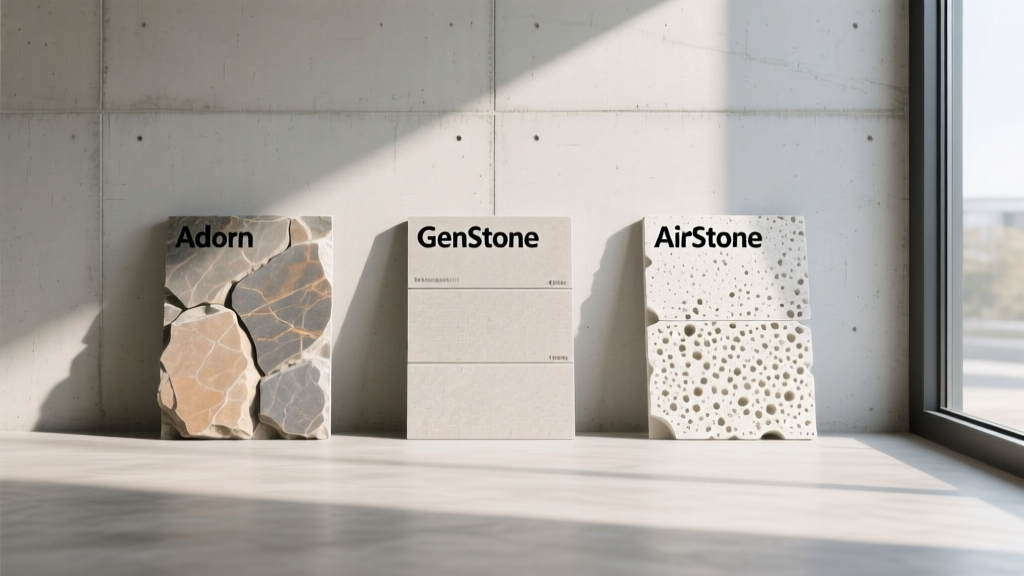
The Mortarless Stone Veneer Landscape
Mortarless stone veneer has disrupted the exterior and interior cladding market by eliminating the need for specialized masons, metal lath, and scratch coats. Among the leading contenders, Adorn stone veneer (manufactured by Westlake Royal Building Products) positions itself as a premium, mineral-based interlocking system. But how does it actually perform against high-density polyurethane (HDPU) alternatives like GenStone or adhesive-reliant systems like AirStone?
This comparison review breaks down the material science, installation realities, and 2026 pricing structures to help contractors and DIYers choose the right system for their specific substrate and climate zone.
Comparison Matrix: Adorn vs. The Competition
Before diving into the nuances of installation, it is critical to understand the fundamental material differences. Adorn is a mineral composite, whereas GenStone is a synthetic foam, and AirStone relies on recycled aggregates without interlocking mechanics.
| Feature | Adorn Stone Veneer | GenStone | AirStone | Traditional Natural Stone |
|---|---|---|---|---|
| Material Base | Mineral/Concrete Composite | High-Density Polyurethane | Recycled Mineral Aggregate | Quarried Natural Stone |
| Weight (per sq. ft.) | ~5.5 to 6.0 lbs | ~1.0 to 1.2 lbs | ~4.5 lbs | 10.0 to 15.0+ lbs |
| Interlocking Mechanism | Yes (Tongue-and-Groove/Shiplap) | Yes (Shiplap edges) | No (Individual pieces) | No (Mortar bed) |
| Cutting Tool Required | Wet masonry saw / Angle grinder | Standard wood saw / Jigsaw | Wet masonry saw / Grinder | Masonry saw / Chisel |
| Avg. Material Cost (2026) | $9.50 - $11.50 / sq. ft. | $10.00 - $12.50 / sq. ft. | $8.00 - $10.00 / sq. ft. | $14.00 - $25.00 / sq. ft. |
Deep Dive: Adorn Stone Veneer Performance
Material Composition and Impact Resistance
Unlike polyurethane panels that can dent upon heavy impact, Adorn's mineral composite core provides a rigid, rock-like surface. This makes it highly suitable for high-traffic interior areas (like wainscoting in commercial hallways) or exterior wainscots where landscaping equipment might strike the wall. However, this density means a standard 2-square-foot Adorn panel weighs roughly 11.5 pounds. A box of 10 panels (20 sq. ft.) weighs over 115 pounds, requiring careful staging and lifting protocols on the job site.
The Interlocking Advantage
Adorn panels feature a precision-molded shiplap edge. This interlocking profile serves two vital functions: it hides the fastener heads of the row below, and it creates a labyrinth seal that significantly reduces wind-driven rain penetration compared to flat-backed systems. According to building enclosure experts at Building Science Corporation, managing bulk water through layered, lapped joints is a fundamental requirement for durable exterior cladding, and Adorn's profile mimics traditional lapped siding principles.
Head-to-Head Matchups
Adorn vs. GenStone: Mineral vs. Polyurethane
The choice between Adorn and GenStone usually comes down to substrate capacity and cutting logistics. GenStone weighs virtually nothing (1 lb/sq ft) and can be cut with a standard circular saw, generating no silica dust. This makes GenStone the undisputed king of quick interior TV-wall makeovers and DIY projects where wet saws are prohibited.
However, Adorn wins on thermal mass and exterior authenticity. Polyurethane expands and contracts significantly with temperature swings. On long, south-facing exterior runs, GenStone seams can occasionally telegraph or gap during extreme winter cold. Adorn’s mineral composite has a much lower coefficient of thermal expansion, keeping seams tight year-round. Furthermore, Adorn accepts standard masonry stains and paints better than HDPU if a homeowner wishes to change the color decades later.
Adorn vs. AirStone: Panels vs. Individual Pieces
AirStone relies on proprietary interior/exterior adhesives and individual, non-interlocking stones. While AirStone offers a highly randomized, organic look that avoids the "repeating pattern" syndrome sometimes seen in panelized systems, the installation time is drastically longer. Installing 100 square feet of AirStone requires buttering the back of hundreds of individual stones. Adorn panels cover 2 square feet each and are secured with construction adhesive and corrosion-resistant screws, cutting installation time by roughly 60% compared to AirStone.
Substrate Preparation and Fastening Realities
A common failure mode in mortarless veneer installations is improper fastening into inadequate substrates. The Journal of Light Construction frequently highlights that manufactured veneers rely entirely on the shear strength of the substrate and fasteners, not a mortar bond.
- Wood Studs (16" o.c.): Adorn can be screwed directly through the panel into the studs using 2.5-inch exterior-grade star-drive screws, provided a structural sheathing (OSB or Plywood) is present.
- Masonry/CMU Walls: Requires tapping Tapcon-style masonry screws or using heavy-duty polyurethane construction adhesive (like Loctite PL Premium 3X) rated for mineral-to-mineral bonding.
- Drywall Interiors: Never rely solely on adhesive over drywall paper. You must locate the studs and ensure the Adorn screws penetrate the drywall and bite at least 1 inch into the wood or metal studs behind it.
2026 Cost Analysis: 100 Sq. Ft. Accent Wall
Pricing for building materials has stabilized entering 2026, but labor premiums for specialized finishes remain high. Below is a realistic cost breakdown for a 100-square-foot exterior accent wall, assuming standard prep and no complex architectural corners.
| Cost Category | Adorn Stone Veneer | GenStone HDPU | Traditional Mortar Stone |
|---|---|---|---|
| Material (Panels/Stones) | $1,050 | $1,150 | $1,600 |
| Trim, Corners & Adhesive | $180 | $150 | $250 (Mortar/Lath) |
| Labor (Professional Install) | $450 (4-6 hours) | $400 (3-5 hours) | $1,200 (2-3 days) |
| Tool Rental / Consumables | $75 (Wet saw blade) | $15 (Wood blades) | $120 (Mixer/Paddles) |
| Total Estimated Cost | $1,755 | $1,715 | $3,170 |
Note: Adorn and GenStone are nearly identical in total installed cost, but traditional masonry remains nearly double due to the intense labor and staging requirements.
Installation Failure Modes to Avoid
When evaluating expert installation guides, several recurring mistakes plague DIYers attempting mortarless veneer systems:
- Capillary Trapping: Sealing the bottom edge of the veneer with caulk. This traps water that enters through micro-joints, forcing it into the sheathing. Always leave the bottom edge open and install a weep screed.
- Pattern Repetition: Failing to rotate panels. Adorn panels have distinct mold variations. If you install them sequentially from a single box without mixing, a visible repeating "stair-step" seam pattern will emerge.
- Over-driving Screws: Driving the screw head too deep crushes the mineral composite edge, breaking the shiplap interlock and leaving a visible divot that cannot be easily patched.
The Final Decision Framework
Choosing between Adorn, GenStone, and traditional systems requires matching the material to your specific project constraints.
- Choose Adorn Stone Veneer if: You need a highly durable, impact-resistant exterior cladding that mimics the thermal mass and rigidity of real stone, and you have access to a wet masonry saw for cutting.
- Choose GenStone if: You are executing an interior DIY project (like a fireplace or media wall), need to minimize structural load, or only have standard woodworking tools available.
- Choose AirStone if: You are covering a highly irregular, curved, or non-standard surface where rigid 2-foot panels cannot bend or conform to the geometry.
- Choose Traditional Mortar Stone if: You are building a custom luxury home where absolute authenticity is required, local building codes mandate traditional masonry ties, and budget is not a primary constraint.
By understanding the mineral composition and interlocking mechanics of Adorn, builders can leverage its speed of installation without sacrificing the rugged longevity expected from premium stone cladding.
Written by
Marcus ChenMarcus Chen is a licensed structural engineer (PE) and building materials analyst with over 12 years of experience across residential, commercial, and industrial construction. He holds a Master of Science in Civil Engineering from UC Berkeley and spent six years at Thornton Tomasetti before transitioning to independent consulting and technical writing. Marcus specializes in material selection for seismic-prone regions, concrete reinforcement strategies, and lifecycle cost analysis. His work has been cited by the American Concrete Institute (ACI) and the Structural Engineers Association of California (SEAOC). When he is not on a job site or at his desk, you will find him hiking the Sierra Nevada or restoring a 1920s craftsman bungalow in Oakland, CA.
More from Marcus Chen
View all
Construction Cost
How Much Did the Eiffel Tower Cost to Build?
How much did the Eiffel Tower cost to build in 1889? We adjust for inflation and compare its budget to modern skyscraper construction.
Aug 4, 2026

Fire Resistance
What Is a Fire Resistant Material? Testing & Certification Guide
Discover what is a fire resistant material through ASTM and UL testing. Learn how fire ratings, certifications, and assemblies work in construction.
Aug 4, 2026

Construction Cost
How Much Did the Burj Khalifa Cost to Build?
How much did the Burj Khalifa cost to build? We break down the $1.5B project and extract 5 money-saving strategies for your next build.
Jul 30, 2026