Brick or Stone Veneer: Complete Exterior Material Guide
Deciding between brick or stone veneer for your exterior? Compare costs, durability, installation, and aesthetics in our complete material guide.

The Structural Reality: Veneer vs. Solid Masonry
When architects and builders debate brick or stone for exterior cladding, the conversation must begin with a critical structural distinction: modern residential and light-commercial construction rarely uses solid load-bearing masonry. Instead, both materials are applied as veneers. A veneer is a non-structural, single-wythe (single-layer) cladding attached to a backup wall system—typically wood or steel studs with structural sheathing. The backup wall carries the gravity and lateral loads, while the veneer serves as a weather-resistant, aesthetic skin.
Understanding this distinction is vital because it dictates the framing requirements, foundation ledges, and moisture management strategies for your project. According to the The Masonry Society, both brick and stone veneers require a continuous air space and a properly integrated weather-resistive barrier (WRB) to prevent moisture intrusion into the structural cavity.
Brick Veneer: Technical Specifications and Performance
Clay brick veneer remains a benchmark for durability. Extruded from shale and clay and fired at temperatures exceeding 2,000°F, clay brick is virtually inert. For exterior veneers, the industry standard is Modular brick, measuring 3-5/8 in. x 2-1/4 in. x 7-5/8 in. with a 3/8 in. mortar joint.
Key Technical Metrics
- Weight: Approximately 40 pounds per square foot (psf). This requires a continuous masonry ledge on the foundation or specialized steel angle supports at every floor level.
- Compressive Strength: Ranges from 3,000 psi to over 12,000 psi, governed by ASTM C652 (Hollow Brick) or ASTM C216 (Facing Brick).
- Mortar Pairing: Type N mortar (750 psi) is standard for most exterior veneers, offering sufficient strength while allowing for slight flexing and moisture evaporation without cracking the brick face.
- Thermal Mass: Brick absorbs and slowly releases heat, which can shift peak cooling loads by up to two hours in hot climates, though its inherent R-value is negligible (R-0.2 per inch). Continuous insulation behind the sheathing is mandatory to meet 2026 energy codes.
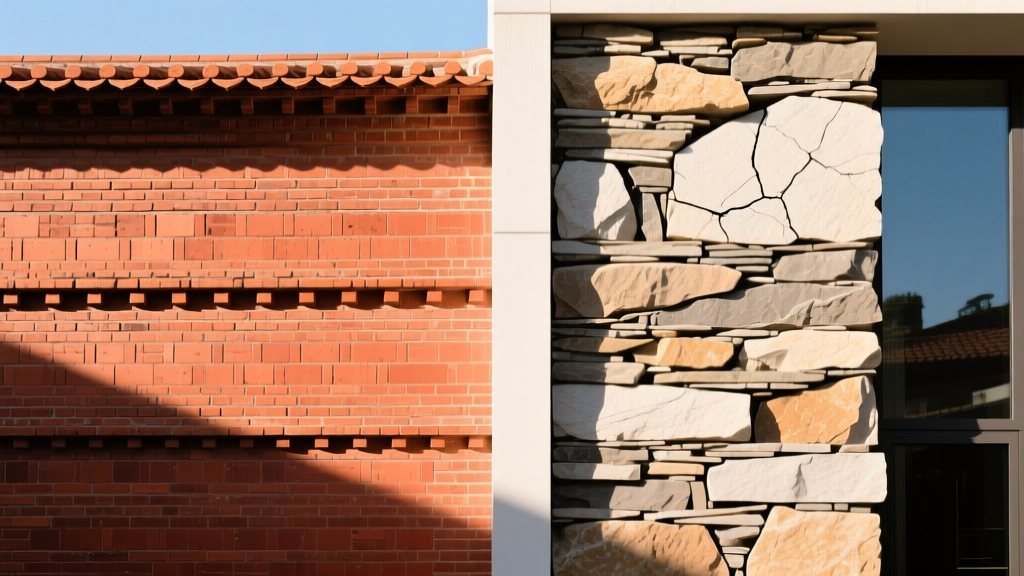
Stone Veneer: Natural vs. Manufactured (MSV)
Stone veneer splits into two distinct categories, each with vastly different installation protocols and price points.
Natural Stone Veneer
Quarried and sliced to a 3/4-inch to 1-1/2-inch thickness, natural stone (such as limestone, slate, or fieldstone) is heavy and irregular. It requires a metal lath and a scratch coat of mortar applied directly to the WRB before the stone is set. Natural stone weighs between 25 and 45 psf, demanding robust structural support and deep foundation ledges.
Manufactured Stone Veneer (MSV)
Crafted from Portland cement, lightweight aggregates, and iron-oxide pigments poured into molds taken from real stone, MSV replicates the look of natural stone at a fraction of the weight. According to guidelines from the National Concrete Masonry Association, high-quality MSV must meet ASTM C1670 standards, ensuring freeze-thaw durability and colorfastness. MSV typically weighs 15 psf or less, and many modern systems are now available as panelized, mortarless interlocking units that drastically reduce labor times.
Head-to-Head Matrix: Brick or Stone?
| Feature | Clay Brick Veneer | Manufactured Stone (MSV) | Natural Stone Veneer |
|---|---|---|---|
| Average Weight | 40 psf | 10 - 15 psf | 25 - 45 psf |
| Material Cost (2026) | $6.00 - $10.00 / sq ft | $9.00 - $14.00 / sq ft | $16.00 - $30.00 / sq ft |
| Installed Cost | $14.00 - $22.00 / sq ft | $18.00 - $26.00 / sq ft | $35.00 - $55.00 / sq ft |
| Installation Method | Individual units, mortar bed, weep holes | Lath, scratch coat, mortar set OR panelized | Lath, scratch coat, thick mortar set |
| Maintenance | Very Low (occasional tuckpointing at 50 yrs) | Low (sealant recommended every 10 yrs) | Low (may require re-sealing in wet climates) |
| Color Longevity | Permanent (fired clay) | Excellent (integral pigments, UV stable) | Permanent (natural mineral variation) |
2026 Cost Breakdown: Hidden Expenses to Anticipate
Comparing material costs alone is a common error when deciding between brick or stone. The true cost of ownership includes structural modifications, scaffolding, and moisture management accessories.
- Foundation Ledge Engineering: Because brick and natural stone exceed 40 psf, structural engineers must design reinforced concrete masonry unit (CMU) or poured concrete ledges. This adds $1,500 to $3,500 to the foundation phase of a standard 2,500 sq ft home. MSV can often be supported by standard wood framing with blocking, eliminating this cost.
- Flashing and Weep Systems: Code requires through-wall flashing and weep holes at the base of all brick veneer and above all openings. A high-quality flexible flashing membrane (like DuPont Tyvek FlexWrap) and corrugated weep vents add $1.50 to $2.50 per linear foot.
- Corner Pieces: Both brick and stone require specialized corner units to wrap the building edge and maintain the illusion of mass. Corner pieces are priced per linear foot and cost 30% to 50% more than flat field units.
When installing manufactured stone veneer, inexperienced masons often "smear" the mortar joint across the face of the stone to hide gaps. This not only ruins the aesthetic but traps moisture against the stone face. Because MSV is porous, trapped moisture combined with freeze-thaw cycles will cause the face of the stone to spall and pop off within 3 to 5 winters. Always insist on recessed or flush tooled joints with zero face-smearing.
Installation Protocols and Common Failure Modes
The longevity of any masonry veneer relies entirely on the drainage plane behind it. The most common failure in both brick and stone veneers is not the material degrading, but water becoming trapped in the wall cavity.
Brick Veneer Failures
Efflorescence: A white, powdery deposit of water-soluble salts on the brick face. This occurs when water enters the wall cavity, dissolves salts in the mortar or clay, and migrates to the surface. Prevention requires a strict 1-inch clear air space behind the brick, free of mortar droppings (snots), and properly spaced weep holes (maximum 32 inches on center).
Spalling: The flaking or peeling of the brick face. This is almost exclusively caused by using a mortar that is harder and less permeable than the brick itself (e.g., using Type S or Type M mortar on a soft, low-psi brick). Water enters the brick, freezes, and because it cannot escape through the dense mortar joint, it blows the face off the brick.
Stone Veneer Failures
Lath Delamination: For traditional mortar-set stone, the metal lath must be attached directly to the studs or sheathing with corrosion-resistant fasteners penetrating at least 1 inch into the framing. If lath is attached only to the WRB or foam insulation, the sheer weight of the stone will pull the lath off the wall, resulting in catastrophic collapse.
Hydrostatic Pressure at Grade: A frequent error is burying the bottom course of stone veneer in soil or mulch. Soil retains moisture, which wicks up into the stone and the wood framing behind it, causing severe rot. Building codes universally mandate a minimum 4-inch clearance between the bottom of the masonry veneer and final grade, or 2 inches if paved.
"The decision between brick or stone should never be made on aesthetics alone. The structural capacity of your existing foundation and the specific micro-climate of your build site—particularly freeze-thaw cycles and driving rain exposure—must dictate the material selection." — 2026 Masonry Design & Build Guidelines
The Final Decision Framework: Which Should You Choose?
Use this practical framework to finalize your material selection based on your project constraints.
Choose Brick Veneer If:
- You are building new construction from the ground up and can easily integrate a continuous masonry ledge into the foundation plan.
- You desire a traditional, formal, or colonial architectural aesthetic.
- You want a zero-maintenance material that will never require sealing and will outlast the structural framing of the house.
- You are building in a region with extreme temperature swings, leveraging the thermal mass of the brick to stabilize interior temperatures.
Choose Manufactured Stone Veneer (MSV) If:
- You are executing a renovation or remodel and the existing foundation cannot support the 40+ psf dead load of brick or natural stone.
- You want the rustic, irregular texture of natural stone but need to keep the project budget under $25 per square foot installed.
- You are cladding complex architectural features, arches, or tight interior spaces where cutting and shaping heavy clay brick is cost-prohibitive.
Choose Natural Stone Veneer If:
- You are designing a high-end custom build where budget is secondary to authentic material provenance and unique, non-repeating geological patterns.
- The design calls for massive, thick-stone profiles (like Tuscan fieldstone or heavy limestone) that cannot be accurately replicated by manufactured molds.
- You require a material that can be locally quarried to meet strict LEED or sustainable building material sourcing credits.
For further technical specifications on mortar mixing ratios, flashing details, and air-space requirements, consult the technical notes provided by the Brick Industry Association before finalizing your architectural drawings.
Written by
Elena RodriguezElena Rodriguez is a civil engineer and technical writer specializing in concrete technology, masonry systems, and ASTM/ACI compliance. She earned her B.S. in Civil Engineering from Texas A&M University and spent a decade at a materials testing laboratory, performing over 2,000 concrete compressive strength tests and masonry prism evaluations. Elena is an ACI-certified Field Testing Technician (Grade I) and a member of ASTM Committee C12 on Natural Building Stone. She currently consults on forensic engineering cases involving concrete failures and moisture intrusion. Based in San Antonio, TX, Elena is a proud member of the Society of Women Engineers (SWE) and coaches her daughter's FIRST Robotics team.
More from Elena Rodriguez
View all
Walls & Panels
Cost Analysis: Light Gauge Steel Framing Advantages and Disadvantages
Evaluate light gauge steel framing advantages and disadvantages through a strict cost analysis lens, comparing material, labor, and lifecycle expenses.
Aug 4, 2026

Walls & Panels
Gypsum Board Types: Exact Specifications, Thickness & Dimensions
Compare standard, Type X, and moisture-resistant gypsum board types. Get exact specifications, thicknesses, dimensions, and ASTM standards for your project.
Aug 4, 2026

Fire Resistance
Best Fire-Resistant Outdoor Decking Materials: 2026 Buyer Guide
Discover the best fire-resistant outdoor decking materials for 2026. Compare Class A PVC, aluminum, and hardwood options for WUI compliance and safety.
Aug 4, 2026