Brownstone Building Material: Expert Maintenance and Repair Guide
Learn how to clean, patch, and preserve brownstone building material. Expert guide covering spalling repair, safe washing PSI, and 2026 costs.

The Petrology of Brownstone: Why It Demands Specialized Care
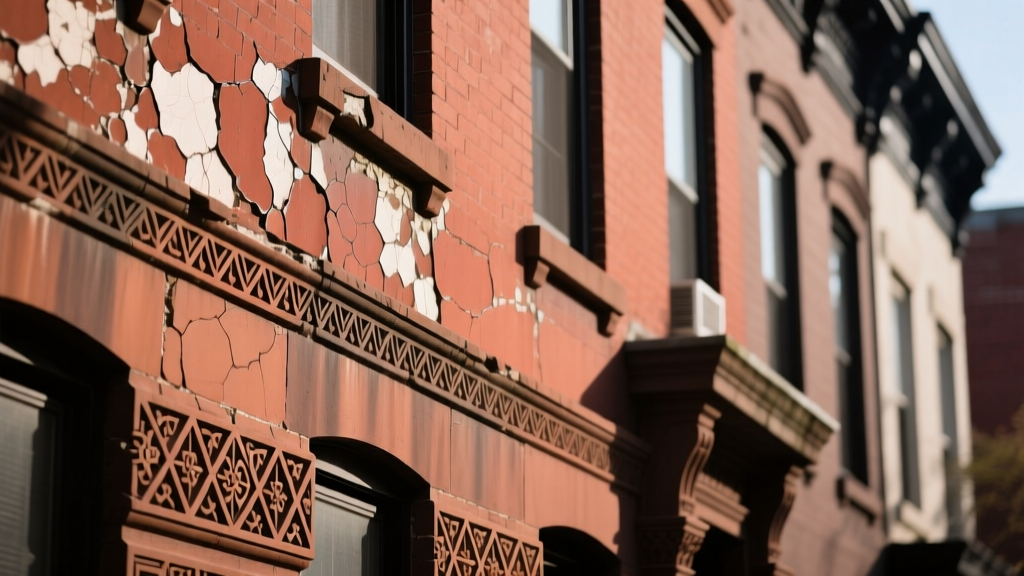
Brownstone is a Triassic or Jurassic arkosic sandstone, historically quarried in the Connecticut River Valley and widely used for 19th-century rowhouses in cities like New York and Boston. Unlike dense granite or limestone, brownstone building material is characterized by its high feldspar content and a clay-rich matrix that binds its quartz grains. This specific mineralogy makes it highly susceptible to moisture-related deterioration. When the clay matrix absorbs water, it expands; during freeze-thaw cycles, this expansion causes the stone's surface to sheer off in a process known as spalling or contour scaling.
Preserving this historic masonry requires abandoning standard concrete repair logic. Modern Portland cement is too hard and impermeable for brownstone. Applying standard masonry sealers or harsh chemical cleaners will accelerate decay by trapping moisture inside the stone's pore structure. Effective maintenance relies on low-impact cleaning, breathable repair compounds, and strict moisture management.
Diagnosing Deterioration in Brownstone Building Material
Before initiating any repair protocol, accurately identify the failure mode. Misdiagnosing the symptom often leads to treatments that worsen the underlying pathology.
1. Contour Scaling and Spalling
Spalling appears as blistering, flaking, or peeling of the stone surface, often leaving a jagged, lighter-colored inner core exposed. This is primarily driven by water infiltration from faulty roof gutters, rusting iron cramps (which expand as they oxidize), or rising damp. If the stone sounds hollow when tapped with a wooden mallet, delamination has occurred beneath the surface.
2. Efflorescence and Subflorescence
Efflorescence presents as a white, powdery salt deposit on the surface. While unsightly, it is relatively harmless. Subflorescence, however, occurs when salt crystallization happens just beneath the stone's surface. The crystallization pressure exceeds the tensile strength of the brownstone, causing micro-fracturing and eventual surface loss. Subflorescence requires poultice extraction, not surface scraping.
3. Biological Colonization
Algae, lichen, and moss thrive on the porous, moisture-retaining surface of north-facing brownstone facades. While lichen roots can penetrate the stone's micro-fissures, aggressive removal will tear away the stone's face. Biological growth must be killed chemically before gentle mechanical removal.
The Safe Cleaning Protocol
The National Park Service Preservation Brief 1 explicitly warns against abrasive cleaning methods for historic masonry. For brownstone, a low-pressure water and chemical wash is the only acceptable cleaning methodology.
- Pre-Wet the Masonry: Saturate the wall with clean water using a garden hose. This prevents the cleaning solution from being absorbed too deeply into the dry, porous stone.
- Apply Alkaline Cleaner: Use a specialized, non-ionic masonry cleaner such as PROSOCO Sure Klean® ReKlean or an equivalent alkaline bio-wash. Avoid all acidic formulations.
- Dwell Time and Agitation: Allow the solution to dwell for 5 to 10 minutes, keeping it wet with a mister. Gently agitate stubborn biological growth with a natural-bristle brush (never wire bristles, which leave iron particles that will rust and stain the stone).
- Low-Pressure Rinse: Rinse the facade using a pressure washer equipped with a 40-degree fan-tip nozzle. Maintain a minimum distance of 12 inches from the masonry surface and strictly limit the pressure to a maximum of 300 PSI.
Repair Strategies: Patching vs. Dutchman Inserts
When brownstone building material suffers localized spalling or mechanical damage, conservationists choose between cementitious patching and Dutchman (stone replacement) repairs. The New York City Landmarks Preservation Commission mandates that repairs match the historic stone in color, texture, and permeability.
| Repair Method | Application Scenario | Recommended Materials | Longevity |
|---|---|---|---|
| Cementitious Patching | Shallow spalls (under 1.5 inches deep), edge repairs, and missing ornamental details. | Conproco Set Point or Edison Coatings System 45. Must be custom-tinted with mineral oxides. | 15-25 Years |
| Dutchman Insert | Deep structural decay, severe contour scaling, or damage exceeding 2 inches in depth. | Salvaged historic brownstone or matching Ohio/PA sandstone, set with Type O lime mortar. | 50+ Years |
The Dutchman Technique: This involves using a masonry saw to cut out the deteriorated stone in a clean, geometric block (avoiding feather edges). A new piece of matching sandstone is carved to fit the void with a 1/8-inch tolerance. It is then bedded in a soft, breathable Type O mortar (high lime, low Portland cement content) and secured with non-corrosive stainless steel or fiberglass pins.
The Sealant Trap: Why Breathability Matters
A common and catastrophic mistake in brownstone maintenance is the application of film-forming waterproofing sealers (like acrylics or urethanes). These products create a vapor barrier on the surface. While they prevent rain from entering, they also trap internal moisture from rising damp or interior condensation. When the trapped water freezes, it spalls the stone from behind the sealer.
"Historic masonry must be allowed to breathe. If a water-repellent coating is deemed absolutely necessary to protect highly vulnerable carved details, only penetrating, breathable siloxane or silane-based consolidants should be used, and only after the masonry has been completely dried and desalinated." — NPS Guidelines on Masonry Preservation
If a siloxane consolidant is required, perform a RILEM tube water absorption test before and after application to ensure the stone's vapor permeability has not been reduced by more than 5%.
2026 Maintenance and Restoration Cost Breakdown
Budgeting for brownstone restoration requires an understanding of specialized labor rates. General masons often lack the conservation training required for historic sandstone, making specialized heritage contractors a necessity. Below are the current average market rates for professional brownstone maintenance.
| Service | 2026 Average Cost | Frequency | Critical Notes |
|---|---|---|---|
| Low-Pressure Bio-Wash | $4.50 - $8.00 / sq ft | Every 3-5 Years | Includes scaffolding and neutral pH chemicals. |
| Cementitious Patching | $85 - $140 / sq ft | As Needed | Cost increases significantly for ornamental carving replication. |
| Dutchman Replacement | $300 - $550 / block | As Needed | Pricing assumes standard ashlar blocks; quoins and lintels cost more. |
| Siloxane Consolidation | $3.50 - $6.00 / sq ft | Every 10-15 Years | Only apply to highly exposed, carved elements, not flat ashlar walls. |
Proactive Moisture Management
The most cost-effective maintenance strategy for brownstone building material is preventing water ingress before it reaches the masonry. Ensure that copper or lead-coated copper flashing is installed above all projecting stone elements (cornices, water tables, and window hoods). Maintain roof gutters and downspouts rigorously; a single clogged downspout that overflows onto a brownstone facade can cause thousands of dollars in spalling damage within a single winter. Inspect mortar joints annually and repoint using a Type O or Type N lime-putty mortar whenever joints become recessed by more than 1/4 inch.
Written by
Priya KapoorPriya Kapoor is a real estate market analyst and construction economics researcher with expertise in housing affordability, development feasibility, and infrastructure investment. She holds a Master of Regional Planning from Cornell University and previously worked as a senior analyst at CBRE's Investment Properties group, where she modeled returns for $4B in mixed-use development pipelines. Priya now runs an independent research practice advising developers, municipalities, and REITs on construction cost forecasting and market timing. She publishes the quarterly "BuildMat Market Pulse" report tracking material price indices across 12 commodity categories. Based in Austin, TX, Priya serves on the board of Habitat for Humanity Austin and is a marathon runner.
More from Priya Kapoor
View all
Construction Cost
Cost to Build a 1600 Sq Ft Home in 2026: Full Breakdown
Accurate 2026 cost to build a 1600 sq ft home—material, labor, and regional pricing breakdowns included. Plan your budget with real-time estimates.
Aug 11, 2026

Wood & Lumber
Name the Types of Wood for Pressure Treatment and Preservation
Learn how to name the types of wood best suited for pressure treatment. Compare species treatability, chemical retention levels, and 2026 preservation costs.
Aug 4, 2026

Stone & Masonry
Stone Veneer Suppliers Lindenhurst: 2026 Cost Analysis
Analyze 2026 stone veneer costs in Lindenhurst, NY. Compare local supplier pricing, delivery fees, and Suffolk County installation labor rates.
Aug 4, 2026