Dutch Quality Stone Veneer: Design Profiles & Style Guide
Explore Dutch Quality Stone veneer profiles, color blends, and architectural pairings. A comprehensive design guide for interior and exterior applications.

The Architecture of Manufactured Stone: Why Dutch Quality?
Dutch Quality Stone (DQS) has carved a distinct niche in the architectural cladding market by engineering manufactured stone veneer (MSV) that replicates the geological nuance of natural stone while eliminating the structural burden. For architects and designers, the primary advantage of DQS lies in its weight-to-profile ratio. Weighing approximately 10 to 12 pounds per square foot, it adheres directly to properly prepared substrates without requiring masonry ties, lintels, or foundational reinforcements. This allows for seamless integration into complex architectural features like cantilevered gables, interior accent walls, and multi-story facades.
Beyond structural convenience, the brand utilizes proprietary color-oxide blending and polyurethane mold-casting techniques that capture the micro-textures of quarried stone. As of 2026, DQS remains a preferred specification for high-end residential and boutique commercial projects where authentic shadow lines and tactile surface variations are non-negotiable.
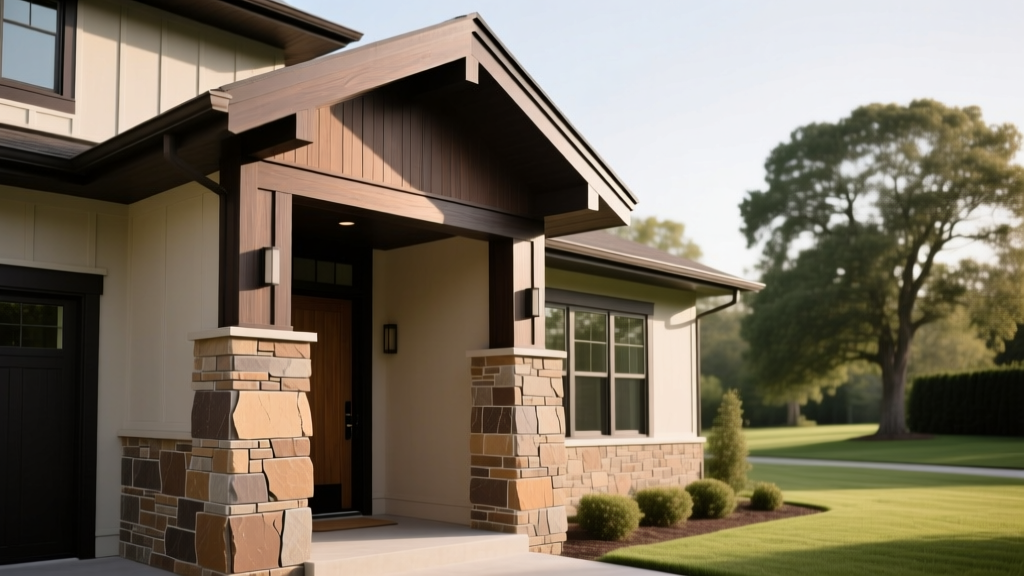
Signature Profile Showcase: Matching Stone to Architectural Style
Selecting the correct profile is the most critical design decision when specifying DQS. The profile dictates the shadow line, the mortar joint requirement, and the overarching architectural language of the structure.
Weather Ledge (Modern & Transitional)
Weather Ledge is a linear, dry-stack profile characterized by long, horizontal ledges and tight, mortarless joints. The stones range from 2 to 6 inches in height and up to 24 inches in length. Design Application: Ideal for mid-century modern, contemporary, and transitional architecture. It excels as a wainscoting application on exterior facades or as a floor-to-ceiling fireplace surround in minimalist interiors. Because it requires no mortar joints, the installation yields a clean, uninterrupted shadow line that emphasizes horizontal geometry.
Tuscany (Mediterranean & Old World)
Tuscany mimics traditional European fieldstone, featuring irregular, rounded shapes with varying thicknesses. Design Application: This profile demands a visible, often recessed mortar joint (typically a gray or buff Type N or Type S mortar). It is the definitive choice for Tuscan, Spanish Colonial, and French Country estates. Designers frequently pair Tuscany with heavy timber brackets, stucco wall planes, and terracotta roofing to achieve an authentic Old World patina.
Stonewood (Rustic & Craftsman)
Stonewood replicates the look of hand-chiseled limestone blocks, featuring rectangular shapes with slightly rounded edges and a rugged, split-face texture. Design Application: Perfect for Craftsman, Prairie, and Mountain Modern styles. The blocky geometry provides a structured, grounded appearance. It is highly effective when used to clad structural columns, chimney chases, and foundation skirting. A contrasting, flush-tooled white or light gray mortar joint enhances the geometric grid of the stone.
Brookstone (Traditional & Cottage)
Brookstone captures the aesthetic of water-tumbled river rock, featuring smooth, oval, and rounded shapes. Design Application: Best suited for Cape Cod, Cottage, and rustic cabin designs. The organic, flowing shapes soften rigid architectural lines. It is frequently used in landscape architecture for retaining walls, outdoor kitchens, and fire pits, as well as interior applications like spa-like bathroom surrounds.
Design Framework: The 60-30-10 Rule for Stone Facades
When integrating Dutch Quality Stone veneer into an exterior elevation, apply the classic 60-30-10 color ratio to maintain visual balance:
- 60% Dominant Field Color: The primary siding material (e.g., fiber cement lap siding or stucco). Choose a neutral, low-LRV (Light Reflectance Value) tone.
- 30% Secondary Texture: The Dutch Quality Stone veneer. Use this for high-impact zones: the foundation water table, entryway columns, and chimney chase.
- 10% Accent Trim: Fascia, window casings, and shutters. Use a high-contrast color (e.g., dark bronze or matte black) to frame the stone and siding.
Color Blends and Material Pairings
Dutch Quality Stone offers proprietary color blends that utilize multiple oxide layers to prevent the flat, monochromatic look common in lower-tier MSV. Specifying the correct undertone is vital to prevent clashing with roofing and trim.
| DQS Color Blend | Dominant Undertone | Ideal Siding Pairing | Recommended Roof Shingle |
|---|---|---|---|
| Chardonnay | Warm Beige / Golden | Sage Green or Cream Lap | Weathered Wood / Brown |
| Weathered | Cool Gray / Ash | Navy Blue or Charcoal | Slate Gray / Black |
| Mocha | Rich Brown / Espresso | Warm White or Taupe | Driftwood / Earth Tones |
| Iron Ore | Dark Charcoal / Black | Crisp White or Cedar Shake | Architectural Black |
Technical Specifications and Moisture Management
Aesthetic success relies entirely on proper substrate preparation and moisture management. Dutch Quality Stone veneer must be installed in strict compliance with ASTM C1670 (Standard Specification for Adhered Manufactured Stone Masonry Veneer). According to the Masonry Veneer Manufacturers Association (MVMA), failure to include a continuous weather-resistive barrier (WRB) and a corrosion-resistant weep screed at the base of the wall assembly is the leading cause of MSV efflorescence and substrate rot.
For exterior applications, designers must specify a minimum 4-inch clearance between the finished grade and the bottom of the stone veneer. In regions with heavy snowfall, this clearance should be increased to 6 inches to prevent capillary action and freeze-thaw spalling. Behind the veneer, a 1-inch air cavity paired with a drainage mat is highly recommended by building science experts at Building Science Corporation to ensure any incidental moisture that penetrates the mortar matrix can drain freely to the weep screed.
2026 Cost & Estimation Metrics
Budgeting for Dutch Quality Stone requires understanding the bifurcation of flat pieces and corner pieces. Flats are sold by the square foot (SF), while corners are sold by the linear foot (LF). A common estimation error is calculating the total surface area and ordering all flats, which results in visible, repeating seams at the building corners.
Estimator Warning: The Corner Factor
Always measure exterior corners, window returns, and door jambs in linear feet. One linear foot of DQS corner pieces typically covers 0.75 to 1.0 square feet of surface area. Deduct this coverage from your total square footage before ordering flat pieces to avoid 15-20% material overage.
Current Material Pricing (2026):
- Flat Pieces: $7.50 to $10.50 per SF, depending on the profile and regional distributor freight costs.
- Corner Pieces: $11.00 to $15.00 per LF.
- Waste Factor: Add 10% for flat cuts and 15% for complex geometries (arches, tight radii).
- Installation Labor: $14.00 to $22.00 per SF for licensed masons, encompassing lath, scratch coat, mortar, and stone placement.
Frequently Asked Design Questions
Can Dutch Quality Stone be installed directly over painted brick?
No. Painted brick lacks the mechanical tooth required for mortar adhesion. The existing paint must be completely removed via sandblasting or grinding, or the brick must be covered with a dimpled drainage mat, metal lath, and a Portland cement scratch coat before applying the veneer.
How does DQS perform in high-heat interior applications like fireplace inserts?
Dutch Quality Stone is non-combustible and can safely withstand the heat generated by wood-burning and gas fireplace inserts. However, the mortar used to adhere the stone must be a high-temperature, refractory-rated masonry mortar within 18 inches of the direct firebox opening to prevent thermal cracking.
Is sealing the stone veneer recommended for exterior facades?
Applying a breathable, silane-siloxane penetrating sealer is highly recommended for exterior applications, particularly in climates with frequent freeze-thaw cycles. Avoid film-forming acrylic sealers, which trap moisture vapor inside the masonry assembly and lead to catastrophic spalling during winter months.
Written by
Marcus ChenMarcus Chen is a licensed structural engineer (PE) and building materials analyst with over 12 years of experience across residential, commercial, and industrial construction. He holds a Master of Science in Civil Engineering from UC Berkeley and spent six years at Thornton Tomasetti before transitioning to independent consulting and technical writing. Marcus specializes in material selection for seismic-prone regions, concrete reinforcement strategies, and lifecycle cost analysis. His work has been cited by the American Concrete Institute (ACI) and the Structural Engineers Association of California (SEAOC). When he is not on a job site or at his desk, you will find him hiking the Sierra Nevada or restoring a 1920s craftsman bungalow in Oakland, CA.
More from Marcus Chen
View all
Construction Cost
How Much Did the Eiffel Tower Cost to Build?
How much did the Eiffel Tower cost to build in 1889? We adjust for inflation and compare its budget to modern skyscraper construction.
Aug 4, 2026

Fire Resistance
What Is a Fire Resistant Material? Testing & Certification Guide
Discover what is a fire resistant material through ASTM and UL testing. Learn how fire ratings, certifications, and assemblies work in construction.
Aug 4, 2026

Construction Cost
How Much Did the Burj Khalifa Cost to Build?
How much did the Burj Khalifa cost to build? We break down the $1.5B project and extract 5 money-saving strategies for your next build.
Jul 30, 2026