Stacked Stone Veneer Exterior: Complete Material & Design Guide
Master exterior stacked stone veneer with our complete guide covering ASTM standards, moisture management, top brands, and precise installation specs.

Defining Exterior Stacked Stone Veneer
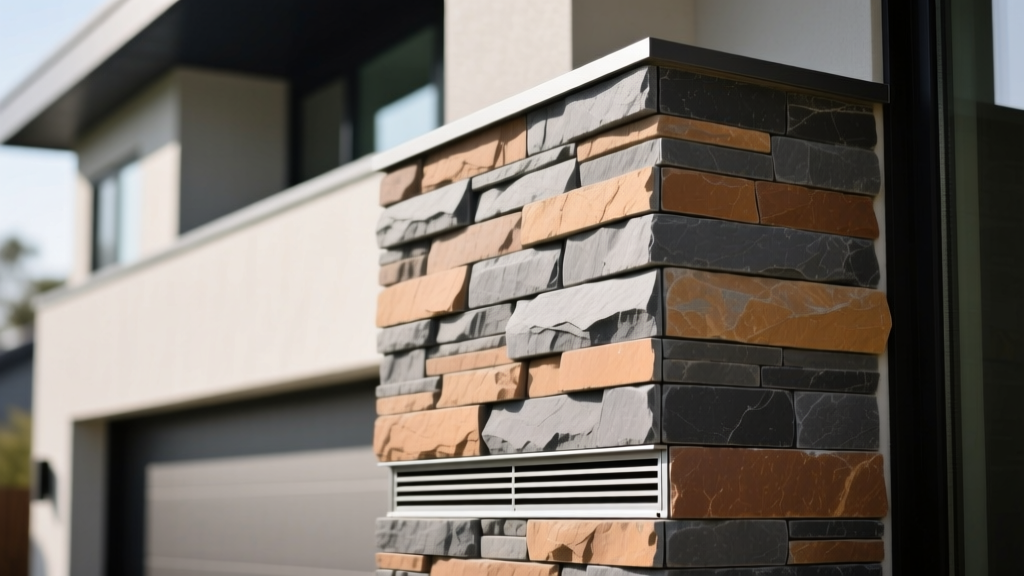
Stacked stone veneer for exterior applications consists of narrow, linear stone profiles installed without visible mortar joints, creating a clean, modern, and highly textured facade. Unlike traditional full-bed masonry, adhered veneer relies on a scratch coat and mortar bond to a structural backing rather than bearing its own weight. For exterior use, materials must meet stringent durability standards to withstand freeze-thaw cycles, UV degradation, and wind-driven rain. Manufactured stacked stone must comply with ASTM C1670 (Standard Specification for Adhered Manufactured Stone Masonry Veneer Units), which dictates compressive strength, water absorption, and freeze-thaw resistance parameters.
Material Composition & Weight Specifications
Exterior stacked stone is available in two primary categories: natural stone and manufactured (cultured) stone. The choice impacts structural loading, cutting requirements, and overall project cost.
| Specification | Manufactured Stacked Stone | Natural Stacked Stone |
|---|---|---|
| Base Material | Portland cement, pumice, iron oxide pigments | Quarried granite, basalt, slate, or quartzite |
| Weight per Sq. Ft. | 6.5 – 9.0 lbs | 10.0 – 14.5 lbs |
| Average Thickness | 1.0 – 2.5 inches | 1.5 – 4.0 inches |
| Water Absorption | < 12% (ASTM C1670 compliant) | Varies (Granite <1%, Sandstone up to 8%) |
| Cutting Method | Masonry blade, wet tile saw, or nippers | Diamond-tipped wet saw required |
The 5-Layer Exterior Wall Assembly
The longevity of an exterior stacked stone veneer installation depends entirely on the moisture management system behind it. A proper exterior adhered masonry veneer (AMV) assembly requires five distinct layers to manage hydrostatic pressure and prevent wood rot.
- Structural Sheathing: Minimum 7/16-inch OSB or 1/2-inch plywood, fastened to framing per local building codes.
- Weather-Resistive Barrier (WRB): Two layers of Grade D building paper (60-minute) or a single layer of high-performance housewrap. The Building Science Corporation strongly recommends a ventilated rainscreen gap (using a 3D drainage mat like Keene DriWall) between the WRB and the lath to allow bulk water to drain freely.
- Corrosion-Resistant Lath: Minimum 2.5 lb/sq yd self-furring galvanized expanded metal lath. Must be fastened with 1-inch galvanized roofing nails or corrosion-resistant lath screws spaced 6 inches on center, penetrating directly into the wall studs.
- Scratch Coat: A 1/2-inch thick layer of Type S mortar applied to the lath and horizontally scored to provide a mechanical key for the final setting bed.
- Setting Bed & Veneer: Type S mortar (minimum 1800 psi compressive strength) applied to the back of each stone (back-buttering) and pressed into the scratch coat.
Top Brands & Product Lines for Exterior Use
Selecting a manufacturer with a proven track record in exterior freeze-thaw performance is critical. Below are the industry-leading profiles specifically engineered for exterior stacked applications.
Eldorado Stone: Stackstone 3D
Eldorado Stone's Stackstone 3D profile features elongated, linear shapes with deep shadow lines. Manufactured using high-density lightweight concrete, it weighs approximately 8.5 lbs per square foot. The colorways (such as 'Alderwood' and 'Sierra') utilize integral iron oxide pigments that resist UV fading. Expect material costs between $9.50 and $12.00 per square foot.
Cultured Stone: Ledgestone
Cultured Stone (a Boral company) offers the Ledgestone profile, characterized by shorter, staggered linear pieces that create a highly textured, rustic-modern aesthetic. It complies with both ASTM C1670 and ICC-ES AC51. Material pricing typically ranges from $8.00 to $10.50 per square foot.
Coronado Stone: Thin Brick & Stacked Ledge
Coronado's Stacked Ledge provides a tighter, more uniform joint profile. Their manufacturing process includes a proprietary acrylic polymer admixture that reduces water absorption to under 9%, making it highly suitable for coastal or high-humidity exterior environments. Pricing averages $8.50 to $11.00 per square foot.
Common Failure Modes & Troubleshooting
Exterior stacked stone failures are rarely caused by the stone itself; they are almost exclusively the result of improper moisture management or incorrect mortar chemistry.
- Efflorescence (White Staining): Caused by water-soluble salts migrating to the surface. Prevent this by using low-alkali Portland cement, ensuring the wall cavity can dry to the exterior, and avoiding acid-based cleaners during construction.
- Delamination (Stone Falling Off): Usually occurs when the scratch coat is applied over dusty lath, or when stones are not back-buttered. In freeze-thaw climates, water gets trapped behind an unbuttered stone, freezes, expands, and pops the stone off the wall.
- Spalling (Surface Flaking): Happens when moisture is trapped inside the stone and freezes. This is frequently caused by applying a film-forming acrylic sealer instead of a breathable penetrating sealer.
Sealing & Maintenance Protocols
Most high-quality manufactured stacked stones do not require sealing. However, if the stone is in a high-splash zone (near grade, behind exterior sinks, or on retaining walls), a sealer is recommended. You must use a penetrating silane/siloxane water repellent, such as Prosoco SureKlean Weather Seal Siloxane PD. These sealers react chemically with the masonry to create a hydrophobic barrier below the surface while remaining 100% vapor-permeable. Never apply urethane or acrylic 'wet-look' sealers to exterior stone, as they trap internal moisture and guarantee freeze-thaw spalling.
Cost Breakdown: Materials vs. Labor
Exterior stacked stone veneer is a premium cladding option. The linear nature of stacked profiles makes them faster to install than random ashlar patterns, but the required prep work keeps labor costs significant.
| Cost Component | Low Estimate | High Estimate | Notes |
|---|---|---|---|
| Stone Veneer Material | $8.00 / sq ft | $14.00 / sq ft | Manufactured vs. Natural quarried stone |
| Mortar, Lath & WRB | $2.50 / sq ft | $4.50 / sq ft | Includes galvanized lath, Type S mortar, drainage mat |
| Labor (Prep & Install) | $14.00 / sq ft | $24.00 / sq ft | Varies heavily by regional union rates and scaffolding needs |
| Total Installed Cost | $24.50 / sq ft | $42.50 / sq ft | Excludes structural framing or sheathing repairs |
For a standard 400-square-foot exterior accent wall or foundation skirt, expect total project costs to range between $9,800 and $17,000. Always refer to the manufacturer's specific installation guidelines to ensure your warranty remains valid, as improper WRB or mortar selection will void most material guarantees.
Written by
Elena RodriguezElena Rodriguez is a civil engineer and technical writer specializing in concrete technology, masonry systems, and ASTM/ACI compliance. She earned her B.S. in Civil Engineering from Texas A&M University and spent a decade at a materials testing laboratory, performing over 2,000 concrete compressive strength tests and masonry prism evaluations. Elena is an ACI-certified Field Testing Technician (Grade I) and a member of ASTM Committee C12 on Natural Building Stone. She currently consults on forensic engineering cases involving concrete failures and moisture intrusion. Based in San Antonio, TX, Elena is a proud member of the Society of Women Engineers (SWE) and coaches her daughter's FIRST Robotics team.
More from Elena Rodriguez
View all
Walls & Panels
Cost Analysis: Light Gauge Steel Framing Advantages and Disadvantages
Evaluate light gauge steel framing advantages and disadvantages through a strict cost analysis lens, comparing material, labor, and lifecycle expenses.
Aug 4, 2026

Walls & Panels
Gypsum Board Types: Exact Specifications, Thickness & Dimensions
Compare standard, Type X, and moisture-resistant gypsum board types. Get exact specifications, thicknesses, dimensions, and ASTM standards for your project.
Aug 4, 2026

Fire Resistance
Best Fire-Resistant Outdoor Decking Materials: 2026 Buyer Guide
Discover the best fire-resistant outdoor decking materials for 2026. Compare Class A PVC, aluminum, and hardwood options for WUI compliance and safety.
Aug 4, 2026