Faux Veneer Stone Technical Specs: ASTM Standards and Weight Limits
Explore the technical specifications of faux veneer stone, including ASTM C1670 standards, weight limits, compressive strength, and substrate requirements.
Core Material Composition and Manufacturing Tolerances
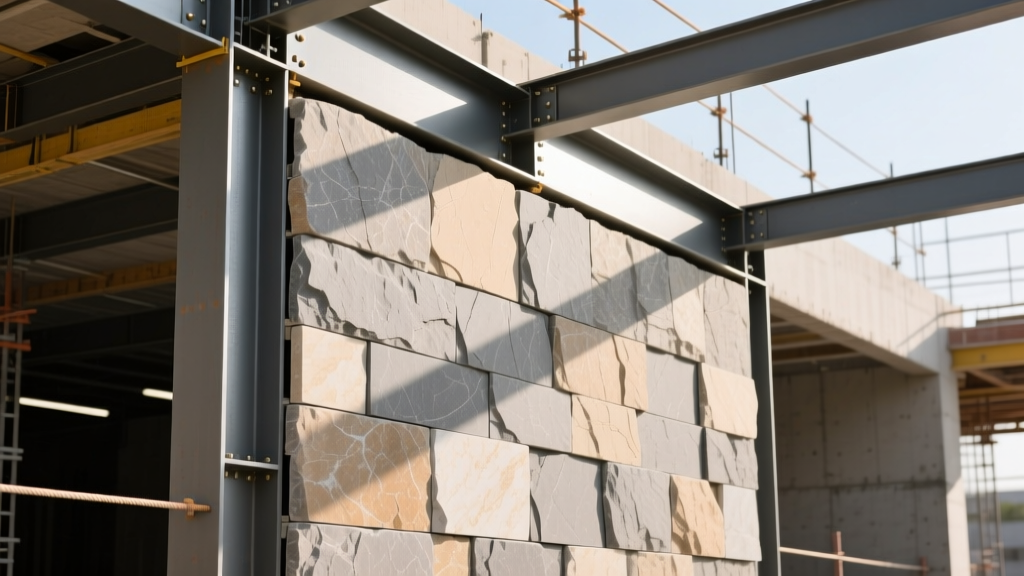
Faux veneer stone, technically classified as Adhered Manufactured Stone Masonry Veneer (MSV), is a non-load-bearing architectural cladding. Unlike natural stone, MSV is engineered using a precise slurry mix designed to replicate the aesthetic of quarried masonry while drastically reducing structural dead loads. The core matrix consists of Portland cement (Type I or II), lightweight aggregates, and synthetic pigments.
Aggregate Ratios and Pigment Oxidation
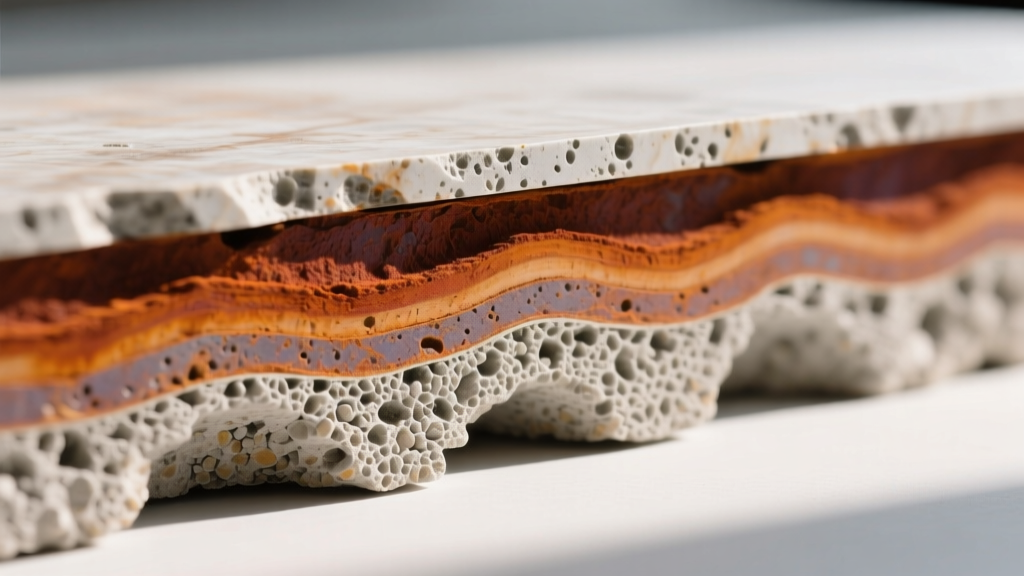
The lightweight aggregates—typically expanded shale, slate, or clay—must conform to ASTM C331 standards for lightweight masonry units. These aggregates reduce the overall density of the faux veneer stone to between 105 and 120 lbs per cubic foot, compared to 160+ lbs per cubic foot for natural limestone or granite. Coloration is achieved using synthetic iron oxide pigments (ASTM C979) integrated directly into the concrete matrix, not merely surface-painted. To prevent UV degradation and ensure colorfastness, pigment concentration is strictly capped at 10% by weight of the cementitious material. Manufacturing tolerances dictate a thickness ranging from 1.0 to 2.5 inches, with a maximum allowable variance of ±1/8 inch per unit.
ASTM C1670 Compliance and Structural Testing
The governing standard for faux veneer stone in North America is ASTM C1670 (Standard Specification for Adhered Manufactured Stone Masonry Veneer). Compliance requires rigorous batch testing to ensure the material can withstand environmental and mechanical stressors without delamination or fracturing.
| ASTM Test Method | Property Evaluated | Minimum MSV Requirement |
|---|---|---|
| ASTM C140 | Compressive Strength | 1,800 psi (12.4 MPa) |
| ASTM C99 | Flexural Strength (Modulus of Rupture) | 400 psi (2.75 MPa) |
| ASTM C666 | Freeze-Thaw Durability (50 cycles) | < 3% weight loss, no cracking |
| ASTM C140 | Water Absorption | < 22% by weight |
| ASTM C1670 | Dimensional Tolerance (Thickness) | 1.0" to 2.5" (±1/8") |
Weight, Thickness, and Substrate Load Limits
The primary engineering advantage of faux veneer stone is its reduced dead load. While natural stone veneer typically weighs 25 to 40 lbs per square foot (psf), manufactured faux veneer stone weighs between 10 and 15 psf. This weight reduction eliminates the need for continuous concrete masonry unit (CMU) footings or structural steel shelf angles in most residential and light-commercial applications.
Standard 2x4 or 2x6 wood framing (16" on center) with 1/2" OSB or plywood sheathing can easily support the 15 psf dead load of faux veneer stone without additional structural reinforcement, provided the wall height does not exceed 30 feet without intermediate lateral support.
Moisture Management and Thermal Permeability
Faux veneer stone is a porous, cementitious material. With a water absorption rate of up to 22%, it is not a waterproof barrier. Proper moisture management behind the veneer is non-negotiable to prevent wood rot, mold, and structural degradation.
Weather-Resistant Barriers (WRB) and Weep Screeds
According to the International Code Council Evaluation Service (ICC-ES) and the Manufactured Stone Veneer Manufacturers Association (MSVMA), exterior installations require a dual-layer moisture barrier. This typically consists of two layers of Grade D asphalt-impregnated building paper, or one layer of housewrap combined with one layer of Grade D paper. The outer layer acts as a slip sheet, allowing the metal lath and mortar to move independently of the inner weather barrier.
At the base of the wall, a corrosion-resistant weep screed (ASTM C1063) must be installed. The weep screed must feature minimum 3/16" weep holes spaced no more than 33 inches apart and be positioned at least 4 inches above finished grade or 2 inches above paved surfaces to prevent capillary moisture wicking and soil-borne efflorescence.
Fire Resistance and Acoustic Ratings
Because faux veneer stone is composed entirely of inorganic, cementitious materials, it offers exceptional fire performance. However, it does not act as a standalone fire-rated assembly.
- Surface Burning Characteristics: Tested per ASTM E84, MSV consistently achieves a Class A rating (Flame Spread Index < 25; Smoke Developed Index < 450).
- Non-Combustibility: Passes ASTM E136, meaning it will not ignite or contribute fuel to a fire.
- Acoustic Impact: The addition of 1.5" faux veneer stone and a 1/2" mortar scratch coat adds approximately 1.5 to 2.0 Sound Transmission Class (STC) points to a standard wall assembly. It should not be relied upon as a primary acoustic dampening material.
Installation Tolerances and Mortar Specifications
The longevity of faux veneer stone relies entirely on the chemical and mechanical bond between the unit, the mortar, and the metal lath. Using incorrect mortar mixes is the leading cause of efflorescence and unit pop-offs.
Metal Lath and Fasteners
A minimum 2.5 lb/sq yd self-furring galvanized welded wire lath (ASTM A1062 or ASTM A153 Class D) is required. The self-furring dimples must hold the lath 1/4" away from the WRB, allowing the scratch coat mortar to fully encapsulate the wire. Fasteners must be corrosion-resistant roofing nails or staples, penetrating the structural framing (not just the sheathing) by a minimum of 1 inch, spaced no more than 6 inches apart along studs.
Mortar Chemistry and Curing
For exterior applications, Type S mortar (ASTM C270) is mandatory for both the scratch coat and the setting bed. Type S provides a minimum compressive strength of 1,800 psi and superior tensile bond strength compared to Type N (750 psi).
Never use calcium chloride or other chloride-based accelerating compounds in the mortar mix for faux veneer stone. Chlorides react with the Portland cement and iron oxide pigments, causing severe, irreversible white staining (efflorescence) and metallic rust spotting on the stone face. In cold weather (below 40°F), use hot water and Type III (high-early strength) cement instead of chemical accelerators.
The scratch coat must be applied at a thickness of 1/2" and scored horizontally to create a mechanical key. It requires a minimum 24 to 48 hours of moist curing before the setting bed and faux veneer stone units are applied. The setting bed mortar should be applied to the back of each stone unit (buttering) to ensure 100% coverage, eliminating voids where water could pool and freeze.
2026 Material Cost and Procurement Metrics
When specifying faux veneer stone for commercial or high-end residential projects, accurate budgeting requires accounting for both field stone and specialized architectural profiles. As of 2026, material costs for standard field stone range from $6.50 to $12.00 per square foot, depending on the complexity of the mold and the brand (e.g., Cultured Stone, Eldorado Stone). Corner pieces, which are essential for maintaining the illusion of full-depth masonry at wall terminations, are priced per linear foot, typically ranging from $8.00 to $14.00 per linear foot. Always factor in a 10% waste allowance for field cuts and a 5% allowance for corner pieces to account for breakage during transit and installation.
Written by
Elena RodriguezElena Rodriguez is a civil engineer and technical writer specializing in concrete technology, masonry systems, and ASTM/ACI compliance. She earned her B.S. in Civil Engineering from Texas A&M University and spent a decade at a materials testing laboratory, performing over 2,000 concrete compressive strength tests and masonry prism evaluations. Elena is an ACI-certified Field Testing Technician (Grade I) and a member of ASTM Committee C12 on Natural Building Stone. She currently consults on forensic engineering cases involving concrete failures and moisture intrusion. Based in San Antonio, TX, Elena is a proud member of the Society of Women Engineers (SWE) and coaches her daughter's FIRST Robotics team.
More from Elena Rodriguez
View all
Walls & Panels
Cost Analysis: Light Gauge Steel Framing Advantages and Disadvantages
Evaluate light gauge steel framing advantages and disadvantages through a strict cost analysis lens, comparing material, labor, and lifecycle expenses.
Aug 4, 2026

Walls & Panels
Gypsum Board Types: Exact Specifications, Thickness & Dimensions
Compare standard, Type X, and moisture-resistant gypsum board types. Get exact specifications, thicknesses, dimensions, and ASTM standards for your project.
Aug 4, 2026

Fire Resistance
Best Fire-Resistant Outdoor Decking Materials: 2026 Buyer Guide
Discover the best fire-resistant outdoor decking materials for 2026. Compare Class A PVC, aluminum, and hardwood options for WUI compliance and safety.
Aug 4, 2026