How to Clean and Maintain a Fireplace Wall Stone Veneer
Expert guide to cleaning, sealing, and maintaining a fireplace wall stone veneer. Learn soot removal, efflorescence treatment, and sealer selection.

The Unique Challenges of Fireplace Stone Veneer
Maintaining a fireplace wall stone veneer requires navigating two opposing forces: extreme thermal cycling and acidic combustion byproducts. Unlike standard interior accent walls, fireplace surrounds experience localized temperature spikes that cause micro-expansion and contraction in both the stone and the mortar joints. Over time, this thermal stress can compromise surface sealers and widen hairline cracks, allowing soot and moisture to penetrate the substrate.
Furthermore, wood-burning and even some gas fireplaces produce microscopic particulate matter and acidic gases. When these settle on porous natural stone or manufactured concrete veneer, they bond to the surface. Improper cleaning methods—such as using harsh acids on limestone or wire brushes on manufactured stone—can cause irreversible etching, rust staining, and pigment loss.
Routine Dusting and Soot Removal Protocol
The most common mistake homeowners make with fireplace stone is waiting until the end of the burning season to clean it. Soot is highly acidic; prolonged contact degrades the calcium carbonate in natural stones and eats away at the Portland cement binder in manufactured veneers. A bi-weekly maintenance routine during active use is critical.
Step-by-Step Dry Soot Extraction
Never introduce water to fresh soot. Water combined with wood smoke residue creates weak carbonic and sulfuric acids that will permanently etch the stone surface. Instead, use a dry extraction method:
- HEPA Vacuuming: Use a vacuum with a soft brush attachment and a HEPA filter to remove loose ash and particulate matter from the deep crevices of stacked stone profiles.
- Vulcanized Rubber Sponge: For adhered soot, use a dry chemical sponge (vulcanized rubber), such as those made by Absorene. Wipe the stone in a single direction. Do not scrub in circles, as this grinds the carbon into the stone pores.
- Sponge Maintenance: As the sponge turns black, use a utility knife to slice off the dirty top layer, exposing a fresh, clean surface. Do not wash the sponge; water ruins its electrostatic properties.
Deep Cleaning: Tackling Efflorescence and Stains
When routine dry cleaning is insufficient, or when white, powdery efflorescence appears on the mortar joints or stone faces, a wet cleaning protocol is required. The approach depends entirely on whether your fireplace wall stone veneer is natural or manufactured.
Natural Stone vs. Manufactured Veneer Chemistry
Natural stones like granite and slate are highly resistant to mild acids, making diluted muriatic acid (1 part acid to 10 parts water) effective for stubborn efflorescence. However, never use acid on limestone, marble, or travertine, as it will instantly dissolve the stone surface. For these calcareous stones, rely on a specialized alkaline cleaner.
Manufactured stone veneer (MSV) is essentially colored concrete. Acid washes will strip the surface cement paste, exposing the aggregate and fading the iron-oxide pigments. For MSV, use a non-acidic, specialized cleaner like Prosoco Sure Klean Light Duty Concrete Cleaner, following the manufacturer's dilution ratios precisely.
| Cleaner Type | Best For | Avoid On | Active Ingredient / Example |
|---|---|---|---|
| pH-Neutral Stone Soap | Routine washing, dust removal | Heavy soot, thick efflorescence | Miracle Stone & Tile Cleaner |
| Alkaline Degreaser | Wood smoke stains, creosote buildup | Unsealed porous sandstone | Trisodium Phosphate (TSP) alternatives |
| Mild Acid Wash (1:10) | Efflorescence on granite, slate, brick | Limestone, marble, MSV, travertine | Diluted Muriatic or Phosphoric Acid |
| Non-Acidic MSV Cleaner | Manufactured concrete veneer, mortar smears | Highly polished natural stone | Prosoco Sure Klean Light Duty |
For comprehensive guidelines on maintaining calcareous and siliceous stones, the Natural Stone Institute provides detailed chemical compatibility charts that should be consulted before applying any new cleaning agent to your hearth.
Sealing Your Fireplace Wall Stone Veneer
Applying a sealer to a fireplace wall stone veneer is highly recommended to prevent soot penetration and simplify future cleaning. However, the high-heat environment of a fireplace dictates the type of sealer you must use.
Silane/Siloxane vs. Acrylic Sealers
Avoid film-forming acrylic or polyurethane sealers at all costs. When exposed to the radiant heat of a fire, these topical sealers will soften, trap moisture beneath the surface, and eventually turn milky white (a defect known as blushing) or peel entirely. Furthermore, acrylics can emit volatile organic compounds (VOCs) when heated, creating an indoor air quality hazard.
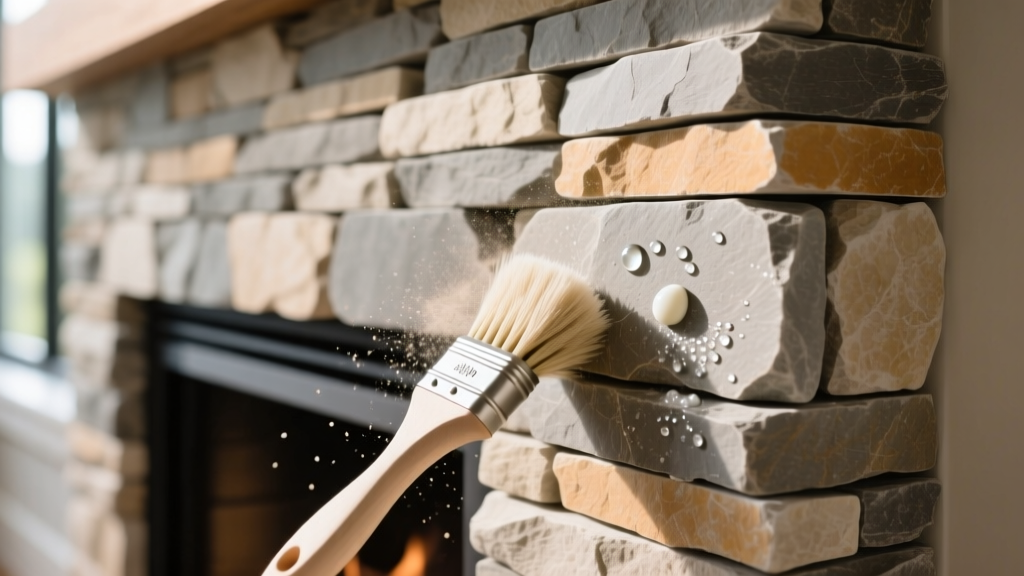
Instead, use a penetrating silane/siloxane sealer (such as Foundation Armor SX5000 WB or Prosoco Siloxane PD). These sealers react chemically with the silica and alkalis in the stone and mortar to form a hydrophobic barrier deep within the pores. They do not alter the surface appearance, leave no film to blister, and are completely heat-stable.
Mortar Joint Inspection and Repair
The mortar joints in a fireplace wall stone veneer are the most vulnerable component to thermal expansion. Hairline cracks (less than 1/16 inch) are normal and generally do not require immediate intervention. However, cracks exceeding 1/8 inch compromise the structural bond and allow moisture ingress, which can lead to freeze-thaw damage if the fireplace is on an exterior wall.
Choosing the Right Repair Material
Standard Type S mortar is too rigid for veneer applications and will crack again under thermal stress. Veneer should be installed and repaired using Type N mortar (1 part Portland cement, 1 part hydrated lime, 6 parts sand), which offers a compressive strength of roughly 750 psi and the necessary flexibility to accommodate heat expansion. For detailed masonry standards and joint specifications, refer to the Brick Industry Association Technical Notes.
For minor, non-structural hairline cracks where color-matching is difficult, a high-quality, sanded acrylic elastomeric caulk (like Sashco Big Stretch) can be used. It mimics the texture of mortar while providing up to 500% elongation, ensuring the joint will not split during extreme heating cycles.
Clearances and Safety Considerations
While the stone veneer itself is non-combustible, the materials behind it and adjacent to it may not be. According to the Chimney Safety Institute of America (CSIA) and NFPA 211 standards, combustible materials (such as wood mantels or drywall) must maintain a minimum clearance of 12 inches from the firebox opening unless specific shielding is used. When maintaining or repairing the veneer near the mantel transition, ensure you are not inadvertently bridging this clearance gap with combustible sealants or expanding foams.
Frequently Asked Questions
Can I use a pressure washer to clean my interior fireplace stone?
No. Pressure washers operate at 1,500 to 3,000 PSI, which will instantly destroy the mortar joints and blast the protective patina off natural stone. Interior fireplace walls should only be cleaned using low-pressure manual scrubbing with a nylon-bristle brush.
How often should I reseal the stone veneer around my fireplace?
Due to the thermal cycling and constant exposure to microscopic soot particles, fireplace veneers typically require resealing every 2 to 3 years. High-use wood-burning fireplaces may require annual sealing. Always rely on the water drop test rather than a strict calendar schedule.
My manufactured stone veneer is fading near the firebox. Is this normal?
Prolonged exposure to intense UV light and direct heat can cause iron-oxide pigments in manufactured concrete veneer to oxidize and fade over decades. If the fading is severe and occurred rapidly, it may indicate that an incompatible, film-forming sealer was applied, which has baked into the surface. Consult a masonry restoration professional to evaluate the damage.
Written by
David NakamuraDavid Nakamura is a licensed architect (AIA) and construction technology writer focused on sustainable building methods, mass timber engineering, and high-performance building envelopes. He holds a Master of Architecture from the University of Washington and is a certified Passive House Consultant (CPHC). David spent eight years at the Seattle firm Mithun, where he led the design of three LEED Platinum projects, before founding his own practice specializing in net-zero residential design. He serves on the editorial advisory board of GreenBuilder Magazine and has authored peer-reviewed papers on cross-laminated timber (CLT) connections for the Journal of Structural Engineering. In his spare time, David teaches woodworking at Pratt Fine Arts Center and kayaks the Puget Sound.
More from David Nakamura
View all
Construction Cost
Labor Cost to Build a Deck Per Sq Ft: 2026 Installation Guide
Discover the exact labor cost to build a deck per sq ft in 2026. This installation guide breaks down contractor rates, complexity factors, and hidden fees.
Aug 4, 2026

Construction Cost
How Much Does It Cost to Build a 3 Bedroom House? Financing Guide
Learn exactly how much it costs to build a 3 bedroom house and explore 2026 financing options, construction loan types, and budget frameworks for your build.
Aug 4, 2026

Construction Cost
Cost to Build a Tennis Court: 2026 Guide
How much does it cost to build a tennis court in 2026? Breakdowns for asphalt, concrete, and synthetic surfaces plus fencing and lighting.
Jul 30, 2026