Floor and Decor Stone Veneer: Complete 2026 Material Guide
Explore the 2026 Floor and Decor stone veneer lineup. Compare natural ledger panels vs manufactured stone, true costs, and expert installation specs.

Decoding the Floor and Decor Stone Veneer Lineup
Floor and Decor has fundamentally altered the masonry supply chain by offering direct-import natural and manufactured stone veneer at big-box retail prices. However, navigating their inventory requires a clear understanding of the structural and aesthetic differences between their two primary categories: Natural Stone Ledger Panels and Manufactured Stone Veneer (MSV). While the showroom displays make both options look interchangeable, their substrate requirements, weight loads, and cutting methodologies differ drastically.
Natural stone veneer at Floor and Decor is predominantly sold in modular ledger panels (typically 6 inches by 24 inches). These are pre-assembled Z-shaped or flat-backed quartzite, slate, or sandstone pieces glued to a mesh backing. They offer unparalleled authenticity and UV stability but carry significant weight. Conversely, their Manufactured Stone Veneer (MSV) is cast from Portland cement, lightweight aggregates, and iron oxide pigments. MSV mimics the profile of fieldstone, dry-stack, or weathered brick, offering a lighter weight alternative that is easier to cut on-site without specialized wet saws.
Crucial Building Code Warning: Weight Limits
According to the International Code Council (ICC), adhered masonry veneer is strictly limited to a maximum weight of 15 pounds per square foot (psf). Natural stone ledger panels frequently push 12 to 14 psf, leaving almost zero margin for error regarding mortar thickness and substrate integrity. If your structural framing cannot support this dead load, you must pivot to MSV, which averages 7 to 9 psf.
2026 Pricing Breakdown: The True Installed Cost
Retailers often market stone veneer based solely on the per-square-foot material cost. For contractors and DIYers, this metric is misleading. The true cost of a Floor and Decor stone veneer project includes the substrate preparation, metal lath, mortar, and corner pieces, which are sold by the linear foot and often account for 20% of the total budget.
| Material Category | F&D Retail Cost (Per Sq. Ft.) | Corner Pieces (Per Lin. Ft.) | Weight (Approx.) | Required Cutting Tool |
|---|---|---|---|---|
| Natural Quartzite Ledger | $8.99 - $11.49 | $14.99 - $18.50 | 13 - 15 lbs/sq ft | 10' Wet Tile Saw (Diamond Blade) |
| Natural Slate Ledger | $7.49 - $9.29 | $12.99 - $15.50 | 11 - 13 lbs/sq ft | 10' Wet Tile Saw / Angle Grinder |
| Manufactured Stacked Stone | $5.29 - $7.99 | $9.50 - $12.99 | 7 - 9 lbs/sq ft | Masonry Blade on Angle Grinder |
| Type S Mortar (80lb Bag) | $12.50 (Covers ~15 sq ft) | N/A | N/A | N/A |
| Galvanized Wire Lath | $1.10 - $1.45 | N/A | 0.2 lbs/sq ft | Tin Snips |
Note: Prices reflect early 2026 national averages and may fluctuate based on regional freight surcharges and local store inventory.
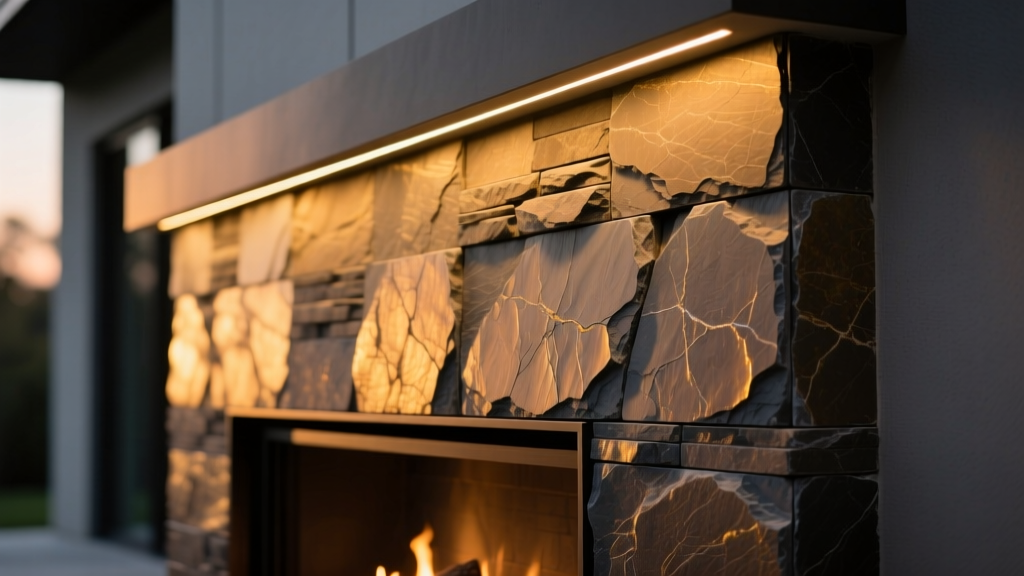
Top Product Lines Evaluated
Natural Stone Ledger Panels: The Quartzite Series
Floor and Decor's Quartzite ledger panels (often stocked in colorways like 'Durango Cream', 'Golden White', and 'Charcoal') are the highest-density options on their showroom floor. Because quartzite is a metamorphic rock, it is virtually impervious to water absorption, making it the superior choice for exterior applications in freeze-thaw climates. The primary drawback is fabrication. Cutting quartzite dry generates hazardous silica dust and chips the edges. You must use a continuous-rim diamond blade on a water-fed wet saw to achieve clean, tight inside corners.
Manufactured Stone Veneer: The Dry-Stack Profiles
The MSV dry-stack profiles emulate modern, mortarless-looking walls while still requiring a traditional mortar bedding. The advantage of F&D's manufactured lines is the integrated color palette. Because the pigments are mixed into the concrete slurry, chipping the face during installation reveals a similar base color, unlike natural stone where a chip might expose a contrasting mineral vein. Furthermore, MSV can be scored and snapped or cut rapidly with a 4.5-inch angle grinder equipped with a turbo-rim masonry blade, drastically reducing installation time on complex geometries like archways and fireboxes.
The 4-Step Adhered Installation Protocol
Skipping substrate preparation is the leading cause of veneer delamination. The Masonry Veneer Manufacturers Association (MVMA) mandates a strict four-step process for all adhered veneer applications over wood or steel framing.
- Weather Barrier and Lath Application: Over exterior sheathing, apply two layers of Grade D water-resistant barrier (WRB). Staple 2.5 lb/sq yd galvanized expanded metal lath (ASTM C847) horizontally. Overlap horizontal seams by 1 inch and vertical seams by 2 inches. Fasten with corrosion-resistant nails or staples every 6 inches into the wall studs, not just the sheathing.
- The Scratch Coat: Mix ASTM C270 Type S mortar. The Portland Cement Association recommends a mix of 1 part Portland cement, 1/2 part hydrated lime, and 4.5 parts masonry sand by volume, or simply use pre-bagged Type S masonry cement. Trowel a 3/8-inch to 1/2-inch layer of mortar completely encapsulating the lath. Score the surface horizontally with a coarse rake to create a mechanical key. Cure for a minimum of 48 hours.
- Setting the Veneer: Butter the back of each stone with a 1/2-inch layer of fresh Type S mortar. Press the stone firmly into the scratch coat until mortar squeezes out slightly at the edges. Maintain a 1/2-inch to 1-inch joint for fieldstone, or push ledger panels tight together for a dry-stack aesthetic.
- Jointing and Tooling (For MSV with joints): Once the mortar has firmed up (thumbprint hard, usually 30-60 minutes), tool the joints with a pointing trowel and a stiff bristle brush to compact the mortar and remove excess. Never use a wire brush on MSV, as it will leave metallic streaks that rust over time.
Troubleshooting and Efflorescence Prevention
Efflorescence—the white, powdery salt deposit that blooms on masonry surfaces—is the most common aesthetic complaint with stone veneer. It occurs when water-soluble salts within the Portland cement mortar migrate to the surface and crystallize upon evaporation.
Expert Insight: Never use muriatic acid or standard brick cleaners to remove efflorescence from Manufactured Stone Veneer. The acid will react with the Portland cement matrix, permanently etching the surface and stripping the iron oxide pigments. Instead, allow the efflorescence to dry completely, brush it off with a dry, stiff nylon brush, and address the underlying moisture intrusion. For persistent cases, use a specialized, non-acidic efflorescence remover formulated specifically for colored concrete products.
To prevent efflorescence from forming in the first place, ensure proper site drainage and install a weep screed at the base of all exterior veneer installations. The weep screed must be positioned a minimum of 4 inches above finished soil grade or 2 inches above paved surfaces to allow trapped moisture behind the WRB to escape, keeping the mortar bed dry and stable for decades.
Written by
Elena RodriguezElena Rodriguez is a civil engineer and technical writer specializing in concrete technology, masonry systems, and ASTM/ACI compliance. She earned her B.S. in Civil Engineering from Texas A&M University and spent a decade at a materials testing laboratory, performing over 2,000 concrete compressive strength tests and masonry prism evaluations. Elena is an ACI-certified Field Testing Technician (Grade I) and a member of ASTM Committee C12 on Natural Building Stone. She currently consults on forensic engineering cases involving concrete failures and moisture intrusion. Based in San Antonio, TX, Elena is a proud member of the Society of Women Engineers (SWE) and coaches her daughter's FIRST Robotics team.
More from Elena Rodriguez
View all
Walls & Panels
Cost Analysis: Light Gauge Steel Framing Advantages and Disadvantages
Evaluate light gauge steel framing advantages and disadvantages through a strict cost analysis lens, comparing material, labor, and lifecycle expenses.
Aug 4, 2026

Walls & Panels
Gypsum Board Types: Exact Specifications, Thickness & Dimensions
Compare standard, Type X, and moisture-resistant gypsum board types. Get exact specifications, thicknesses, dimensions, and ASTM standards for your project.
Aug 4, 2026

Fire Resistance
Best Fire-Resistant Outdoor Decking Materials: 2026 Buyer Guide
Discover the best fire-resistant outdoor decking materials for 2026. Compare Class A PVC, aluminum, and hardwood options for WUI compliance and safety.
Aug 4, 2026