How to Clean, Seal, and Maintain Outdoor Stone Veneer
Protect your exterior. Learn expert maintenance, cleaning, and sealing protocols for outdoor stone veneer to prevent efflorescence and moisture damage.

Diagnostic Framework: Identifying Veneer Distress
Exterior stone veneer systems—whether natural or manufactured concrete-based—are highly durable but remain vulnerable to moisture intrusion, freeze-thaw cycling, and biological colonization. Before applying any cleaning agents or sealers, conduct a thorough visual inspection to identify underlying systemic failures. Treating symptoms without addressing the root cause will result in recurring damage.
Common Failure Modes
- Spalling and Delamination: The face of the stone flakes or pops off. This is almost exclusively caused by trapped moisture freezing and expanding within the pore structure, or by the use of a non-breathable film-forming sealer.
- Efflorescence: A white, powdery salt deposit on the surface. This indicates that water is moving through the masonry, dissolving soluble salts from the mortar or stone, and depositing them on the surface as the water evaporates.
- Joint Recession: Mortar joints erode more than 1/4 inch deep. This allows wind-driven rain to bypass the weather-resistant barrier (WRB) and penetrate the substrate.
- Biological Growth: Green or black staining (algae, mildew, or lichen) thrives in shaded, north-facing elevations where moisture lingers and UV exposure is minimal.
Material-Specific Cleaning Protocols
The cleaning methodology must be strictly matched to the stone type. Manufactured stone veneer (MSV) is a cementitious product with a colored surface layer; aggressive cleaning will strip the pigment and expose the raw aggregate beneath. Natural stone varies wildly in hardness and porosity.
| Material Type | Max Pressure (PSI) | Recommended Chemistry | Prohibited Chemicals |
|---|---|---|---|
| Manufactured Stone (MSV) | 1,200 PSI (12" nozzle distance) | Mild, non-acidic detergents (e.g., Prosoco Sure Klean Restoration Cleaner) | Muriatic acid, hydrochloric acid, bleach |
| Soft Natural (Limestone, Sandstone) | 1,500 PSI (18" nozzle distance) | Neutral pH masonry cleaners, specialized limestone cleaners | Any acidic cleaners (pH < 6) |
| Hard Natural (Granite, Slate, Quartzite) | 2,500 PSI (12" nozzle distance) | Alkaline cleaners for organics; diluted acid for mineral stains | Unbuffered hydrofluoric acid |
According to the Brick Industry Association (BIA) Technical Notes on masonry cleaning, the fundamental rule is to always use the gentlest means possible. Begin with a low-pressure water rinse and a stiff, non-metallic bristle brush. If chemical intervention is required, apply the cleaner from the bottom up to prevent streaking, and rinse from the top down.
Eradicating Efflorescence and Biological Growth
Efflorescence and biological stains require entirely different chemical approaches. Misdiagnosing a white deposit as mold, or treating efflorescence with bleach, will waste time and potentially etch the stone surface.
Step-by-Step Efflorescence Removal
- Dry Brushing: Efflorescence is water-soluble. If the wall is dry, remove as much of the white powder as possible using a stiff, dry nylon brush. Do not use water at this stage, as it will simply dissolve the salts and drive them back into the pores.
- Identify the Moisture Source: Efflorescence is a symptom, not a disease. Check for clogged weep holes, missing flashing, or negative grading directing soil moisture against the veneer base.
- Chemical Treatment: For stubborn deposits on hard natural stone, use a diluted acidic masonry cleaner specifically formulated for efflorescence. Note: Never use acid on manufactured stone veneer. For MSV, rely on dry brushing and specialized non-acidic efflorescence removers that utilize chelating agents rather than acids.
Biological Growth Remediation
Algae and mildew require biocides. While household bleach (sodium hypochlorite) is a common DIY choice, it can degrade the lignin in wood siding adjacent to the stone and harm landscaping. Professional-grade quaternary ammonium compounds (quats) or oxygenated bleach (sodium percarbonate) provide longer-lasting residual protection against regrowth without the harsh environmental impact of chlorine bleach. Apply the biocide, allow a 15-minute dwell time (keeping the surface wet), and rinse thoroughly.
The Sealing Debate: Penetrating vs. Film-Forming
One of the most pervasive myths in masonry maintenance is that all outdoor stone veneer must be sealed. The National Park Service (NPS) Preservation Brief 1 explicitly warns against the indiscriminate application of waterproof coatings on masonry, noting that trapped moisture causes far more damage than the water the coating was meant to repel.
Choosing the Right Sealer Chemistry
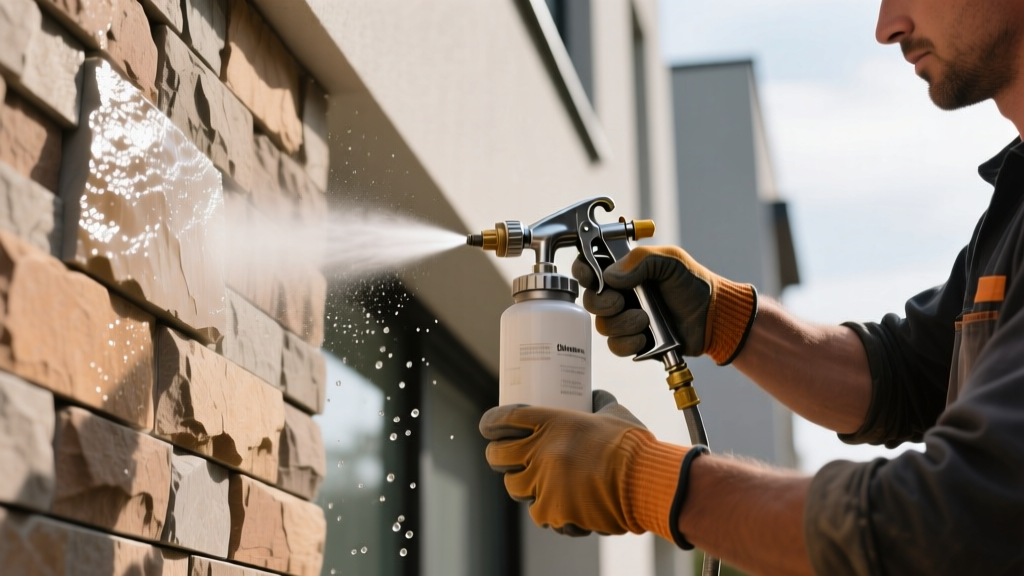
If your veneer is in a high-splash zone, faces severe wind-driven rain, or is highly porous (like certain sandstones), a penetrating sealer is warranted. Avoid acrylics, urethanes, and epoxies entirely.
- Silane/Siloxane Blends (Recommended): These are reactive, penetrating sealers. They do not clog the pores; instead, they chemically bond to the silica within the masonry matrix, creating a hydrophobic barrier that repels liquid water while allowing water vapor to pass through. Look for products with a high solids content (minimum 5-7% active siloxane for vertical applications). Expect to pay $0.60 to $1.20 per square foot for high-quality commercial-grade siloxane.
- Silicone Resins: Offer good water repellency but can degrade under heavy UV exposure, leading to yellowing or loss of efficacy over time. Generally inferior to siloxanes for exterior vertical applications.
- Film-Forming Acrylics (Avoid): These sit on the surface, creating a glossy "wet look." They trap vapor, peel, flake, and require aggressive chemical stripping for removal. They are the primary culprit behind spalling manufactured stone.
Application Metrics
Apply penetrating sealers using a low-pressure (under 50 PSI) pump sprayer. Apply in a single, continuous, saturating coat from the bottom up to avoid drip marks. Coverage rates typically range from 100 to 150 square feet per gallon, depending on the porosity of the stone and the depth of the mortar joints. Ambient temperatures must be between 45°F and 90°F during application and for 24 hours post-application to ensure proper cross-linking.
Mortar Joint Remediation and Tuckpointing
Mortar joints are the sacrificial element of any masonry system. They are designed to be slightly softer and more permeable than the stone itself. When joints deteriorate, water infiltration accelerates exponentially.
Selecting the Correct Mortar Type
Using a mortar that is too hard (high Portland cement content) will force the stone to absorb all structural stress and thermal expansion, leading to cracked stone faces.
- Type N Mortar (Recommended for most veneers): A medium-strength mix (1 part Portland cement, 1 part hydrated lime, 6 parts sand). It offers excellent flexibility and breathability, making it ideal for manufactured stone and soft natural stones above grade.
- Type S Mortar: Higher compressive strength. Only use this for structural applications or below-grade retaining walls. It is generally too rigid for exterior above-grade veneer.
When tuckpointing, use a diamond-tipped masonry blade to grind out the deteriorated mortar to a depth of at least 2 to 2.5 times the width of the joint. Clean the joint with compressed air, dampen it with water to prevent the dry old masonry from sucking the moisture out of the new mortar too quickly, and pack the new mortar tightly using a pointing trowel and jointer. Tool the joint to a slightly concave profile to shed water effectively.
Frequently Asked Questions
Can I use a pressure washer on manufactured stone veneer?
Yes, but with strict limitations. Keep the pressure under 1,200 PSI, use a wide 40-degree fan tip, and maintain a minimum distance of 12 inches from the surface. Angling the wand upward into the horizontal mortar joints will force water behind the veneer and compromise the weather-resistant barrier.
How often should outdoor stone veneer be resealed?
High-quality silane/siloxane sealers typically last 5 to 10 years on vertical surfaces. Do not reapply on a fixed schedule. Instead, perform a splash test: toss a cup of water onto the wall. If the water beads up and runs off, the sealer is intact. If the stone darkens rapidly and absorbs the water, it is time to reseal.
Is it normal for mortar to crack slightly along the stone edge?
Micro-cracking (hairline cracks at the stone-to-mortar interface) is common and often harmless, resulting from thermal expansion differentials between the stone and the mortar. However, if the cracks are wider than 1/16 inch, allow water ingress, or run continuously through the mortar bed joints, the wall requires professional tuckpointing and a review of the structural substrate for deflection.
Written by
Priya KapoorPriya Kapoor is a real estate market analyst and construction economics researcher with expertise in housing affordability, development feasibility, and infrastructure investment. She holds a Master of Regional Planning from Cornell University and previously worked as a senior analyst at CBRE's Investment Properties group, where she modeled returns for $4B in mixed-use development pipelines. Priya now runs an independent research practice advising developers, municipalities, and REITs on construction cost forecasting and market timing. She publishes the quarterly "BuildMat Market Pulse" report tracking material price indices across 12 commodity categories. Based in Austin, TX, Priya serves on the board of Habitat for Humanity Austin and is a marathon runner.
More from Priya Kapoor
View all
Construction Cost
Cost to Build a 1600 Sq Ft Home in 2026: Full Breakdown
Accurate 2026 cost to build a 1600 sq ft home—material, labor, and regional pricing breakdowns included. Plan your budget with real-time estimates.
Aug 11, 2026

Wood & Lumber
Name the Types of Wood for Pressure Treatment and Preservation
Learn how to name the types of wood best suited for pressure treatment. Compare species treatability, chemical retention levels, and 2026 preservation costs.
Aug 4, 2026

Stone & Masonry
Stone Veneer Suppliers Lindenhurst: 2026 Cost Analysis
Analyze 2026 stone veneer costs in Lindenhurst, NY. Compare local supplier pricing, delivery fees, and Suffolk County installation labor rates.
Aug 4, 2026