Is Stone Veneer Waterproof? Design Guide for Wet Areas & Exteriors
Discover if stone veneer is waterproof. Learn how to design moisture-resistant accent walls, showers, and outdoor kitchens with proper waterproofing systems.

The Short Answer: Stone vs. The System
When architects and homeowners ask, 'is stone veneer waterproof,' the technical answer is no. Neither natural stone nor manufactured concrete veneer is inherently impervious to water. Natural stones like sandstone and limestone are highly porous, while manufactured veneer relies on a concrete matrix that readily absorbs moisture through capillary action. However, a properly engineered stone veneer assembly is entirely waterproof. The distinction lies in shifting the design focus from the decorative face to the hidden structural and moisture-management layers behind it.
For high-end design applications—such as indoor steam showers, outdoor kitchen islands, and architectural water features—relying on the stone itself to repel water guarantees catastrophic failure, including efflorescence, substrate rot, and freeze-thaw spalling. Achieving a waterproof finish requires a meticulously layered system that manages liquid water and water vapor independently of the stone's natural absorption rate.
Anatomy of a Waterproof Veneer Assembly
Designing a moisture-resistant stone feature requires treating the wall as a multi-tiered drainage and defense system. According to guidelines published by the Building Science Corporation, managing bulk water and vapor diffusion requires distinct material layers. For exterior applications and high-moisture interiors, the assembly must follow this strict sequence:
- Structural Substrate: Exterior-grade plywood, OSB, or concrete masonry units (CMU).
- Weather-Resistive Barrier (WRB): A code-compliant house wrap (like Tyvek) or fluid-applied membrane that acts as the primary water-resistive layer and secondary drainage plane.
- Weep Screed (ASTM C2285): A corrosion-resistant metal flashing at the base of the wall that terminates the WRB and allows any trapped water to drain out of the assembly.
- Metal Lath (ASTM C847): Minimum 2.5 lb/sq yd galvanized or stainless steel lath, mechanically fastened through the WRB into the structural framing.
- Scratch Coat: A 1/2-inch to 3/4-inch layer of Type S mortar, scored horizontally to provide a mechanical key for the final setting bed.
- Setting Bed & Stone: Type S mortar applied to the back of the stone (back-buttering is mandatory for wet areas) and pressed into the scratch coat.
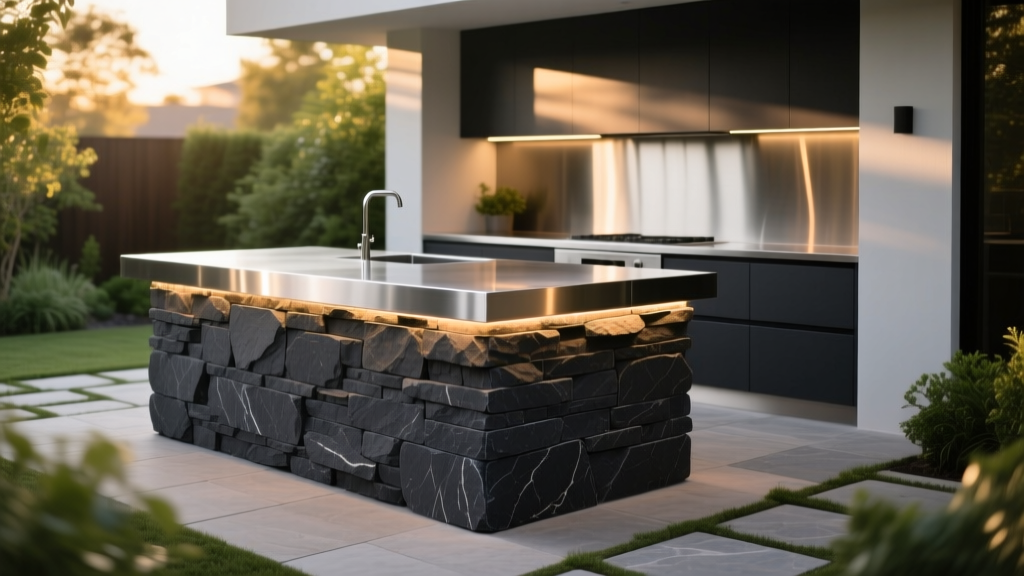
Designing High-Moisture Interiors: The Shower Challenge
Incorporating stacked stone or ledger panels into a shower enclosure is a striking design choice, but it introduces severe moisture risks. Standard cement backer board (like Durock or HardieBacker) is water-resistant, not waterproof. If water penetrates the mortar joints and the stone, it will saturate the backer board and eventually compromise the wood framing.
To build a genuinely waterproof interior stone shower, you must utilize a surface-applied liquid waterproofing membrane. Products like LATICRETE HYDRO BAN or Custom Building Products RedGard are painted directly over the cement backer board, creating a seamless, monolithic rubberized barrier. The National Park Service Preservation Brief on Masonry emphasizes that moisture management in masonry assemblies must prevent water from reaching vulnerable structural substrates.
Zone 1 (Submerged/Heavy Splash): Shower floors and lower 6 inches of walls. Avoid stone veneer here; use large-format porcelain or solid stone slabs with epoxy grout.
Zone 2 (Direct Splash): Mid-level shower walls. Use low-porosity stone (slate, granite) with a dense mortar bed and penetrating sealer.
Zone 3 (Ambient Humidity): Upper walls and bathroom accents. High-porosity stones (limestone, sandstone) are safe here, provided bathroom ventilation exceeds 80 CFM.
Material Matrix: Porosity and Wet-Area Suitability
Not all stones react to moisture identically. The absorption rate dictates the required maintenance, the type of sealer needed, and the suitability for exterior freeze-thaw climates or interior steam environments. Below is a performance matrix for common veneer materials in wet applications.
| Material Type | Avg Porosity | Wet Area Rating | Design Application & Edge Cases |
|---|---|---|---|
| Granite Veneer | 0.5% - 1.5% | Excellent | Ideal for outdoor kitchens and shower accents. Highly resistant to staining and freeze-thaw damage. Heavy weight requires reinforced substrate. |
| Slate | 1.0% - 4.0% | Very Good | Excellent for water features and shower walls. Must be sealed to prevent delamination (flaking) in high-humidity steam showers. |
| Manufactured (Concrete) | 8.0% - 12.0% | Fair to Good | Requires high-quality penetrating sealer for exteriors. Prone to efflorescence if a weep screed and WRB are omitted. |
| Limestone | 5.0% - 10.0% | Fair | Beautiful for dry interior accents and covered patios. Highly susceptible to acid etching from shower soaps and hard water. |
| Sandstone | 10.0% - 15.0%+ | Poor | Strictly for dry, interior design features. Will rapidly degrade, spall, and harbor mold if used in showers or unprotected exteriors. |
The Chemistry of Sealers: Penetrating vs. Film-Forming
Selecting the correct sealer is the final line of defense in a stone veneer design. Sealers generally fall into two chemical categories, and choosing the wrong one will ruin a high-end installation.
Penetrating Sealers (Silane/Siloxane)
These are the only sealers recommended for wet areas and exterior veneers. Silane and siloxane molecules are small enough to penetrate the microscopic pores of the stone and mortar, reacting chemically to form a hydrophobic resin below the surface. This stops liquid water from entering while allowing water vapor to escape (breathability). Brands like Miracle Sealants 511 Impregnator or Aqua Mix Sealer's Choice Gold are industry standards. Reapplication is typically required every 3 to 5 years for exterior applications.
Film-Forming Sealers (Acrylics/Urethanes)
These sealers sit on top of the stone, creating a physical plastic-like shell. While they enhance color and provide a 'wet look' that designers often love, they are disastrous for wet environments. If moisture gets behind the stone (through a microscopic mortar crack), the film-forming sealer traps it inside. When the sun heats the exterior wall, or hot water hits an interior shower wall, the trapped vapor expands, blowing the face off the stone—a process known as spalling.
Cost Breakdown for Waterproof Veneer Systems (2026)
Budgeting for a waterproof stone veneer project requires looking beyond the cost of the stone itself. The hidden moisture-management layers and specialized labor significantly impact the final price. Below is a realistic 2026 cost breakdown per square foot for a premium, fully waterproofed installation.
- Substrate Prep & Cement Board: $2.50 - $4.00 / sq ft
- Liquid Waterproofing Membrane (e.g., RedGard): $1.50 - $2.50 / sq ft
- Metal Lath & Fasteners: $1.00 - $1.80 / sq ft
- Type S Mortar (Scratch & Setting): $1.20 - $2.00 / sq ft
- Stone Veneer Material: $8.00 - $22.00 / sq ft (Natural stone skews higher)
- Specialized Masonry Labor: $18.00 - $30.00 / sq ft
- Penetrating Sealer & Application: $2.00 - $4.50 / sq ft
Total Installed Cost: Expect to pay between $34.20 and $66.80 per square foot for a fully waterproofed, code-compliant stone veneer system. While this is 20% to 30% more expensive than a standard 'dry-area' interior accent wall installation, skipping the waterproofing layers in wet environments will inevitably lead to remediation costs exceeding $15,000 due to mold abatement and structural framing replacement.
Written by
James ThorntonJames Thornton is a construction industry veteran with 25 years of hands-on experience in wood framing, lumber grading, and residential building codes. He started as a framing carpenter in rural Oregon, earned his ICC Residential Building Inspector certification, and eventually became a senior plan reviewer for the City of Portland Bureau of Development Services. James holds a B.S. in Wood Science & Technology from Oregon State University and is a certified lumber grader through the West Coast Lumber Inspection Bureau (WCLIB). He has inspected over 3,000 residential construction sites and authored the city's internal guide on advanced framing techniques (2x6 at 24" O.C.). James lives in Bend, OR, where he builds custom timber-frame cabins and competes in lumberjack sports.
More from James Thornton
View all
Insulation
Best Home Insulation Materials: Complete 2026 Guide
Compare top home insulation materials for 2026. Find R-values, installed costs per square foot, and best uses for fiberglass, spray foam, and mineral wool.
Aug 4, 2026

Sustainable Building
Certify Your Green Building Material for LEED and WELL
Step-by-step guide to certifying a green building material for LEED v5 and WELL v2. Master EPDs, HPDs, and VOC limits for 2026 project specifications.
Aug 4, 2026

Stone & Masonry
Veneer Stacked Stone Panels: Interior Design & Style Showcase
Discover how veneer stacked stone panels transform interiors. Explore modern design profiles, material pairings, and technical installation specs.
Aug 4, 2026