Lava Stone Veneer Cost Analysis: 2026 Pricing Guide
Comprehensive 2026 cost analysis for lava stone veneer. Compare natural basalt vs. manufactured profiles, labor rates, and hidden structural costs.

Material Cost Matrix: Natural Basalt vs. Manufactured Lava Profiles
When specifying lava stone veneer, the first critical cost variable is material origin. The market divides into two distinct categories: natural basalt (true volcanic rock) and manufactured stone veneer (MSV) engineered to mimic porous lava textures. Natural basalt is quarried, diamond-wire cut, and split, resulting in higher material and freight costs. Manufactured alternatives, such as the volcanic profiles offered by Eldorado Stone, utilize pumice, Portland cement, and iron oxide pigments to replicate the aesthetic at a fraction of the weight and cost.
| Material Type | Avg. Material Cost (per sq. ft.) | Weight (lbs/sq. ft.) | Avg. Thickness | Lead Time (2026) |
|---|---|---|---|---|
| Natural Basalt Thin Veneer | $24.00 - $38.00 | 11.0 - 15.0 | 0.75' - 1.25' | 6 - 12 weeks |
| Manufactured Lava MSV | $11.00 - $18.00 | 8.0 - 10.5 | 1.0' - 2.5' | 2 - 4 weeks |
| Natural Basalt Panels (Pre-set) | $35.00 - $55.00 | 14.0 - 18.0 | 1.5' | 8 - 16 weeks |
Freight Surcharge Warning: Natural basalt is exceptionally dense (approx. 3.0 g/cm³). For projects exceeding 500 square feet, LTL (Less-Than-Truckload) freight shipping for natural stone will add $2.50 to $4.50 per square foot to your baseline material cost, depending on proximity to the port of entry or domestic quarry. Manufactured stone is typically distributed through regional dealers, drastically reducing last-mile delivery fees.
Hidden Structural Costs: Weight and Substrate Reinforcement
The most frequently underestimated line item in lava stone veneer budgets is structural reinforcement. Because dark, dense stone is typically installed on exterior facades or interior feature walls, the substrate must support the dead load without deflection.
Standard 2x4 wood framing at 16 inches on-center can support up to 15 lbs/sq. ft. of veneer weight. If your natural basalt veneer exceeds 1.25 inches in thickness, or if you are installing over existing masonry without a continuous concrete footing, you must install a structural steel angle iron ledger bolted directly to the foundation. Expect to pay $14.00 to $22.00 per linear foot for a galvanized steel ledger installation, including masonry anchors and flashing.
For interior applications over drywall, the drywall must be removed down to the studs. Installing heavy natural stone directly over 5/8-inch drywall risks catastrophic shear failure. The substrate must be upgraded to 1/2-inch or 3/4-inch exterior-grade plywood or cement backer board, adding $1.80 to $3.50 per square foot in prep materials.
Installation Labor and Consumables Breakdown
Labor rates for stone veneer installation in 2026 average between $16.00 and $28.00 per square foot, heavily dependent on the stone's profile. Natural basalt thin veneer requires meticulous dry-fitting and cutting with continuous-rim diamond blades to manage the dense, brittle nature of the rock. Manufactured lava profiles are softer and can be scored and snapped or cut with standard abrasive masonry blades, reducing labor time by approximately 15%.
Required Consumables and Code Compliance
According to guidelines published by The Masonry Society, exterior adhered veneer systems must adhere to strict moisture management protocols. Your consumables budget must include:
- Weather-Resistive Barrier (WRB): Two layers of Grade D building paper or a fluid-applied membrane ($1.20 - $2.50/sq. ft.).
- Corrosion-Resistant Lath: Minimum 2.5 lb/sq. yd galvanized steel lath (ASTM C1063). Do not use interior-grade lath for exterior applications, as rust stains will bleed through the porous lava stone texture ($1.80/sq. ft.).
- Weep Screeds: PVC or galvanized weep screeds at all base terminations to allow moisture egress ($3.50 per linear foot).
- Mortar: Type S mortar mix for exterior scratch coats and setting beds. For interior applications over cement board, a polymer-modified thin-set mortar (ANSI A118.4) is required ($0.80 - $1.40/sq. ft.).
The Efflorescence Risk: Sealing Dark Stone
Lava stone and dark basalt profiles present a unique maintenance challenge: efflorescence. When water migrates through the mortar bed and stone, it carries soluble salts to the surface. On light-colored limestone, this white, powdery calcium carbonate deposit is barely noticeable. On charcoal or black lava stone, efflorescence is glaringly obvious and can ruin the aesthetic within months of installation.
To mitigate this, you must factor in the cost of high-performance chemical sealers and specialized mortars:
- Use Low-Alkali Mortar: Standard Portland cement is high in alkali. Specify a low-alkali Portland cement or a pre-blended, efflorescence-controlled mortar mix for the setting bed.
- Silane/Siloxane Sealers: Never use acrylic or polyurethane film-forming sealers on exterior lava stone. They trap moisture inside the wall cavity, leading to spalling during freeze-thaw cycles. Instead, apply a breathable, penetrating silane/siloxane sealer (such as Prosoco Siloxane PD). Budget $0.45 to $0.85 per square foot for the sealer and two-coat application labor.
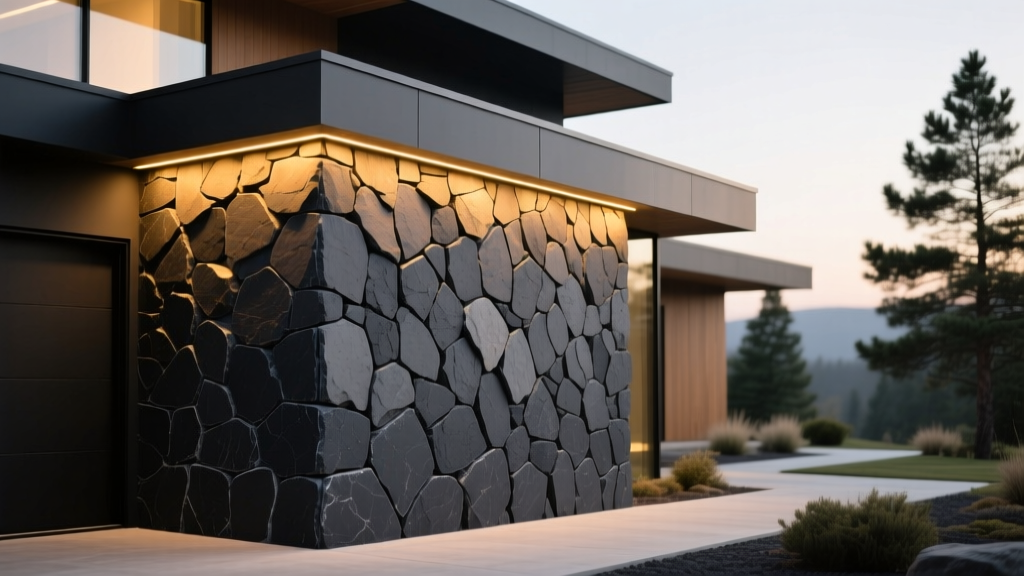
Decision Framework: When to Choose Natural vs. Manufactured
Selecting between natural basalt and manufactured lava profiles should be driven by project constraints rather than just aesthetic preference. Use the following framework to finalize your specification:
Specify Natural Basalt When:
- The project is a high-end commercial facade or luxury residence where material authenticity is a primary selling point.
- The stone will be used in high-impact zones (e.g., commercial lobbies, exterior wainscoting) where the extreme hardness (Mohs 6-7) of basalt prevents scratching and chipping.
- The design requires precise, tight-joint ashlar patterns that benefit from the uniform density of diamond-cut natural stone.
Specify Manufactured Lava MSV When:
- The substrate is an existing wood-framed structure without a continuous concrete footing, and adding structural ledgers is cost-prohibitive.
- The project timeline is aggressive; MSV is typically available from local dealers within days, whereas imported natural basalt can face 12-week port delays.
- The installation involves complex curves, arches, or tight interior corners where the lighter, softer MSV can be easily mitered and shaped on-site.
Industry data tracked by publications like Stone World indicates a steady shift toward high-fidelity manufactured profiles for residential projects due to these structural and logistical advantages, while natural basalt remains the standard for institutional and luxury commercial architecture. By accurately budgeting for the hidden structural loads, specialized mortars, and breathable sealers required for dark stone, you can ensure your lava stone veneer installation remains structurally sound and visually pristine for decades.
Written by
Elena RodriguezElena Rodriguez is a civil engineer and technical writer specializing in concrete technology, masonry systems, and ASTM/ACI compliance. She earned her B.S. in Civil Engineering from Texas A&M University and spent a decade at a materials testing laboratory, performing over 2,000 concrete compressive strength tests and masonry prism evaluations. Elena is an ACI-certified Field Testing Technician (Grade I) and a member of ASTM Committee C12 on Natural Building Stone. She currently consults on forensic engineering cases involving concrete failures and moisture intrusion. Based in San Antonio, TX, Elena is a proud member of the Society of Women Engineers (SWE) and coaches her daughter's FIRST Robotics team.
More from Elena Rodriguez
View all
Walls & Panels
Cost Analysis: Light Gauge Steel Framing Advantages and Disadvantages
Evaluate light gauge steel framing advantages and disadvantages through a strict cost analysis lens, comparing material, labor, and lifecycle expenses.
Aug 4, 2026

Walls & Panels
Gypsum Board Types: Exact Specifications, Thickness & Dimensions
Compare standard, Type X, and moisture-resistant gypsum board types. Get exact specifications, thicknesses, dimensions, and ASTM standards for your project.
Aug 4, 2026

Fire Resistance
Best Fire-Resistant Outdoor Decking Materials: 2026 Buyer Guide
Discover the best fire-resistant outdoor decking materials for 2026. Compare Class A PVC, aluminum, and hardwood options for WUI compliance and safety.
Aug 4, 2026