How to Clean and Maintain a Veneer Stone Fireplace Surround
Learn expert techniques to clean, seal, and maintain your veneer stone fireplace surround. Protect against soot, heat damage, and efflorescence.

The Chemistry of Soot and Stone Veneer
A veneer stone fireplace surround faces extreme thermal cycling, acidic soot buildup, and microscopic ash infiltration. Unlike standard wall installations, fireplace surrounds require specialized maintenance protocols. The primary challenge lies in the porosity of the material. Manufactured Stone Veneer (MSV) is a Portland cement-based product, making it highly alkaline and exceptionally vulnerable to acidic cleaners. Natural Stone Veneer (NSV) varies; calcareous stones like limestone and marble will etch instantly upon contact with acids, while siliceous stones like slate and quartzite are more resilient but still prone to soot staining.
Standard household glass or multi-surface cleaners often contain ammonia or mild acids that degrade the cementitious binder in MSV and strip the protective patina from NSV. According to guidelines from the Natural Stone Institute, maintaining the structural and aesthetic integrity of stone requires strictly pH-neutral (7.0) or slightly alkaline (8.0-9.0) cleaning agents formulated specifically for masonry and stone substrates.
Step-by-Step Soot and Ash Removal
Removing carbon deposits and fly ash from a veneer stone fireplace surround requires a systematic approach to prevent driving the soot deeper into the stone’s capillary pores.
1. Dry Extraction
Never apply water to dry soot. Water combines with carbon ash to create a highly alkaline, staining sludge that penetrates deep into the stone. Use a HEPA-filtered shop vacuum with a soft brush attachment to remove loose ash. Follow this with a dry, medium-stiffness nylon-bristle brush to dislodge embedded particulates from the mortar joints and stone crevices. Never use wire brushes; they shed microscopic iron filaments that will oxidize and create permanent rust stains on the veneer.
2. Pre-Wetting the Substrate
Before applying any liquid cleaner, pre-wet the stone surround with clean, cold water using a low-pressure pump sprayer. MSV and porous NSV act like sponges. Pre-wetting fills the capillary pores with clean water, preventing the dirty cleaning solution from being absorbed into the stone. The surface should be damp, not dripping.
3. Application and Agitation
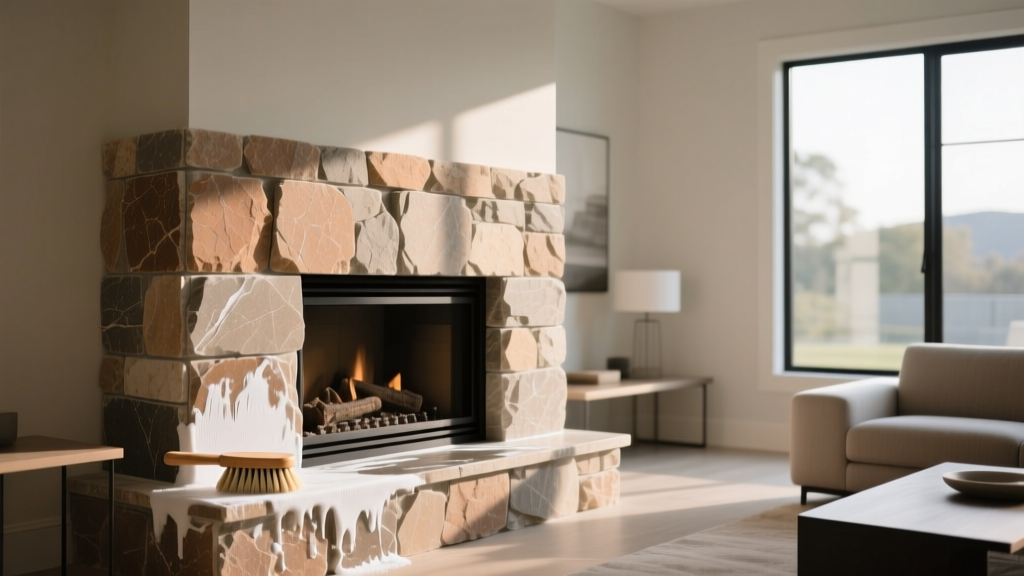
Apply an alkaline masonry cleaner, such as PROSOCO SureKlean Fireplace Cleaner, using a pump sprayer. Allow the solution to dwell for 5 to 7 minutes. Do not let the cleaner dry on the surface. Agitate the surface using a nylon-bristle brush in a circular motion, focusing heavily on the mortar joints where soot accumulates.
4. Low-Pressure Rinse
Rinse the surround thoroughly with clean water. Use a garden hose or a pressure washer set to a maximum of 400 PSI with a 40-degree wide fan tip. High-pressure washing (above 1,000 PSI) will erode the mortar joints and scar the surface of manufactured veneer.
Sealing Your Veneer Stone Fireplace Surround
Applying a sealer to a fireplace surround is not optional; it is a critical defense against heat-induced moisture migration and soot infiltration. However, the thermal cycling of a fireplace (rapid expansion and contraction) destroys standard sealers. Film-forming acrylic sealers will blister, peel, and turn opaque white when exposed to surface temperatures exceeding 150°F.
You must use a penetrating, siloxane-based or silane-based sealer. These chemicals react with the silica in the stone and mortar to form a hydrophobic barrier below the surface, allowing the stone to breathe and release water vapor without trapping heat.
| Sealer Type | Chemical Base | Heat Tolerance | Vapor Permeable? | Reapplication Frequency |
|---|---|---|---|---|
| Penetrating Siloxane | Water/Solvent | Up to 400°F | Yes (100%) | 3-5 Years |
| Penetrating Silane | Solvent | Up to 350°F | Yes (100%) | 5-7 Years |
| Film-Forming Acrylic | Water | < 150°F (Fails) | No (Traps Moisture) | 1-2 Years |
| Color-Enhancing Sealer | Solvent | Up to 250°F | Partial (60-80%) | 1-3 Years |
Application Protocol
Before sealing, verify the stone is completely dry. Use a pinless moisture meter; readings must be below 15%. Apply the siloxane sealer in two coats using a low-pressure sprayer. The second coat must be applied "wet-on-wet" (within 3 to 5 minutes of the first coat) to ensure deep penetration before the initial carrier solvent flashes off. Wipe away any excess sealer that pools on the surface with a microfiber cloth to prevent glossy spotting.
Troubleshooting Common Fireplace Stone Issues
Efflorescence (White Powdery Residue)
Efflorescence occurs when water-soluble salts within the mortar or stone migrate to the surface and crystallize upon evaporation. On a fireplace surround, this is often driven by the heat of the fire pulling moisture out of the masonry. The Fix: Do not use water to clean efflorescence, as it simply redissolves the salts and pushes them back into the pores. Use a dry, stiff nylon brush to aggressively sweep away the crystals. For stubborn deposits, apply a specialized, non-acidic efflorescence remover formulated for manufactured stone.
Crumbling Mortar Joints
The intense heat of a fireplace causes rapid thermal expansion. If the original installer used a rigid, high-strength mortar (like Type S or Type M), the mortar will not flex with the stone, leading to micro-cracking and eventual crumbling. The Fix: Rake out the degraded mortar to a depth of 3/4 inch using a mortar rake or angle grinder. Repoint the joints using Type N mortar (approx. 750 PSI compressive strength). As outlined by the Masonry Society, Type N offers the ideal balance of flexibility and adhesion for veneer applications subjected to thermal cycling. Tool the joint to a concave profile to compress the mortar against the stone edges, creating a superior water shed.
Heat Discoloration
Prolonged exposure to high heat can cause certain natural stones (particularly sandstones and some slates) to oxidize and turn yellow or red. Manufactured stone may scorch if the firebox lacks proper clearance. The Fix: Heat discoloration is a permanent chemical alteration of the iron minerals within the stone and cannot be cleaned off. Ensure your firebox meets the clearance requirements mandated by the Chimney Safety Institute of America (CSIA) to prevent excessive radiant heat transfer to the surround. If the stone is already discolored, applying a color-enhancing penetrating sealer can help blend the scorched areas with the surrounding stone.
Annual Maintenance Checklist
To preserve the structural integrity and aesthetic of your veneer stone fireplace surround, execute the following maintenance schedule annually, preferably in late summer before the heavy burning season begins.
- Inspect Mortar Joints: Run a flathead screwdriver lightly along the joints. If the mortar powders or crumbles, schedule repointing with Type N mortar.
- Perform a Water Drop Test: Splash a few drops of water onto the stone. If it beads up, your sealer is intact. If it absorbs into the stone within 30 seconds and darkens the surface, it is time to reapply a siloxane penetrating sealer.
- Clearance Verification: Ensure no combustible materials (wood mantels, drywall) have shifted closer than the manufacturer’s specified clearance to the stone veneer.
- Deep Clean: Execute the 4-step dry extraction and alkaline wash process detailed above to remove the previous season's carbon buildup before it permanently stains the substrate.
Written by
Marcus ChenMarcus Chen is a licensed structural engineer (PE) and building materials analyst with over 12 years of experience across residential, commercial, and industrial construction. He holds a Master of Science in Civil Engineering from UC Berkeley and spent six years at Thornton Tomasetti before transitioning to independent consulting and technical writing. Marcus specializes in material selection for seismic-prone regions, concrete reinforcement strategies, and lifecycle cost analysis. His work has been cited by the American Concrete Institute (ACI) and the Structural Engineers Association of California (SEAOC). When he is not on a job site or at his desk, you will find him hiking the Sierra Nevada or restoring a 1920s craftsman bungalow in Oakland, CA.
More from Marcus Chen
View all
Construction Cost
How Much Did the Eiffel Tower Cost to Build?
How much did the Eiffel Tower cost to build in 1889? We adjust for inflation and compare its budget to modern skyscraper construction.
Aug 4, 2026

Fire Resistance
What Is a Fire Resistant Material? Testing & Certification Guide
Discover what is a fire resistant material through ASTM and UL testing. Learn how fire ratings, certifications, and assemblies work in construction.
Aug 4, 2026

Construction Cost
How Much Did the Burj Khalifa Cost to Build?
How much did the Burj Khalifa cost to build? We break down the $1.5B project and extract 5 money-saving strategies for your next build.
Jul 30, 2026