White Stone Veneer Stacked vs. Ledge Profile: 2026 Comparison Review
Compare white stone veneer stacked profiles against ledge options. Discover 2026 costs, installation specs, and top brand reviews for your build.

The Shift Toward Clean Lines: Stacked vs. Traditional Profiles
Architectural trends in 2026 continue to favor transitional and modern farmhouse aesthetics, driving massive demand for crisp, minimalist exterior and interior cladding. When specifying white stone veneer stacked in a dry-fit or tight-mortar configuration, designers achieve a linear, contemporary look that contrasts sharply with the rustic, irregular shadow lines of traditional ledge or fieldstone profiles. However, selecting the right profile involves more than just visual preference; it dictates installation methodology, structural weight, and long-term maintenance.
This comparison review breaks down the technical, financial, and aesthetic differences between stacked white veneer and its closest competitor, the ledge profile, while evaluating top manufactured stone lines currently dominating the market.
Profile Showdown: Stacked vs. Ledge vs. Fieldstone
Understanding the geometric differences between stone profiles is critical for calculating material yields and labor hours. Stacked stone is characterized by uniform, rectangular cuts designed to fit tightly together, whereas ledge stone features varying heights and depths to mimic natural, weathered outcroppings.
| Feature | Stacked Profile (White) | Ledge Profile (White) | Fieldstone / Cobble |
|---|---|---|---|
| Average Thickness | 1.5" to 2.5" | 2.0" to 4.0" | 2.5" to 5.0" |
| Weight per Sq. Ft. | 9.5 - 11.5 lbs | 12.0 - 14.5 lbs | 13.0 - 16.0 lbs |
| Shadow Line Depth | Minimal (0" to 0.5") | Pronounced (1" to 2") | Highly Irregular |
| Primary Joint Style | Dry-stack or tight 0.25" rake | Standard 0.5" to 1" mortar joint | Wide 1"+ contoured joints |
| Best Application | Exterior facades, retaining walls, traditional hearths | Rustic exteriors, landscape features, accent pillars |
Top 3 Manufactured White Stacked Veneer Lines in 2026
Not all manufactured stone veneer (MSV) is created equal. The quality of the molds, the consistency of the iron-oxide pigments, and the density of the concrete mix dictate the final result. Here is how the top three manufacturers compare for white stacked profiles.
1. Eldorado Stone - Stacked Stone (Alpine & Linen)
Eldorado Stone remains the benchmark for mold variety. Their 'Alpine' colorway offers a stark, bright white with subtle cool-gray undertones, ideal for modern interiors. The molds capture the micro-texture of split-face granite without the heavy rustication of ledge stone.
- Price: $9.50 - $11.50 per sq. ft. (material only)
- Pros: Exceptional corner piece availability; high mold variation prevents repetitive patterns.
- Cons: Lighter pigments can show efflorescence more readily if installed with high-Portland mortar.
2. Coronado Stone - Stacked Stone (White Mountain)
Coronado's 'White Mountain' leans slightly warmer, incorporating faint beige and cream striations. This makes it highly forgiving in exterior applications where pure white might look blinding under direct sunlight.
- Price: $8.75 - $10.25 per sq. ft.
- Pros: Excellent color consistency batch-to-batch; slightly denser concrete mix reduces chipping during transit.
- Cons: Fewer distinct mold shapes compared to Eldorado, requiring careful layout planning to avoid visible repetition.
3. Dutch Quality Stone - Stacked Stone (Snowcap)
A premium option, 'Snowcap' features a highly variegated white palette with charcoal accents. It bridges the gap between contemporary and rustic.
- Price: $11.00 - $13.50 per sq. ft.
- Pros: Deep, realistic texturing; integrated color throughout the concrete body (no painted surface).
- Cons: Premium pricing; longer lead times for custom orders.
The Dry-Stack vs. Mortared Installation Debate
When installing white stone veneer stacked profiles, the joint treatment dramatically alters the final aesthetic and the technical requirements of the build.
Dry-Stack (Mortarless Appearance)
Dry-stacking involves applying stones tightly against one another with no visible mortar joint.
Because there is no mortar joint to hide gaps, the substrate must be perfectly plumb. Any bowing in the wall framing will result in 'lippage' (stones protruding past their neighbors), which catches harsh shadows and ruins the linear illusion of the stacked profile.
Tight Mortar Joint (Raked or Flush)
For exterior applications, the National Concrete Masonry Association (NCMA) strongly recommends a mortared joint for stacked stone to prevent water infiltration behind the veneer. A tight 1/4-inch joint, struck flush or slightly raked, maintains the modern linear look while providing a crucial moisture barrier. Use a Type N mortar rather than Type S. Type N has a lower Portland cement content, which reduces the risk of efflorescence (white salt deposits) and is less likely to crack under minor structural deflection.
2026 Cost Analysis: Material and Labor Breakdown
White stacked stone veneer carries unique labor variables. While the material is lighter and easier to handle than ledge stone, the precision required for dry-stacking or tight-jointing increases masonry labor hours.
| Cost Category | Stacked White Veneer | Traditional Ledge Veneer |
|---|---|---|
| Material (Veneer & Corners) | $9.00 - $13.00 / sq. ft. | $8.50 - $12.00 / sq. ft. |
| Substrate Prep (WRB, Lath, Scratch) | $2.50 - $3.50 / sq. ft. | $2.50 - $3.50 / sq. ft. |
| Masonry Labor (Installation) | $16.00 - $24.00 / sq. ft. | $13.00 - $19.00 / sq. ft. |
| Mortar & Accessories | $1.00 - $1.50 / sq. ft. | $1.50 - $2.50 / sq. ft. |
| Total Installed Cost | $28.50 - $42.00 / sq. ft. | $25.50 - $37.00 / sq. ft. |
Note: Labor costs for white stacked veneer are 15-25% higher than ledge stone. Masons must constantly clean excess mortar off the bright white faces during installation. If mortar smears dry on white stone, acid washing is required, which risks etching the cementitious surface and altering the color.
Maintenance and Efflorescence Prevention
White stone veneer is highly susceptible to visible efflorescence. Efflorescence occurs when water-soluble salts from the mortar, lath, or concrete base migrate to the surface and crystallize upon evaporation. Against a dark gray or brown stone, this is barely noticeable; on bright white veneer, it looks like severe staining.
Prevention Protocols
- Capstones and Flashing: Never install stacked veneer without a proper capstone, drip edge, or Z-flashing at the top of the wall. Water must be shed away from the face of the stone.
- Weep Screeds: Ensure a corrosion-resistant weep screed is installed at the base, minimum 4 inches above grade, to allow trapped moisture to escape.
- Penetrating Sealers: If sealing is desired, use a breathable, silane/siloxane penetrating sealer. Never use a film-forming acrylic sealer on MSV. Film-formers trap moisture inside the wall cavity, leading to spalling and freeze-thaw damage. Refer to guidelines from The Masonry Society regarding breathable water repellents for cementitious products.
Final Verdict: Which Profile Should You Specify?
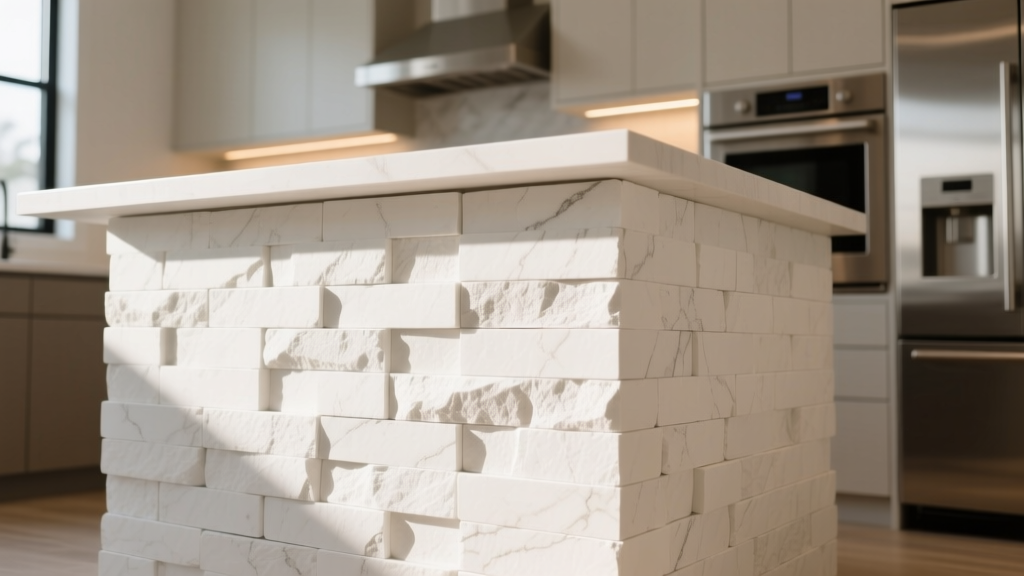
Choose white stone veneer stacked profiles if your project demands a contemporary, linear aesthetic, particularly for interior feature walls, modern kitchen islands, or transitional exterior wainscoting. The higher labor cost is offset by the premium, custom-home appearance it delivers. Opt for a tight, Type N mortared joint for exteriors to balance the modern look with necessary weatherproofing.
Choose ledge stone if you are cladding large exterior facades, working with traditional architectural styles, or need to minimize masonry labor costs. The deeper shadow lines and wider mortar joints of ledge stone are far more forgiving of imperfect framing and require less meticulous surface cleaning during installation.
Written by
Priya KapoorPriya Kapoor is a real estate market analyst and construction economics researcher with expertise in housing affordability, development feasibility, and infrastructure investment. She holds a Master of Regional Planning from Cornell University and previously worked as a senior analyst at CBRE's Investment Properties group, where she modeled returns for $4B in mixed-use development pipelines. Priya now runs an independent research practice advising developers, municipalities, and REITs on construction cost forecasting and market timing. She publishes the quarterly "BuildMat Market Pulse" report tracking material price indices across 12 commodity categories. Based in Austin, TX, Priya serves on the board of Habitat for Humanity Austin and is a marathon runner.
More from Priya Kapoor
View all
Construction Cost
Cost to Build a 1600 Sq Ft Home in 2026: Full Breakdown
Accurate 2026 cost to build a 1600 sq ft home—material, labor, and regional pricing breakdowns included. Plan your budget with real-time estimates.
Aug 11, 2026

Wood & Lumber
Name the Types of Wood for Pressure Treatment and Preservation
Learn how to name the types of wood best suited for pressure treatment. Compare species treatability, chemical retention levels, and 2026 preservation costs.
Aug 4, 2026

Stone & Masonry
Stone Veneer Suppliers Lindenhurst: 2026 Cost Analysis
Analyze 2026 stone veneer costs in Lindenhurst, NY. Compare local supplier pricing, delivery fees, and Suffolk County installation labor rates.
Aug 4, 2026