Modern Stone Veneer: Complete Material and Design Guide
Explore modern stone veneer materials, costs, and installation protocols. Compare polyurethane, cast stone, and sintered panels for contemporary builds.

What Defines "Modern" Stone Veneer?
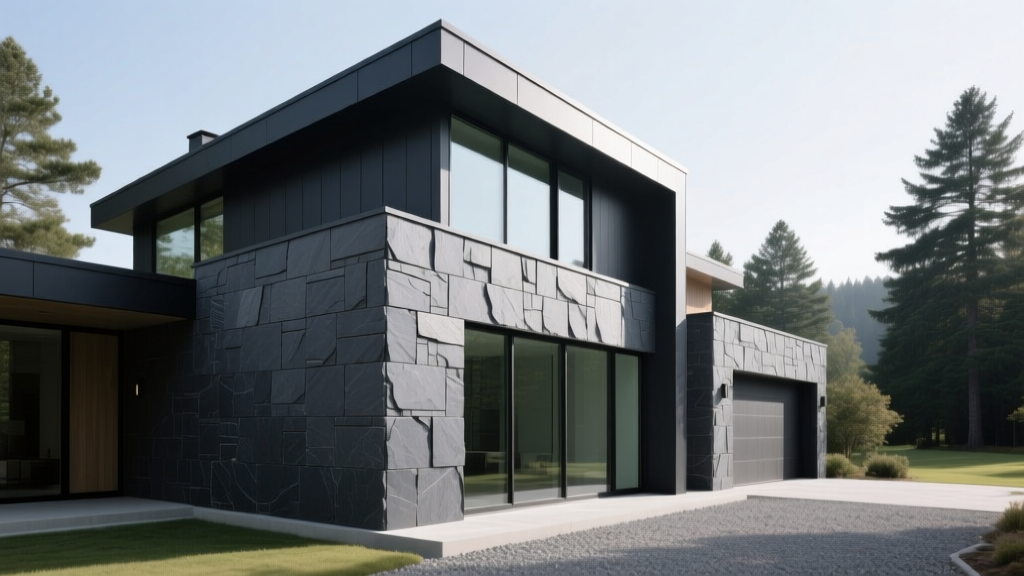
Modern stone veneer represents a distinct departure from traditional stacked, ledgestone, or cobblestone profiles. While traditional veneers rely on irregular shapes, deep grout lines, and rustic textures, modern stone veneer prioritizes clean sightlines, large-format panels, and minimal joint visibility. This aesthetic aligns with contemporary architectural styles—such as mid-century modern, minimalist, and neo-brutalist designs—where the cladding acts as a monolithic or precision-milled surface rather than a hand-laid masonry wall.
From a manufacturing standpoint, modern profiles are achieved through high-fidelity 3D scanning of natural quarried stone, followed by precision casting or sintering. The result is a product that replicates the exact micro-texture of limestone, basalt, or slate, but with engineered dimensional consistency that allows for tight, mortarless, or mechanically fastened installations.
Core Material Types & Performance Matrix
Selecting the right modern stone veneer requires understanding the substrate limitations, moisture exposure, and structural load capacities of your project. The market is currently dominated by three distinct material categories.
| Material Category | Weight (per sq ft) | Installation Method | Best Application | Moisture Tolerance |
|---|---|---|---|---|
| High-Density Polyurethane (PU) | 1.0 - 1.5 lbs | Mortarless / Adhesive | Interior accent walls, weight-restricted exteriors, DIY | High (Impervious) |
| Architectural Cast Stone (Concrete) | 10.0 - 14.0 lbs | Mortared (Scratch coat & lath) | Exterior facades, commercial builds, high-impact zones | Moderate (Requires sealing) |
| Sintered Stone / Porcelain Panels | 3.5 - 5.0 lbs | Mechanical Fastening / Thin-set | High-end exteriors, wet rooms, modern fireplace surrounds | Extreme (Zero absorption) |
2026 Cost Breakdown: Material vs. Labor
Pricing for modern stone veneer has shifted as manufacturing efficiencies in polyurethane and sintered stone have scaled. When budgeting, contractors and homeowners must separate the cladding cost from the preparation and labor costs.
Average Installed Costs (Per Square Foot)
- Polyurethane Panels: $11.00 - $16.00 (Material) + $4.00 - $7.00 (Labor) = $15.00 - $23.00 / sq ft
- Cast Stone Veneer: $8.00 - $14.00 (Material) + $9.00 - $15.00 (Labor) = $17.00 - $29.00 / sq ft
- Sintered Stone Panels: $18.00 - $28.00 (Material) + $12.00 - $20.00 (Labor) = $30.00 - $48.00 / sq ft
Note: Exterior cast stone installations require additional budget for weather-resistant barriers (WRB), metal lath, and weep screeds, adding approximately $2.50 to $4.00 per square foot in preparatory materials.
The Mortarless vs. Mortared Decision Framework
Choosing between a mortarless interlocking system and a traditional mortared application dictates the longevity and maintenance requirements of the facade. Use this framework to determine the correct path:
Choose Mortarless (Polyurethane or Interlocking Cast) When:
- The substrate is an interior drywall or cement board surface where moisture management is not a concern.
- The project involves a weight-restricted structure, such as a manufactured home, RV, or upper-story wood-frame cantilever.
- The design requires rapid installation with zero curing time or masonry cleanup.
Choose Mortared (Cast Stone) When:
- The installation is on an exterior grade-level facade subject to physical impact, freeze-thaw cycles, and wind-driven rain.
- Local building codes mandate a drainage plane and weep screed system for adhered masonry veneer (AMV) below the roofline.
- The design requires custom cutting, mitering, and variable joint widths that rigid interlocking panels cannot accommodate.
Exterior Installation Protocol & Moisture Management
The most common cause of modern stone veneer failure is not the material itself, but improper moisture management behind the cladding. According to building envelope experts at Building Science Corporation, adhered veneers act as a reservoir cladding, meaning they can absorb and hold moisture against the wall assembly. Proper detailing is non-negotiable.
- Weather-Resistant Barrier (WRB): Apply two layers of Grade D building paper or a high-performance fluid-applied WRB over the structural sheathing. The dual-layer approach creates a microscopic drainage gap between the WRB and the scratch coat.
- Corrosion-Resistant Lath: Fasten self-furring, galvanized metal lath (minimum 2.5 lbs per square yard) using corrosion-resistant fasteners driven directly into the wall studs, not just the sheathing. Overlap horizontal seams by 1 inch and vertical seams by 2 inches.
- Weep Screed Installation: Install a code-compliant weep screed (ASTM C1063) at the base of the wall, maintaining a minimum 4-inch clearance from soil and 2 inches from paved surfaces. This component is critical; it provides an exit point for trapped moisture and supports the weight of the wet scratch coat.
- Scratch Coat & Curing: Apply a 1/2-inch Type S mortar scratch coat, scoring it horizontally to provide a mechanical key. Allow a minimum 48-hour curing period before applying the stone veneer, as detailed in standard manufacturer installation guidelines.
- Panel Application: Apply a 1/2-inch layer of mortar to the back of the modern stone veneer panel (back-buttering) and press firmly into the scratch coat, ensuring a 100% bond with no voids.
Common Failure Modes in Contemporary Designs
Modern stone veneer profiles, particularly those with deep, linear geometries, present unique failure modes that installers must anticipate.
Efflorescence on Dark, Linear Profiles
Dark-colored modern stone veneers (such as charcoal basalt or black slate profiles) make white efflorescence highly visible. Efflorescence occurs when water-soluble salts from the Portland cement in the scratch coat or the cast stone itself migrate to the surface. The Fix: Use a low-alkali Portland cement or a specialized polymer-modified thin-set mortar designed for adhered masonry. Never use acid washes to clean dark modern veneers, as this can etch the pigmented surface; instead, use a dry nylon brush followed by a specialized efflorescence cleaner.
Thermal Expansion Delamination
Large-format modern panels (exceeding 24 inches in length) are susceptible to thermal expansion and contraction. If installed in direct, unbroken spans across different structural substrates (e.g., spanning from a concrete foundation to a wood-framed upper story), the differential movement can shear the mortar bond. The Fix: Always install a soft joint (a flexible polyurethane sealant matched to the mortar color) at the transition point between differing substrates to absorb structural shear and thermal movement.
UV Degradation of Polyurethane Facades
While high-density polyurethane panels are impervious to water, they are vulnerable to ultraviolet degradation if the factory-applied UV-inhibitor topcoat is compromised. Fading or chalking typically appears first on south-facing elevations. The Fix: Specify polyurethane veneers that utilize in-mold mineral oxide pigmentation rather than surface-painted finishes, ensuring the color runs through the entire thickness of the panel.
Frequently Asked Questions
Can modern stone veneer be installed directly over painted brick?
No. Painted brick provides a poor bonding surface for mortar, and the paint layer will inevitably delaminate under the weight of cast stone veneer. You must mechanically fasten metal lath through the brick into the structural backing, or use a mortarless polyurethane system adhered with a high-strength construction adhesive specifically rated for painted masonry.
Do modern stone panels require sealing?
Architectural cast stone (concrete-based) benefits significantly from a breathable, silane/siloxane penetrating sealer, especially in freeze-thaw climates or areas exposed to sprinkler irrigation. Polyurethane and sintered stone panels are inherently non-porous and do not require sealing.
How do I handle outside corners with large-format modern panels?
For a true contemporary look, avoid using pre-cast corner pieces, which often disrupt the linear flow of the design. Instead, utilize a miter cut. Cut the ends of two panels at a precise 45-degree angle using a wet saw with a continuous-rim diamond blade, back-butter the mitered edges with a flexible masonry adhesive, and join them to create a seamless, monolithic outside corner.
Written by
Sarah WhitfieldSarah Whitfield is a chartered quantity surveyor (MRICS) and construction cost analyst with 15 years of experience in material pricing, procurement strategy, and project budgeting. She earned her degree in Construction Management from the University of Reading (UK) and has worked on projects ranging from $2M custom homes to $180M mixed-use developments across North America and Europe. Sarah currently leads cost estimating for BuildMat Insight, maintaining a proprietary database of 4,000+ material price points updated quarterly. She is a frequent contributor to RSMeans cost data panels and has presented at the International Cost Engineering Council (ICEC) congress. Based in Denver, CO, Sarah is an avid trail runner and volunteer mentor for Women in Construction.
More from Sarah Whitfield
View all
Wood & Lumber
What Are the Different Types of Wood? A Builder's Guide
Compare structural softwoods, finish hardwoods, and engineered lumber. Analyze Janka ratings, MOE values, and 2026 pricing for construction.
Aug 4, 2026

Walls & Panels
Steel Framing vs Wood Framing: Corrosion and Moisture Defense
Compare steel framing vs wood framing for moisture resistance. Learn about galvanized coatings, condensation risks, and corrosion protection strategies.
Jul 21, 2026

Stone & Masonry
How to Cut Stone Veneer: Wet Saw vs Grinder Comparison
Compare the best tools for cutting stone veneer. We review wet saws, angle grinders, and chop saws to help you achieve clean, chip-free cuts.
Jul 21, 2026