Daily Care and Stain Removal Playbook for Quartzite Countertops
Master quartzite countertop maintenance with our expert cleaning playbook. Learn exact sealing schedules, stain removal poultices, and daily care routines.
The Metamorphic Reality: Why Quartzite Demands Specific Care
Quartzite is a metamorphic rock formed when pure quartz sandstone is subjected to extreme tectonic heat and pressure. Ranking at a 7 on the Mohs hardness scale, it is significantly harder than granite and highly resistant to scratching. However, its natural formation leaves microscopic fissures and varying degrees of porosity. Unlike engineered surfaces, quartzite is a living geological material that requires a strict, scientifically grounded maintenance protocol to prevent liquid intrusion, staining, and sealer degradation.
Do not confuse natural quartzite with engineered quartz. Engineered quartz (brands like Caesarstone or Silestone) is a composite of 90% crushed quartz dust and 10% polymer resins. It is non-porous and requires zero sealing. Natural quartzite is 100% stone and must be sealed. Applying engineered quartz maintenance logic to natural quartzite will result in deep, irreversible staining within the first year of installation.
Phase 1: The Impregnating Sealer Protocol
Because quartzite is porous, it relies on penetrating (impregnating) sealers to fill microscopic voids below the surface. Topical sealers should never be used, as they trap moisture and create a hazy, artificial film. For optimal protection, use a siloxane-based or fluoropolymer impregnator, such as Miracle Sealants 511 Impregnator or Tenax Ager.
The Water Drop Calibration Test
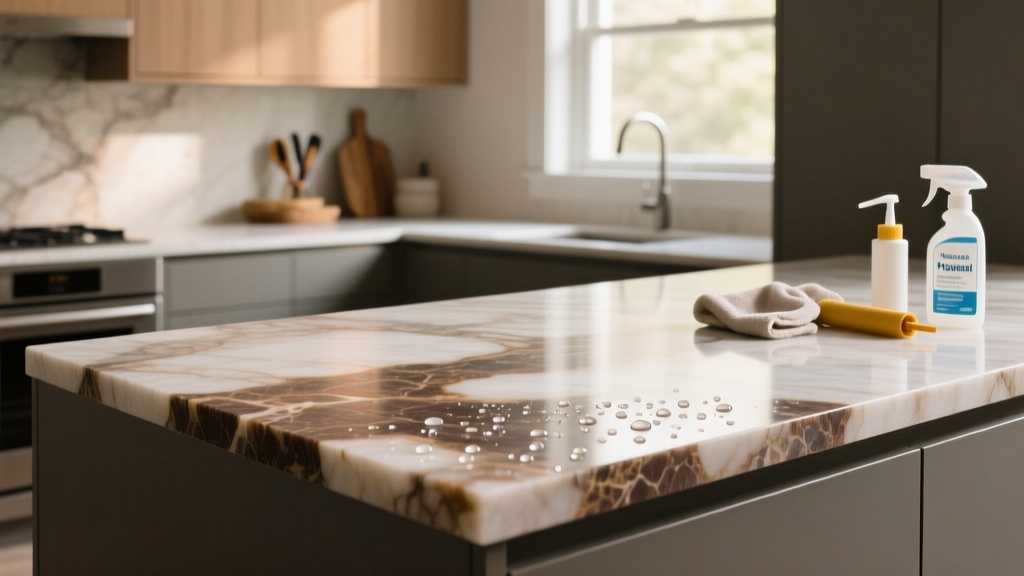
Before applying any sealer, calibrate your stone's current absorption rate. Place a 3-inch diameter puddle of water on the countertop in three distinct zones (near the sink, near the stove, and a low-traffic edge).
- Absorbs in under 5 minutes: Highly porous. Requires immediate sealing and potentially a color-enhancing sealer.
- Absorbs in 10–15 minutes: Moderately porous. Standard impregnating sealer required.
- Absorbs after 30+ minutes or not at all: The stone is either adequately sealed or is a heavily resin-filled exotic variety (common in Macaubas or Taj Mahal quartzites).
Application Steps for Maximum Penetration
- Prep: Clean the surface with an alkaline stone degreaser and allow it to dry completely for 24 hours. Moisture trapped in the pores will block sealer penetration.
- Coat 1: Apply the impregnating sealer generously using a low-lint microfiber pad. Maintain a wet surface for 15 to 20 minutes. If the stone absorbs the sealer and looks dry before 15 minutes, apply more immediately.
- Wipe Down: After the dwell time, aggressively buff the surface dry with a clean terry cloth. Leaving residual sealer on the surface will result in a sticky, hazy residue that requires chemical stripping to remove.
- Coat 2: Wait exactly 2 hours, then repeat the process for a second coat to ensure cross-linking within the deeper fissures.
- Cure: Keep the countertop completely dry for 48 hours. According to the Natural Stone Institute, premature exposure to water during the curing phase compromises the polymer chain formation.
Phase 2: Daily and Weekly Cleaning Matrix
A common misconception is that because pure quartzite is composed of silica (SiO2), it is immune to acidic etching like marble or limestone. While the stone itself will not etch, the impregnating sealer and the factory resin fills used to stabilize exotic quartzite slabs are highly vulnerable to acidic degradation. Using the wrong pH level will strip your sealer in weeks, leaving the stone exposed.
| Cleaning Agent Type | pH Level | Impact on Quartzite & Sealer | Verdict |
|---|---|---|---|
| Dedicated Stone Cleaners (e.g., Weiman, Akemi) | 7.0 (Neutral) | Lifts oils without degrading siloxane sealers or resin fills. | APPROVED |
| Mild Dish Soap (e.g., Dawn) + Warm Water | 7.5 - 8.5 | Safe for daily spills, but leaves a soap scum film if not rinsed. | APPROVED |
| Vinegar / Lemon Juice / Citrus Cleaners | 2.0 - 3.5 | Degrades resin fills, causing dull spots; strips topical sealers. | BANNED |
| Bleach / Ammonia / Heavy Degreasers | 11.0 - 13.0 | Breaks down the chemical bonds of impregnating sealers. | BANNED |
Phase 3: Advanced Stain Extraction (Poultice Playbook)
When liquids bypass the sealer and penetrate the stone's crystalline structure, surface wiping is useless. You must draw the stain out using a chemical poultice. A poultice is a thick paste that dries slowly, pulling the stain from the pores into the absorbent medium via capillary action.
Always cover your poultice with plastic wrap and tape the edges down with painter's tape. Poke 5 to 10 small holes in the plastic with a toothpick. This slows the drying process, forcing the chemical solvent to work deeper into the stone before the powder dries and begins the extraction phase.
Poultice Formulations by Stain Type
| Stain Category | Common Culprits | Liquid Solvent | Absorbent Base |
|---|---|---|---|
| Organic | Coffee, wine, tea, fruit | 12% Hydrogen Peroxide | Kaolin clay or baking soda |
| Oil-Based | Grease, cooking oil, cosmetics | Acetone or mineral spirits | Kaolin clay or diatomaceous earth |
| Biological | Mold, mildew, algae (outdoor) | Diluted bleach (1:4 ratio) | Baking soda |
Execution Steps: Mix the base and solvent into a paste with the consistency of peanut butter. Apply it over the stain at a thickness of exactly 1/4 inch, extending 1 inch beyond the stain's visible border. Cover with plastic wrap and leave for 24 to 48 hours. Once the paste is completely dry and powdery, scrape it off with a plastic putty knife (never metal, which can scratch the quartzite) and rinse with distilled water.
Edge Cases: Resin-Filled Quartzite and Thermal Shock
Not all quartzite is created equal. Highly sought-after exotic quartzites (such as Blue Macaubas, Taj Mahal, and Fantasy Brown) are notoriously brittle at the quarry. To prevent slab breakage during fabrication, manufacturers use a vacuum resin-filling process to inject epoxy or polyester resins into the stone's natural fissures.
This creates a unique maintenance vulnerability: Thermal Shock and Resin Melting.
While pure quartzite can withstand temperatures exceeding 1,600°F, the polyester resins used in exotic slabs begin to soften and discolor at temperatures as low as 300°F. Placing a cast-iron pan directly from a 450°F oven onto a resin-filled quartzite island will not burn the stone, but it will scorch the resin, leaving a permanent, dull, yellowish burn mark that cannot be polished out without professional diamond-pad resurfacing. Furthermore, rapid temperature differentials (thermal shock) can cause the natural stone to expand at a different rate than the resin fill, resulting in micro-cracking along the veining. Always utilize trivets with rubber feet for hot cookware.
Industry Standards and Further Reading
Maintaining natural stone requires adherence to industry best practices rather than anecdotal internet hacks. For comprehensive technical bulletins and geological classifications of natural stone, consult the Natural Stone Institute's consumer care guidelines. Additionally, understanding the fabrication and structural limits of exotic stones is critical; resources like Bob Vila's architectural material guides provide excellent baseline data on the physical properties and long-term ROI of quartzite installations compared to alternative surfaces.