Stone Foundation Repair Cost: Repointing, Rebuilding & Waterproofing
Analyze the true stone foundation repair cost for rubble, fieldstone, and cut stone walls. Get current pricing for repointing, rebuilding, and waterproofing.

Stone foundations, prevalent in residential and commercial structures built before 1940, present unique structural and chemical challenges. Unlike modern poured concrete or CMU block walls, stone foundations rely entirely on the mortar matrix for load distribution, lateral stability, and water resistance. When that mortar matrix degrades due to hydrostatic pressure, freeze-thaw cycles, or improper historical repairs, the structural integrity of the entire building is compromised. Understanding the true stone foundation repair cost requires moving beyond generic concrete repair estimates and analyzing the specific masonry techniques, specialized lime-based materials, and excavation requirements unique to stone.
The Baseline: Average Stone Foundation Repair Cost by Repair Type
Repair costs fluctuate based on the severity of the mortar degradation, the type of stone used, and whether the repair is interior (repointing) or exterior (excavation and waterproofing). The table below outlines current market rates for professional masonry contractors.
| Repair Type | Cost Range | Unit of Measure | Primary Application |
|---|---|---|---|
| Interior Repointing (Tuckpointing) | $18 – $38 | Per Sq. Ft. | Crumbled mortar joints, minor weeping |
| Exterior Repointing & Parge Coat | $35 – $65 | Per Sq. Ft. | Exposed exterior stone, weatherproofing |
| Partial Wall Rebuilding | $150 – $320 | Per Linear Ft. | Severe bowing, collapsed sections |
| Underpinning (Helical Piers) | $1,800 – $2,800 | Per Pier | Settling, subsidence, structural lifting |
| Exterior French Drain & Membrane | $85 – $160 | Per Linear Ft. | Hydrostatic pressure, chronic flooding |
Material Matters: Rubble, Fieldstone, and Cut Stone Pricing Variances
The physical geometry of the stone dictates the volume of mortar required, which directly impacts labor hours and material costs. A contractor cannot price a fieldstone wall using the same square-footage metrics as a cut ashlar wall.
Rubble and Fieldstone Foundations (Pre-1920s)
Rubble stone foundations consist of irregular, unshaped, or roughly shaped stones. Because the stones do not sit flush against one another, the mortar joints are exceptionally wide and deep—often accounting for 30% to 50% of the total wall surface area. Repointing a rubble foundation requires significantly more material and meticulous hand-tooling. Expect labor costs to sit at the absolute top of the pricing spectrum ($30–$38 per sq. ft.) due to the time required to rake out deep, irregular voids and pack them with specialized lime putty.
Cut and Ashlar Stone Foundations (1920s-1950s)
Cut stone (ashlar) foundations feature uniformly shaped blocks with tight, consistent mortar joints (typically 3/8-inch to 1/2-inch wide). Because the stones bear the structural load directly on their flat surfaces, the mortar primarily acts as a water seal and minor leveling agent. Repointing cut stone is faster and requires less mortar volume, generally reducing the stone foundation repair cost to the lower end of the spectrum ($18–$24 per sq. ft.).
Never use modern Type N or Type S Portland cement mortar on pre-1930s stone foundations. Historic stone is often softer and more porous than modern cement. When the foundation experiences minor shifts or freeze-thaw cycles, rigid Portland cement will not flex; instead, it will cause the historic stone faces to spall, crack, and shatter. You must use ASTM C270 Type O or Type L lime-based mortar, which has a lower compressive strength and higher vapor permeability than the stone itself, allowing moisture to escape through the joint rather than the stone.
Itemized Cost Breakdown: Repointing, Rebuilding, and Drainage
Tuckpointing and Repointing Execution
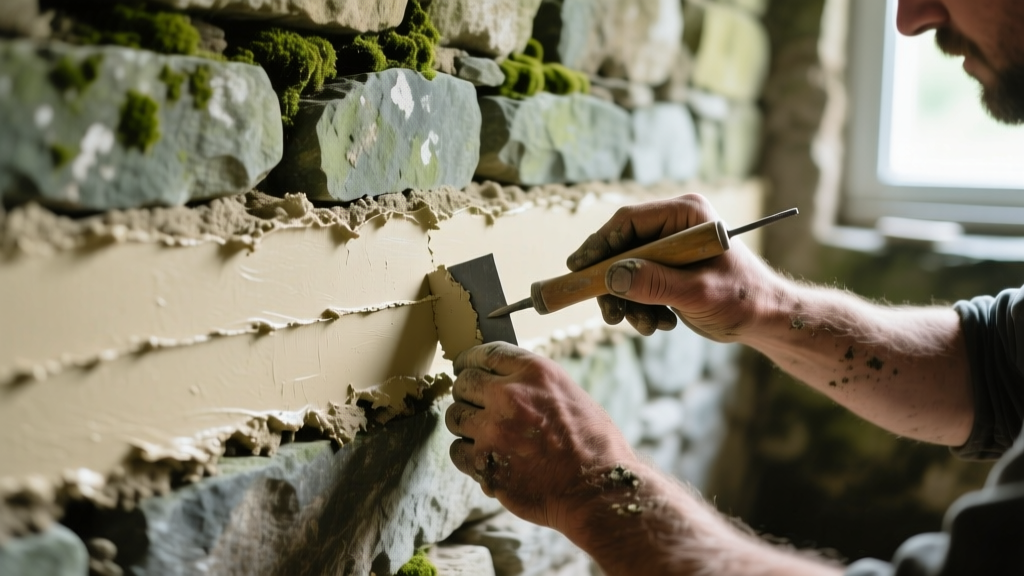
Proper repointing is a multi-step process. Masons must first rake out deteriorated mortar to a depth of 1/2 inch to 1 inch, or twice the width of the joint. The joints are then flushed with water to remove dust and prevent the dry stone from sucking moisture out of the new mortar too quickly. For historic structures, contractors use Natural Hydraulic Lime (NHL 3.5 or NHL 5) or custom-mixed lime putty and sharp sand. The application is done in shallow lifts (layers) to prevent shrinkage cracking. This meticulous process is why interior repointing averages $2,500 to $5,500 for a standard 1,200 sq. ft. basement perimeter.
Partial Rebuilding and Underpinning
When hydrostatic pressure causes a stone wall to bow inward by more than 2 inches, or when the frost line has heaved the footing, repointing is insufficient. Partial rebuilding requires shoring the floor joists above, carefully dismantling the compromised stone section, and rebuilding it with new mortar and supplemental reinforcement (such as stainless steel helical ties). If the foundation is settling due to poor soil bearing capacity, underpinning with helical piers is required. Piers are driven through the unstable soil to load-bearing strata, and a reinforced concrete grade beam is poured beneath the stone footing to transfer the load. Each pier costs between $1,800 and $2,800, with most settling repairs requiring 6 to 12 piers.
Exterior Waterproofing and French Drains
Interior sealants and epoxies are largely ineffective on stone foundations because water will simply migrate through the porous stone and degrade the mortar from the inside out. True waterproofing requires exterior excavation. The soil is dug down to the footing, the stone is cleaned and repointed, and a cementitious parge coat is applied. This is followed by a liquid-applied elastomeric membrane and a dimpled drainage board to protect the membrane and channel water downward. A 4-inch corrugated ADS pipe wrapped in geotextile fabric is laid at the footing level, surrounded by washed gravel, to carry water away from the structure. This comprehensive exterior approach costs $85 to $160 per linear foot but is the only permanent solution for chronic water intrusion.
Hidden Cost Drivers That Inflate Your Estimate
When budgeting for stone foundation repair, contractors often exclude site-specific variables from their initial per-square-foot quotes. Anticipate these hidden costs:
- Interior Finish Demolition: Removing drywall, insulation, and framing to expose the stone wall for interior repointing adds $2 to $5 per square foot of wall area.
- Limited Access Excavation: If heavy machinery (mini-excavators or skid steers) cannot access the exterior perimeter due to tight property lines, fences, or HVAC units, hand-digging is required. Manual excavation can double or triple the exterior waterproofing labor costs.
- Carbon Fiber or Steel I-Beam Stabilization: If a cut stone wall is bowing but not yet collapsing, installing vertical steel I-beams anchored to the floor joists and basement slab costs $800 to $1,200 per beam. Carbon fiber straps are generally not recommended for irregular rubble stone due to poor surface adhesion.
- Engineering and Permits: Structural underpinning or major rebuilding requires a stamped design from a licensed structural engineer, typically costing $800 to $1,500, plus local municipal permit fees.
Decision Framework: Repair vs. Replace
Deciding whether to repair an existing stone foundation or excavate and replace it with poured concrete requires evaluating the historical value of the home, the extent of the damage, and the budget.
| Criteria | Repair (Repointing/Stabilization) | Replace (Excavate & Pour Concrete) |
|---|---|---|
| Structural Condition | Stones are intact; only mortar is failing. Minor bowing (< 2 inches). | Stones are heavily spalled, shattered, or wall is severely bowed/collapsed. |
| Historic Preservation | Required for homes in historic districts or with original architectural value. | Acceptable for non-historic homes where foundation function supersedes original materials. |
| Cost Comparison | $15,000 – $35,000 (Comprehensive repointing & drainage) | $40,000 – $80,000+ (Full perimeter excavation, shoring, and new pour) |
| Timeline | 2 to 4 weeks | 4 to 8 weeks (highly weather-dependent) |
Industry Standards and Expert Sources
When soliciting bids from masonry contractors, ensure their proposed methodology aligns with established preservation and structural standards. Reference the following authoritative guidelines to verify contractor expertise:
- Mortar Selection: Adhere to the ASTM C270 Standard Specification for Mortar for Unit Masonry to ensure the correct compressive strength and lime-to-sand ratios are used for historic stone.
- Preservation Techniques: The National Park Service Preservation Brief 2: Repointing Mortar Joints in Historic Masonry Buildings provides the definitive framework for raking, mixing, and tooling lime-based mortars without damaging historic substrates.
By prioritizing material compatibility and addressing exterior hydrostatic pressure, property owners can stabilize stone foundations for another century of service, avoiding the catastrophic costs associated with total foundation replacement.
Written by
Marcus ChenMarcus Chen is a licensed structural engineer (PE) and building materials analyst with over 12 years of experience across residential, commercial, and industrial construction. He holds a Master of Science in Civil Engineering from UC Berkeley and spent six years at Thornton Tomasetti before transitioning to independent consulting and technical writing. Marcus specializes in material selection for seismic-prone regions, concrete reinforcement strategies, and lifecycle cost analysis. His work has been cited by the American Concrete Institute (ACI) and the Structural Engineers Association of California (SEAOC). When he is not on a job site or at his desk, you will find him hiking the Sierra Nevada or restoring a 1920s craftsman bungalow in Oakland, CA.
More from Marcus Chen
View all
Construction Cost
How Much Did the Eiffel Tower Cost to Build?
How much did the Eiffel Tower cost to build in 1889? We adjust for inflation and compare its budget to modern skyscraper construction.
Aug 4, 2026

Fire Resistance
What Is a Fire Resistant Material? Testing & Certification Guide
Discover what is a fire resistant material through ASTM and UL testing. Learn how fire ratings, certifications, and assemblies work in construction.
Aug 4, 2026

Construction Cost
How Much Did the Burj Khalifa Cost to Build?
How much did the Burj Khalifa cost to build? We break down the $1.5B project and extract 5 money-saving strategies for your next build.
Jul 30, 2026