Stone Veneer Austin: Natural Limestone vs Manufactured Compared
Compare natural Texas limestone and manufactured stone veneer for Austin homes. Get 2026 pricing, weight specs, and climate-specific installation advice.

The Austin Climate and Soil Factor: Why Material Choice Matters
Selecting the right stone veneer in Austin requires navigating two distinct environmental challenges: extreme thermal cycling and expansive clay soils. Summer temperatures routinely exceed 100°F, while winter nights can drop below freezing, causing rapid expansion and contraction in masonry materials. Furthermore, the Blackland Prairie region east of I-35 features highly expansive clay soils that shift significantly with moisture changes, leading to slab-on-grade foundation movement.
Because of these factors, the debate between natural Texas limestone and manufactured stone veneer (MSV) is not purely aesthetic. It is a structural and longevity decision. Rigid, heavy natural stone requires robust structural ledges and careful control joint placement to prevent cracking during foundation shifts. Lightweight MSV, when properly anchored to a framed wall with a decoupled weather-resistive barrier (WRB), can absorb minor structural deflections without telegraphing cracks to the surface.
Natural Texas Limestone Veneer: The Hill Country Standard
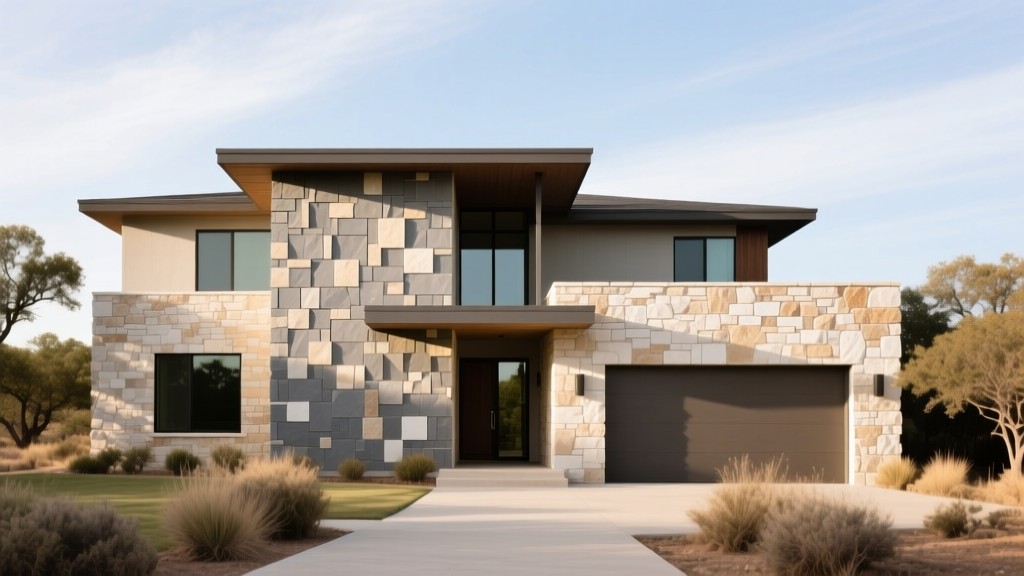
Natural limestone, quarried directly from the Edwards Plateau and Hill Country, is the definitive architectural signature of Central Texas. Varieties like Cordova Cream, Austin White, and Shell Stone offer unparalleled authenticity, featuring fossilized marine deposits and natural color variations that synthetic products struggle to replicate perfectly.
Material Specifications and Structural Demands
Natural limestone veneer is typically cut to a thickness of 3/4 inch to 1.5 inches for veneer applications (distinct from full-bed 4-inch masonry). Even at this reduced thickness, the density of Texas limestone means it weighs between 28 to 35 lbs per square foot.
- Structural Support: Cannot be applied directly to wood framing. Requires a continuous concrete or masonry backup wall, or a structurally engineered steel angle iron ledge bolted to the foundation to carry the dead load.
- Thermal Mass: High thermal mass helps buffer interior temperatures against Austin's intense solar radiation, though this benefit is marginal compared to full-bed masonry.
- Porosity: Texas limestone is naturally porous. In Austin's humid spring season, unsealed limestone can absorb moisture, leading to efflorescence (white salt deposits) if a proper drainage plane is not installed behind the stone.
Manufactured Stone Veneer (MSV): The Lightweight Contender
Manufactured stone veneer has evolved significantly. Modern MSV uses high-density Portland cement mixes, lightweight aggregates (like expanded shale or pumice), and iron oxide pigments baked into the mold. Leading brands available at Austin suppliers like Austin Brick & Tile or McCoy's Building Materials—such as Eldorado Stone and Coronado Stone—now offer profiles that closely mimic local limestone and fieldstone.
Material Specifications and Framing Integration
MSV is engineered specifically for adhered applications over framed construction. It weighs between 10 to 12 lbs per square foot, well within the load-bearing capacity of standard 2x4 or 2x6 wood framing.
- Structural Support: Applied directly over a properly prepared substrate (cement backer board or metal lath over WRB). No foundation ledge or angle iron is required, saving thousands in structural engineering and concrete costs.
- Consistency: Offers uniform thickness and predictable corner pieces, speeding up installation and reducing mason labor hours.
- Colorfastness: High-quality MSV integrates pigments throughout the entire thickness of the cast, meaning chips and scratches do not reveal a different base color.
Head-to-Head Comparison Matrix
The following matrix breaks down the technical differences between natural Hill Country limestone and premium manufactured stone veneer for the Austin market.
| Feature | Natural TX Limestone | Manufactured Stone Veneer |
|---|---|---|
| Weight | 28 - 35 lbs / sq ft | 10 - 12 lbs / sq ft |
| Substrate Requirement | Masonry backup or steel ledge | Wood/metal framing with lath |
| Aesthetic Authenticity | 100% Authentic, unique fossils | 90-95% (Premium lines only) |
| Installation Speed | Slower (heavy, requires cutting) | Faster (lightweight, modular) |
| Moisture Management | Requires air cavity & weep holes | Adhered system, requires WRB |
2026 Austin Pricing and Labor Breakdown
Austin's construction labor market remains highly competitive, and skilled masons charge a premium for quality veneer work. The costs below reflect current 2026 Central Texas market rates for a standard 1,000 square foot exterior facade project.
| Cost Category | Natural Limestone | Manufactured Stone (MSV) |
|---|---|---|
| Material Cost | $14.00 - $22.00 / sq ft | $8.00 - $14.00 / sq ft |
| Structural Prep (Ledge/Lath) | $6.00 - $10.00 / sq ft | $2.50 - $4.50 / sq ft |
| Masonry Labor | $16.00 - $24.00 / sq ft | $12.00 - $18.00 / sq ft |
| Total Installed Cost | $36.00 - $56.00 / sq ft | $22.50 - $36.50 / sq ft |
Note: Scaffolding, demolition of existing siding, and complex architectural details (like arches or deep reveals) will add 10-20% to the total labor costs.
Installation Nuances for Central Texas
Regardless of the material chosen, adhering to guidelines set by the Masonry Society and local building codes is critical. Austin's specific climate demands three non-negotiable installation practices:
1. Heat Management During Mortar Curing
When installing stone veneer in Austin between June and September, ambient temperatures and direct sun can cause Portland cement mortar to flash-set, resulting in weak bonds and efflorescence. Masons must use Type N mortar (which has a higher lime content for workability and flexibility) rather than Type S. Furthermore, mortar retarders must be mixed in, and stone surfaces should be misted with cool water immediately before application to prevent the stone from sucking moisture out of the mortar bed too quickly.
2. Weep Screeds and Drainage Planes
The National Veneer Masonry Association mandates the use of corrosion-resistant weep screeds at the base of all veneer walls. In Austin, where wind-driven rain during spring squalls can force water behind the cladding, a fluid-applied WRB (like Prosoco R-Guard) is vastly superior to traditional housewrap. The weep screed must be installed a minimum of 4 inches above finished grade, or 2 inches above paved surfaces, to prevent soil moisture wicking and termite ingress.
3. Accommodating Foundation Movement
For homes built on expansive clay soils (common in Pflugerville, Round Rock, and East Austin), the veneer must be decoupled from the slab foundation. A 1/2-inch compressible expansion joint must be left between the bottom of the stone veneer and the concrete slab, filled with a closed-cell backer rod and high-quality polyurethane sealant. This prevents the slab from heaving and pushing the stone veneer upward, which causes diagonal cracking at window and door corners.
Final Verdict: Which Should You Choose?
The decision between natural limestone and manufactured stone veneer in Austin ultimately comes down to budget, structural constraints, and architectural intent.
- You are building a custom Hill Country contemporary home where authentic regional materials are a core design pillar.
- Your structural engineer has already specified a continuous masonry backup or heavy-duty foundation ledge.
- Budget allows for $40+ per square foot installed, and you value the unique, unrepeatable fossil patterns of Cordova Cream or Austin White.
- You are retrofitting an existing wood-framed home or adding a second-story accent where the structure cannot support the dead load of natural stone.
- You need to keep material and labor costs under $35 per square foot without sacrificing a high-end aesthetic.
- You prioritize a faster installation timeline and want to minimize the risk of efflorescence associated with highly porous natural stones.
By aligning your material choice with Austin's specific soil dynamics and thermal environment, you ensure your stone veneer remains structurally sound and visually striking for decades.
Written by
James ThorntonJames Thornton is a construction industry veteran with 25 years of hands-on experience in wood framing, lumber grading, and residential building codes. He started as a framing carpenter in rural Oregon, earned his ICC Residential Building Inspector certification, and eventually became a senior plan reviewer for the City of Portland Bureau of Development Services. James holds a B.S. in Wood Science & Technology from Oregon State University and is a certified lumber grader through the West Coast Lumber Inspection Bureau (WCLIB). He has inspected over 3,000 residential construction sites and authored the city's internal guide on advanced framing techniques (2x6 at 24" O.C.). James lives in Bend, OR, where he builds custom timber-frame cabins and competes in lumberjack sports.
More from James Thornton
View all
Insulation
Best Home Insulation Materials: Complete 2026 Guide
Compare top home insulation materials for 2026. Find R-values, installed costs per square foot, and best uses for fiberglass, spray foam, and mineral wool.
Aug 4, 2026

Sustainable Building
Certify Your Green Building Material for LEED and WELL
Step-by-step guide to certifying a green building material for LEED v5 and WELL v2. Master EPDs, HPDs, and VOC limits for 2026 project specifications.
Aug 4, 2026

Stone & Masonry
Veneer Stacked Stone Panels: Interior Design & Style Showcase
Discover how veneer stacked stone panels transform interiors. Explore modern design profiles, material pairings, and technical installation specs.
Aug 4, 2026