Stone Veneer Sealer Technical Specs: Silane vs Siloxane
Compare stone veneer sealer technical specifications, including silane and siloxane chemistry, vapor transmission rates, and application mil thickness.

Chemical Composition: Silane vs. Siloxane Penetrants
Specifying a stone veneer sealer requires matching the molecular weight of the active resin to the porosity and density of the masonry substrate. Penetrating sealers rely on silane and siloxane oligomers that react with the hydroxyl groups present in masonry and natural stone to form a covalent bond, creating a hydrophobic barrier below the surface.
Silane Sealers (Low Molecular Weight)
Silanes possess the smallest molecular structure (typically under 1,000 Daltons). This low molecular weight allows deep penetration—often up to 1/4 inch—into dense, low-porosity substrates like granite, basalt, and high-density slate. Because silanes are highly reactive and volatile, they are frequently formulated as 100% solids or in solvent-based carriers to delay the hydrolysis reaction until the chemical is deep within the stone matrix. Solvent-based silanes are increasingly restricted by VOC regulations; modern water-based silane emulsions utilize proprietary surfactants to achieve comparable penetration depths while maintaining VOC levels below 100 g/L.
Siloxane Sealers (High Molecular Weight)
Siloxanes feature larger molecular chains and higher molecular weights. They cannot penetrate dense stone effectively but are the optimal specification for highly porous substrates, such as manufactured stone veneer (MSV), limestone, and sandstone. Siloxanes typically penetrate 1/16 to 1/8 inch, providing excellent surface-level water repellency without over-penetrating and wasting material in the substrate core.
Silane-Siloxane Blends
For mixed-material facades or standard concrete-based manufactured veneers, a blended formulation (often a 1:4 or 1:1 ratio of silane to siloxane) provides a dual-depth barrier. The silane penetrates the dense aggregate within the MSV, while the siloxane lines the larger capillary pores of the cementitious binder.
Vapor Transmission Rates (VTR) and Moisture Dynamics
The most critical technical specification for any exterior stone veneer sealer is its Water Vapor Transmission (WVT) rate. According to the Building Science Corporation's digest on masonry moisture dynamics, masonry walls must be able to dry to the exterior. If a sealer restricts vapor drive, moisture trapped behind the veneer will freeze, expand, and cause the stone face to delaminate or spall.
Breathability is measured via ASTM E96 Standard Test Methods for Water Vapor Transmission. A compliant penetrating sealer must maintain a vapor transmission rate of at least 90% compared to untreated stone. Film-forming sealers (acrylics, urethanes, and epoxies) drop this rate to below 20% and are strictly contraindicated for exterior, above-grade veneer applications.
| Chemistry Type | Penetration Depth | VTR Retention | UV Stability | Ideal Substrate | Max VOC (g/L) |
|---|---|---|---|---|---|
| 100% Silane (Solvent) | 1/8' - 1/4' | 95 - 99% | Excellent | Granite, Basalt, Dense Slate | 450 - 600 |
| Silane (Water Emulsion) | 1/16' - 1/8' | 95 - 99% | Excellent | Dense Natural Stone, Brick | < 100 |
| Siloxane (Water-based) | 1/32' - 1/16' | 90 - 95% | Very Good | Limestone, Sandstone, MSV | < 100 |
| Acrylic (Film-Forming) | Surface Only | 10 - 20% | Poor (Yellows) | Interior Only / Non-Porous | Varies |
Substrate Preparation and Alkalinity Thresholds
Applying a silane or siloxane sealer to an improperly prepared substrate guarantees premature failure. The chemical bonding process requires direct contact with the masonry substrate; any barrier, moisture, or extreme alkalinity will interrupt the cross-linking reaction.
Never apply a stone veneer sealer over active efflorescence (water-soluble salts). As detailed in the Brick Industry Association's Technical Notes on Efflorescence, sealing over these salts traps them beneath the hydrophobic barrier. Subsequent moisture vapor drive will force the salts to crystallize below the sealer line, generating immense sub-surface hydrostatic pressure that will spall the stone face. Always remove efflorescence mechanically with a stiff non-metallic brush and wash with a specialized masonry cleaner prior to sealing.
Technical Preparation Requirements
- Moisture Content: Substrate moisture content must be below 15% (measured via a pin-type masonry moisture meter) for water-based sealers, and below 5% for solvent-based silanes. Applying to damp stone causes the sealer to react prematurely on the surface, resulting in a white, hazy residue that is nearly impossible to remove from textured stone.
- pH and Alkalinity: Fresh concrete-based manufactured stone veneer is highly alkaline (pH 12-13). High alkalinity rapidly breaks down the siloxane resin before it can bond. Substrates must cure for a minimum of 28 days, and the surface pH must be tested to ensure it has dropped below 10.0 before application.
- Surface Profile: The substrate must be free of form release agents, dirt, and biological growth. Pressure washing at a maximum of 1,500 PSI with a 25-degree tip is required to clean the pores without etching the softer mortars or MSV faces.
Application Specifications: Coverage, Mil Thickness, and Curing
Precision in application dictates the longevity of the hydrophobic barrier. Under-application results in incomplete pore lining, while over-application leads to surface pooling, which dries into a visible, glossy film that alters the natural aesthetic of the stone.
Equipment and Spray Parameters
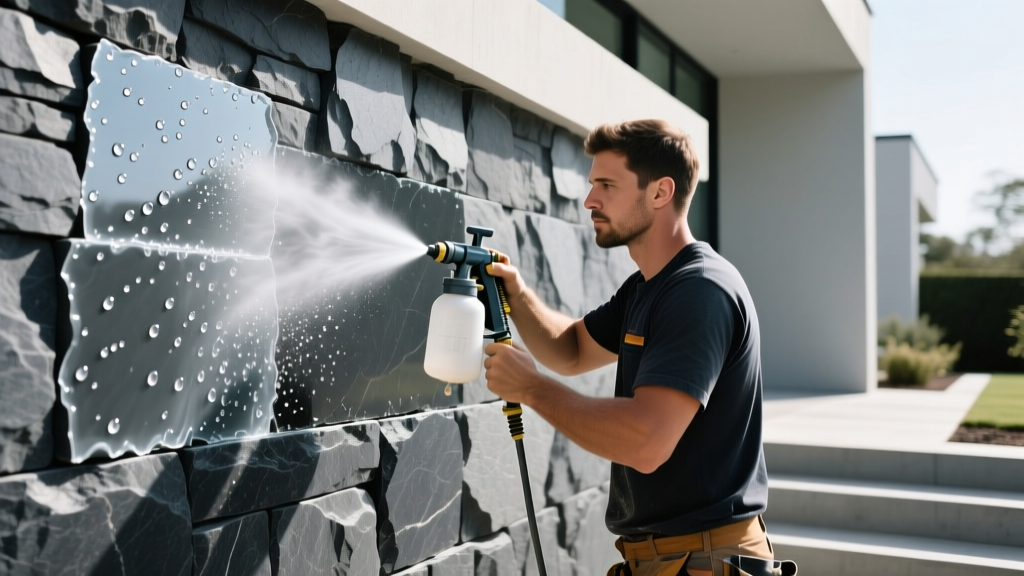
For uniform application on textured stone veneer, an airless sprayer is mandatory. Brush or roller applications cannot force the resin deep into the capillary pores and inevitably leave streak marks on uneven stone profiles.
- Pump Pressure: 500 to 1,000 PSI.
- Spray Tip Size: 0.015 to 0.021 inches (larger tips for higher viscosity solvent-based silanes).
- Spray Pattern: 12-inch fan pattern, held 12 to 18 inches from the substrate.
Coverage Rates and Wet Film Thickness (WFT)
Coverage is highly dependent on the porosity of the specific stone profile. Always conduct a 10-square-foot mock-up area to dial in exact absorption rates.
- Dense Natural Stone (Granite/Slate): 250 to 400 square feet per gallon. Target WFT: 1.0 to 1.5 mils.
- Manufactured Stone Veneer (Standard Profile): 150 to 250 square feet per gallon. Target WFT: 2.0 to 2.5 mils.
- Highly Porous Limestone/Sandstone: 100 to 150 square feet per gallon. Target WFT: 3.0 mils (often requires a wet-on-wet second coat).
When a second coat is required for highly porous substrates, it must be applied 'wet-on-wet'—typically within 3 to 5 minutes of the first coat, before the initial application has fully flashed off. If the first coat cures and establishes its hydrophobic properties, the second coat will bead up and fail to penetrate.
Failure Mode Analysis: Why Stone Veneer Sealers Degrade
Understanding the failure mechanics of masonry sealers allows specifiers to avoid costly remediation. Penetrating sealers do not last forever; they degrade via specific environmental and mechanical pathways.
1. UV and Alkaline Degradation of the Resin
While silanes and siloxanes are highly UV stable compared to acrylics, the upper 1/32 inch of the resin network is still subject to photo-oxidation over a 7 to 10-year service life. More aggressively, high alkalinity from ongoing moisture intrusion behind the veneer (due to failed flashing or missing weep holes) attacks the siloxane bond from the inside out, hydrolyzing the resin and stripping the water repellency from the back face forward.
2. Weep Hole Blockage and Hydrostatic Pressure
A stone veneer sealer should never be applied to the bottom edge of the veneer where it meets the weep screed, nor should it be sprayed directly into the weep holes. If a heavy application bridges the weep cavities, it blocks the drainage plane. Water accumulating in the cavity will bypass the sealed exterior face, infiltrate the interior sheathing, and cause severe structural rot. Always mask weep screeds and flashings during application.
3. Freeze-Thaw Spalling Due to VTR Loss
If a non-breathable film-forming sealer was previously applied to the stone, or if a penetrating sealer was over-applied to the point of surface pooling, the VTR drops. When water vapor migrating from the building interior hits the cold, sealed back of the stone in winter, it condenses. If this water cannot escape outward due to the sealer, it freezes, expands by 9%, and shears the face off the stone. This failure mode is entirely preventable by strictly adhering to ASTM E96 VTR specifications and avoiding film-forming chemistries on exterior veneers.
Written by
Marcus ChenMarcus Chen is a licensed structural engineer (PE) and building materials analyst with over 12 years of experience across residential, commercial, and industrial construction. He holds a Master of Science in Civil Engineering from UC Berkeley and spent six years at Thornton Tomasetti before transitioning to independent consulting and technical writing. Marcus specializes in material selection for seismic-prone regions, concrete reinforcement strategies, and lifecycle cost analysis. His work has been cited by the American Concrete Institute (ACI) and the Structural Engineers Association of California (SEAOC). When he is not on a job site or at his desk, you will find him hiking the Sierra Nevada or restoring a 1920s craftsman bungalow in Oakland, CA.
More from Marcus Chen
View all
Construction Cost
How Much Did the Eiffel Tower Cost to Build?
How much did the Eiffel Tower cost to build in 1889? We adjust for inflation and compare its budget to modern skyscraper construction.
Aug 4, 2026

Fire Resistance
What Is a Fire Resistant Material? Testing & Certification Guide
Discover what is a fire resistant material through ASTM and UL testing. Learn how fire ratings, certifications, and assemblies work in construction.
Aug 4, 2026

Construction Cost
How Much Did the Burj Khalifa Cost to Build?
How much did the Burj Khalifa cost to build? We break down the $1.5B project and extract 5 money-saving strategies for your next build.
Jul 30, 2026