Top Stone Veneer for Fireplace Surround: 2026 Brand Review
Compare the best stone veneer for fireplace surround options in 2026. We review Eldorado, Cultured Stone, and Dutch Quality on cost, heat tolerance, and style.

The Structural & Thermal Reality of Fireplace Veneers
When selecting a stone veneer for fireplace surround applications, the primary constraints are structural load and thermal expansion. Traditional full-bed masonry weighs 35 to 45 pounds per square foot and requires an independent concrete footing. In contrast, modern thin veneers weigh between 10 and 15 pounds per square foot, allowing them to be mounted directly to properly reinforced wall studs without foundational upgrades.
According to the Masonry Veneer Manufacturers Association (MVMA), manufactured stone veneer (MSV) is tested to meet strict weight and freeze-thaw standards. However, fireplace surrounds introduce localized, intense heat cycles. While the stone itself is non-combustible (passing ASTM E136), the substrate and bonding agents must withstand temperatures that can exceed 150°F on the surface during prolonged fires.
2026 Brand Matrix: Top Manufacturers Compared
Not all veneers are engineered equally. The market leaders have refined their profiles and color fastness over the last decade. Below is a direct comparison of the top three brands dominating the 2026 market for hearth applications.
| Brand & Profile | Type | Avg. Weight | Profile Depth | Price (per sq ft) | Best For |
|---|---|---|---|---|---|
| Eldorado Stone (StackStone) |
Manufactured | 10-12 lbs | 1.5" - 2.5" | $9.50 - $12.00 | Modern, linear designs |
| Cultured Stone (Dressed Fieldstone) |
Manufactured | 11-13 lbs | 2.0" - 3.5" | $10.00 - $14.50 | Traditional, rustic hearths |
| Dutch Quality (Dry Stack) |
Manufactured | 10-11 lbs | 1.0" - 2.0" | $8.00 - $11.00 | Budget-conscious remodels |
| Real Stone Systems (Natural Thin Veneer) |
Natural | 13-15 lbs | 0.75" - 1.5" | $14.00 - $22.00 | High-end, authentic textures |
Manufactured vs. Natural Thin Stone: The Hearth Debate
Manufactured Stone Veneer (MSV)
MSV is cast from Portland cement, lightweight aggregates, and iron oxide pigments. For fireplace surrounds, MSV offers a distinct advantage: uniformity in thickness. When working around a firebox insert, maintaining a flush plane is critical for the mantel shelf and trim. MSV profiles like Eldorado’s StackStone are designed with interlocking edges that hide the substrate, reducing the need for complex corner cuts.
The Drawback: MSV is porous. If a log rolls against the hearth and leaves a scorch mark, or if soot accumulates from a poorly drafting flue, cleaning MSV requires specialized masonry cleaners. Acidic cleaners will strip the iron oxide pigments, leaving permanent bleached spots.
Natural Thin Stone Veneer
Natural veneer is sliced from real quarried stone (typically slate, quartzite, or limestone) using diamond-tipped gang saws. It offers unmatched thermal mass and authentic color variation that never fades. Quartzite and slate are exceptionally dense, making them highly resistant to soot staining and easy to wipe down with a damp microfiber cloth.
The Drawback: Natural stone varies wildly in thickness. An installer must "butter" the back of each piece with varying amounts of mortar to create a flat finished plane. This increases labor time by roughly 20% compared to MSV and requires a higher skill level to prevent lippage (uneven edges) around the firebox opening.
💡 Pro Tip: The Mortar Selection Matrix
Do not use standard thinset for a fireplace surround. The thermal cycling (rapid heating and cooling) will cause rigid thinset to micro-fracture, leading to delamination.
- For the Scratch Coat: Use a standard Type S masonry mortar over 2.5 lb galvanized metal lath.
- For Setting MSV: Use a polymer-modified stone veneer mortar (e.g., PRO-MIX or Sakrete Stone Veneer Mortar) which retains flexibility up to 180°F.
- For Setting Natural Stone: Use a high-heat refractory mortar or a premium latex-Portland cement mortar rated for intermittent thermal shock.
Cost Breakdown: 50-Square-Foot Surround Project
Pricing a stone veneer for fireplace surround requires looking beyond the per-square-foot cost of the stone itself. The substrate preparation, moisture barriers, and specialized mortars make up a significant portion of the budget. Below is a realistic 2026 cost breakdown for a standard 50-square-foot floor-to-ceiling surround (excluding the firebox unit and mantel).
| Component | Material Cost (50 sq ft) | Labor Cost (50 sq ft) | Total Estimated Cost |
|---|---|---|---|
| Substrate (1/2" Cement Board, Screws, Tape) | $150 - $200 | $250 - $350 | $400 - $550 |
| Moisture Barrier & Metal Lath | $75 - $100 | $150 - $200 | $225 - $300 |
| Mortar (Scratch Coat & Setting) | $120 - $180 | Included in setting | $120 - $180 |
| Stone Veneer (Mid-Range MSV + 10% Waste) | $550 - $750 | $600 - $900 | $1,150 - $1,650 |
| Total Project Cost | $895 - $1,230 | $1,000 - $1,450 | $1,895 - $2,680 |
Common Failure Modes and How to Prevent Them
Fireplace surrounds are subjected to unique environmental stresses. Understanding these failure modes is critical for long-term durability.
1. Thermal Spalling and Delamination
The Cause: Applying stone directly to drywall or greenboard, or using a mortar with too high a Portland cement content without polymer additives. The intense heat causes the substrate to expand at a different rate than the stone, shearing the bond.
The Fix: Always strip the surround down to the studs. Install a 1/2-inch cementitious backer unit (CBU) like Durock or HardieBacker. Apply a weather-resistive barrier (WRB) and dimpled metal lath before the scratch coat. This creates a decoupled, non-combustible assembly that absorbs thermal movement.
2. Efflorescence Blooming
The Cause: Moisture trapped inside the masonry assembly migrates to the surface, carrying soluble salts that crystallize into a white, powdery residue. This is common in newly built homes where the mortar has not fully cured before the fireplace is used, or if a non-breathable acrylic sealer was applied.
The Fix: Never seal a fireplace surround with a film-forming sealer. If sealing is desired for soot protection, use a penetrating silane/siloxane water repellent that allows water vapor to escape. To remove existing efflorescence, use a dry, stiff-bristle nylon brush; avoid water, which drives the salts back into the pores.
Final Verdict: Selecting Your Veneer
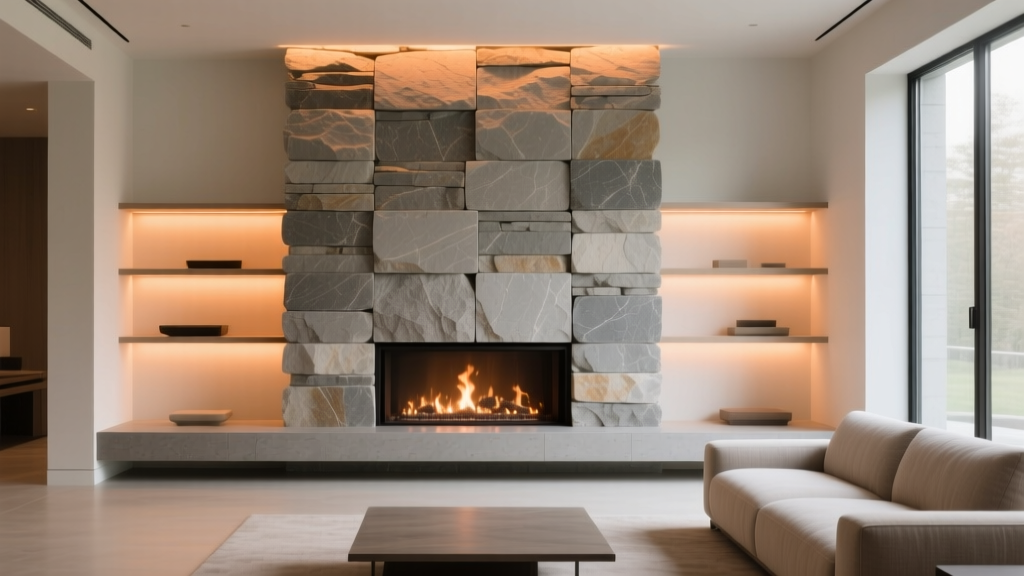
The ideal stone veneer for fireplace surround projects depends entirely on your design aesthetic, budget, and maintenance tolerance.
- Choose Manufactured StackStone (e.g., Eldorado) if you want a clean, contemporary linear look with the easiest installation profile and tightest budget parameters.
- Choose Natural Thin Veneer (e.g., Quartzite or Slate) if you prioritize authentic texture, require a low-porosity surface that resists soot staining, and have the budget for skilled masonry labor.
- Choose Manufactured Fieldstone (e.g., Cultured Stone) for traditional, craftsman, or rustic interiors where deep, varied shadow lines and organic color blending are the primary design goals.
Regardless of the material chosen, the longevity of your fireplace surround hinges on the substrate preparation. Invest the majority of your labor hours into building a rigid, non-combustible cement board and metal lath foundation, and your veneer will remain structurally sound and visually striking for decades.
Written by
James ThorntonJames Thornton is a construction industry veteran with 25 years of hands-on experience in wood framing, lumber grading, and residential building codes. He started as a framing carpenter in rural Oregon, earned his ICC Residential Building Inspector certification, and eventually became a senior plan reviewer for the City of Portland Bureau of Development Services. James holds a B.S. in Wood Science & Technology from Oregon State University and is a certified lumber grader through the West Coast Lumber Inspection Bureau (WCLIB). He has inspected over 3,000 residential construction sites and authored the city's internal guide on advanced framing techniques (2x6 at 24" O.C.). James lives in Bend, OR, where he builds custom timber-frame cabins and competes in lumberjack sports.
More from James Thornton
View all
Insulation
Best Home Insulation Materials: Complete 2026 Guide
Compare top home insulation materials for 2026. Find R-values, installed costs per square foot, and best uses for fiberglass, spray foam, and mineral wool.
Aug 4, 2026

Sustainable Building
Certify Your Green Building Material for LEED and WELL
Step-by-step guide to certifying a green building material for LEED v5 and WELL v2. Master EPDs, HPDs, and VOC limits for 2026 project specifications.
Aug 4, 2026

Stone & Masonry
Veneer Stacked Stone Panels: Interior Design & Style Showcase
Discover how veneer stacked stone panels transform interiors. Explore modern design profiles, material pairings, and technical installation specs.
Aug 4, 2026