Stucco and Stone Veneer: Cost, Durability, and Design Compared
Compare stucco and stone veneer for exterior cladding. Analyze installed costs, moisture management, structural loads, and hybrid transition details.

Material Composition and Structural Load
When evaluating exterior cladding options, understanding the fundamental material science behind stucco and stone veneer is critical for long-term building envelope performance. Traditional hard-coat stucco is a cementitious plaster system consisting of Portland cement, hydrated lime, sand, and water. Applied in a three-coat system (scratch, brown, and finish) over 2.5 lb self-furring galvanized expanded metal lath, it creates a continuous, monolithic shell. According to technical guidelines from the Portland Cement Association, a properly cured three-coat stucco system weighs approximately 10 to 11 pounds per square foot (psf).
Manufactured Stone Veneer (MSV), governed by The Masonry Society and ASTM C1670 standards, is cast from lightweight aggregates (like pumice or expanded shale), Portland cement, and iron oxide pigments. MSV typically weighs between 10 and 15 psf, making it structurally comparable to stucco. However, natural stone veneer (such as real limestone or granite slices) can weigh 30 to 40 psf, requiring engineered structural headers, reinforced foundation footings, and heavy-duty steel angle iron supports at every floor line.
2026 Installed Cost Matrix
Pricing for exterior cladding fluctuates based on regional labor rates, scaffolding requirements, and material availability. The following matrix breaks down the national average installed costs for residential and light commercial applications.
| Cladding Type | Material Cost (per sq.ft.) | Labor Cost (per sq.ft.) | Total Installed (per sq.ft.) |
|---|---|---|---|
| 3-Coat Traditional Stucco | $2.50 - $4.00 | $5.50 - $8.00 | $8.00 - $12.00 |
| Synthetic Stucco (EIFS) | $3.00 - $5.00 | $4.00 - $6.00 | $7.00 - $11.00 |
| Manufactured Stone Veneer (MSV) | $6.00 - $10.00 | $9.00 - $14.00 | $15.00 - $24.00 |
| Natural Stone Veneer (Thin) | $12.00 - $22.00 | $14.00 - $20.00 | $26.00 - $42.00 |
Labor is the primary cost driver for both systems. Stucco requires highly skilled plasterers to achieve uniform thickness and smooth trowel finishes, while MSV installation demands masons capable of blending colors, varying joint depths, and avoiding repetitive "stacked" patterns that reveal the manufactured nature of the product.
Moisture Management and Failure Modes
The most common cause of cladding failure is not material degradation, but trapped moisture. Both stucco and stone veneer are "reservoir claddings," meaning they absorb water during wind-driven rain events and must be allowed to dry. If the weather-resistive barrier (WRB) and drainage plane are compromised, structural rot follows.
Stucco Failure Points
- Diagonal Cracking: Often occurs at the corners of windows and doors due to structural settling or lack of diagonal lath reinforcement.
- Efflorescence: White, powdery salt deposits that appear when moisture migrates through the cementitious matrix, bringing soluble salts to the surface.
- Missing Weep Screeds: ASTM C1063 mandates a weep screed at the base of all stucco walls to allow trapped water to exit. Omitting this or burying it below grade is a catastrophic error.
Stone Veneer Failure Points
- Mortar Bridging: When mortar droppings accumulate in the drainage cavity behind the veneer, they create a bridge that allows water to bypass the WRB and reach the sheathing.
- Freeze-Thaw Spalling: Low-quality MSV with high water absorption rates will chip and flake in northern climates. Always specify MSV with a water absorption rate below 22% (per ASTM C1670) for freeze-thaw regions.
The Hybrid Envelope: Transitioning Stucco and Stone Veneer
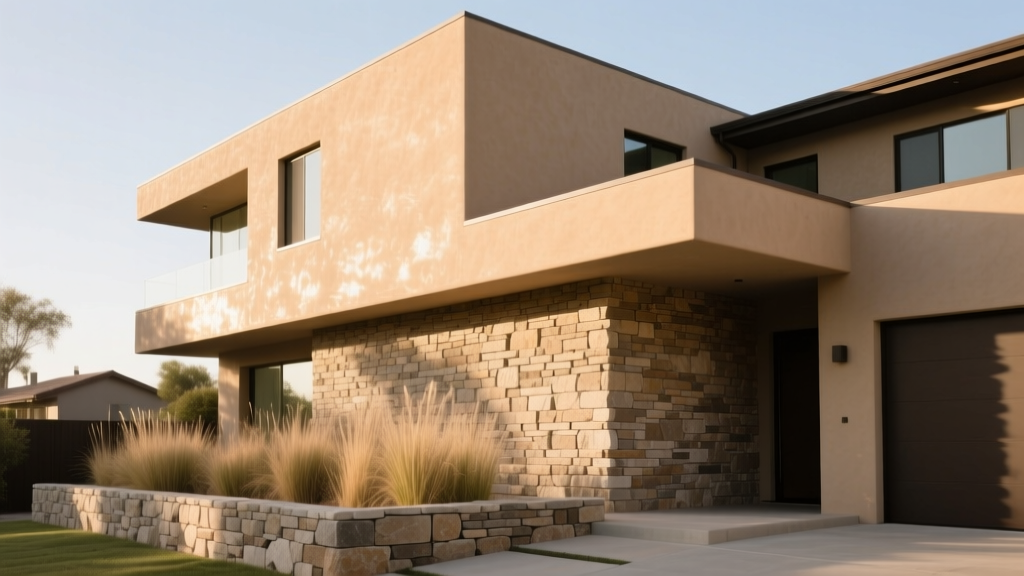
Combining stucco and stone veneer on the same facade is a dominant architectural trend, providing visual weight at the base of the structure while keeping upper-story costs manageable. However, the intersection of these two materials requires precise flashing details.
When transitioning from stone veneer at the bottom to stucco at the top (a horizontal transition), you must install a Z-flashing or a specialized transition weep screed. The stucco must terminate into the upper leg of the flashing, while the stone veneer is built up to the lower leg, leaving a 3/8-inch clearance filled with a high-quality polyurethane sealant (such as Tremco Dymonic or Sikaflex). Do not use cheap acrylic latex caulks, which will UV-degrade and lose adhesion within three years.
For vertical transitions (e.g., a stone column abutting a stucco wall), utilize a casing bead on the stucco side and terminate the stone veneer with a tight mortar joint. A backer rod and sealant joint should be placed between the casing bead and the stone to accommodate differential thermal expansion.
Decision Matrix: Selecting the Right Cladding
Use this practical framework to determine which material—or combination of materials—best suits your specific project parameters.
- Coastal and High-Salinity Environments: Choose traditional stucco, but upgrade the lath to PVC-coated or stainless steel expanded metal to prevent rust bleed. Avoid MSV if the mortar joints will be constantly subjected to salt spray, as the chlorides can degrade the Portland cement matrix over time.
- High-Impact Zones (Wainscoting & Bases): Specify stone veneer for the bottom 36 to 48 inches of the exterior walls. Stone veneer is highly resistant to impact damage from landscaping equipment, kicked debris, and pets, whereas stucco will easily chip and crack under blunt force.
- Tight Budget Constraints: Default to a three-coat stucco system. It offers the lowest cost per square foot of any masonry-based cladding while still providing a 50+ year lifespan and a Class A fire rating.
- Historic Renovations: Natural thin stone veneer or lime-based stucco is required. Modern Portland cement stucco is too rigid and impermeable for historic masonry substrates, which require breathable, flexible lime putty systems to prevent trapping moisture inside historic brick walls.
Ultimately, the choice between stucco and stone veneer rarely comes down to a single factor. By evaluating the structural capacity of your framing, the specific moisture risks of your climate zone, and the long-term maintenance expectations of the building owner, you can specify a cladding assembly that performs flawlessly for decades.
Written by
David NakamuraDavid Nakamura is a licensed architect (AIA) and construction technology writer focused on sustainable building methods, mass timber engineering, and high-performance building envelopes. He holds a Master of Architecture from the University of Washington and is a certified Passive House Consultant (CPHC). David spent eight years at the Seattle firm Mithun, where he led the design of three LEED Platinum projects, before founding his own practice specializing in net-zero residential design. He serves on the editorial advisory board of GreenBuilder Magazine and has authored peer-reviewed papers on cross-laminated timber (CLT) connections for the Journal of Structural Engineering. In his spare time, David teaches woodworking at Pratt Fine Arts Center and kayaks the Puget Sound.
More from David Nakamura
View all
Construction Cost
Labor Cost to Build a Deck Per Sq Ft: 2026 Installation Guide
Discover the exact labor cost to build a deck per sq ft in 2026. This installation guide breaks down contractor rates, complexity factors, and hidden fees.
Aug 4, 2026

Construction Cost
How Much Does It Cost to Build a 3 Bedroom House? Financing Guide
Learn exactly how much it costs to build a 3 bedroom house and explore 2026 financing options, construction loan types, and budget frameworks for your build.
Aug 4, 2026

Construction Cost
Cost to Build a Tennis Court: 2026 Guide
How much does it cost to build a tennis court in 2026? Breakdowns for asphalt, concrete, and synthetic surfaces plus fencing and lighting.
Jul 30, 2026