2026 Stone Veneer Panels Cost Analysis: Material & Labor Rates
Discover the true cost of stone veneer panels in 2026. We break down material prices, labor rates, hidden fees, and ROI for interior and exterior projects.

2026 Material Cost Matrix: Panel Types Compared
The market for architectural cladding has shifted heavily toward modular systems. When evaluating stone veneer panels, contractors and homeowners must distinguish between high-density polyurethane (faux), cementitious manufactured stone, and natural thin-cut stone. Each category carries drastically different material costs, weight profiles, and structural requirements. In 2026, supply chain stabilization has normalized cementitious pricing, while advanced UV-resistant polyurethane molds have seen a slight premium increase due to raw material costs.
| Panel Category | Avg. Material Cost (per sq. ft.) | Weight (per sq. ft.) | Installation Method | Best Application |
|---|---|---|---|---|
| Polyurethane (Faux) | $7.50 - $14.00 | 0.8 - 1.5 lbs | Construction adhesive & screws | Interior accents, skirting, DIY exteriors |
| Manufactured (Cementitious) | $11.00 - $22.00 | 10.0 - 15.0 lbs | Mortar-set over metal lath | Exterior facades, commercial builds, fireplaces |
| Natural Thin-Cut Panels | $24.00 - $45.00+ | 15.0 - 25.0 lbs | Mortar-set with mechanical ties | High-end custom homes, historical restorations |
Manufactured stone masonry veneer (MSMV) remains the industry standard for commercial and high-end residential exteriors. Leading manufacturers like Westlake Royal Building Products (Cultured Stone) engineer their cementitious panels to meet strict ASTM C1670 standards, ensuring freeze-thaw durability and colorfastness that cheaper, non-certified import panels consistently fail to achieve.
Labor Rates: Why Mortar-Set Costs Triple the Price of Interlocking
Material costs only tell half the story. The labor required to install stone veneer panels is entirely dictated by the substrate preparation and the setting method. In 2026, skilled masonry labor commands between $85 and $125 per hour, making the multi-step mortar process a significant budget multiplier.
The Mortar-Set Labor Sequence (Manufactured & Natural)
- Weather-Resistant Barrier (WRB): Applying a code-compliant membrane (e.g., Tyvek or WeatherSmart). Adds $1.50 - $2.50/sq. ft.
- Corrosion-Resistant Metal Lath: Fastening 2.5 lb self-furring galvanized lath to studs or masonry. Adds $2.00 - $3.50/sq. ft.
- Scratch Coat: Troweling a 1/2-inch Portland cement base coat and curing for 24-48 hours. Adds $3.00 - $5.00/sq. ft.
- Panel Setting & Grouting: Buttering each panel with Type S or Type N mortar, pressing to the scratch coat, and finishing joints with a grout bag. Adds $12.00 - $20.00/sq. ft.
Total Installed Labor Cost: $18.50 to $31.00 per square foot.
The Interlocking/Adhesive Sequence (Polyurethane)
Faux panels bypass masonry entirely. Carpenters or advanced DIYers install these directly over OSB, plywood, or existing flat siding using exterior-grade polyurethane adhesive and corrosion-resistant screws hidden in the interlocking shiplap joints.
Total Installed Labor Cost: $4.00 to $9.00 per square foot.
Hidden Costs That Blow Up Your Budget
Estimators frequently miss secondary line items when quoting stone veneer panel projects. To maintain budget integrity, factor in the following variables before signing a contract.
1. Corner Returns and Linear Footage
Flat panels only cover the field. Outside corners require specialized interlocking corner pieces or mitered cuts. Manufactured stone corner units typically cost $15.00 to $45.00 per linear foot. A standard two-story home with four prominent outside corners can easily add $1,200 to $2,500 in corner materials alone.
2. The Waste Factor
Interlocking polyurethane panels generate minimal waste (3-5%) because offcuts can be reused in the next row. Mortar-set manufactured panels, however, require cutting with a diamond-blade wet saw to fit around windows, vents, and rooflines. Always order a 12% to 15% overage for manufactured and natural stone to account for breakage, cutting waste, and color-batch matching.
3. Scaffolding and Site Prep
For exterior elevations exceeding 8 feet, OSHA-compliant scaffolding is mandatory. Expect scaffolding erection and rental to add $2.00 to $4.50 per square foot of wall area. Additionally, if the existing substrate is uneven by more than 1/4 inch over 10 feet, framing shims or furring strips must be installed before lath application, adding $1.50 per square foot.
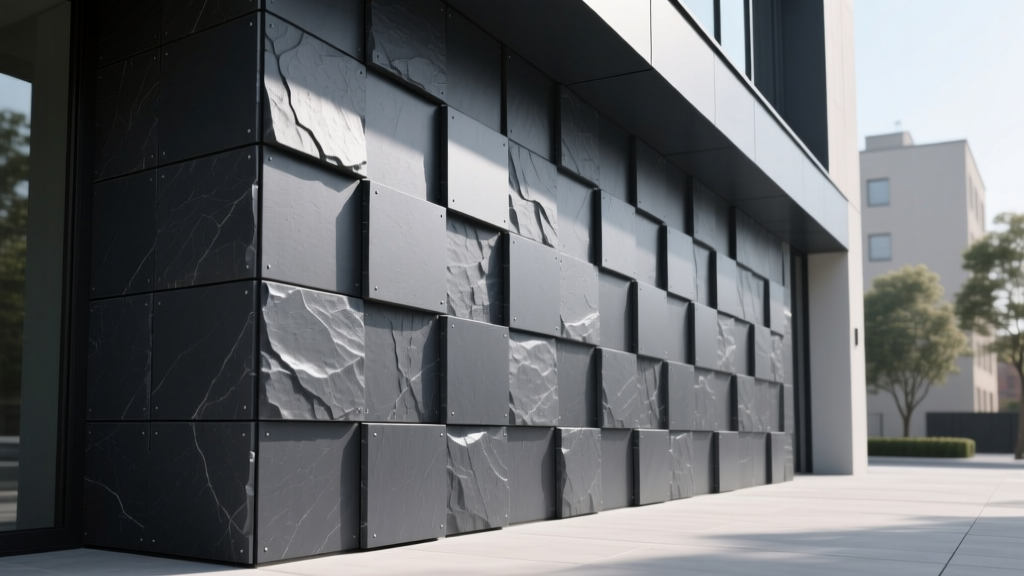
Decision Framework: Which Panel System Fits Your Project?
Choosing the right system requires balancing structural capacity, aesthetic demands, and long-term maintenance. Use this framework to determine the optimal path for your 2026 build.
Choose Polyurethane (Faux) Panels If:
- You are retrofitting an existing structure (like a mobile home skirt or a flat-sided garage) that lacks the structural footing to support 15 lbs/sq. ft. of dead load.
- The project is an interior accent wall, basement theater, or commercial retail display where weight and fire-rating (Class A) are easily managed.
- The timeline is compressed; a two-person crew can install 400 sq. ft. of interlocking faux panels in a single day.
Choose Manufactured (Cementitious) Panels If:
- You are building a new-construction exterior facade or a masonry fireplace surround requiring non-combustible, high-thermal-mass materials.
- Local zoning or HOA guidelines prohibit synthetic/faux exterior cladding materials.
- You require the authentic, varied mineralogy and shadow lines that only Portland cement and iron-oxide pigments can replicate.
"When specifying manufactured stone, always verify the manufacturer's compliance with ASTM C1670. Non-compliant panels frequently suffer from efflorescence and delamination within three to five freeze-thaw cycles due to improper aggregate-to-cement ratios."
— Technical Bulletin, Masonry Institute of America
Troubleshooting Common Installation Failures
Even premium stone veneer panels will fail if the building science is ignored. The National Association of Home Builders (NAHB) frequently cites moisture intrusion as the primary driver of cladding litigation. Avoid these three critical errors:
- Missing Weep Screeds: At the base of any exterior mortar-set installation, a corrosion-resistant weep screed must be installed a minimum of 4 inches above grade (or 2 inches above paved surfaces). This allows trapped water behind the WRB to escape. Omitting this guarantees water pooling and interior drywall rot.
- Mortar Smearing on Polyurethane: If using a hybrid approach or setting faux panels near real masonry, never use standard Portland mortar to adhere polyurethane. The alkalinity of the cement will chemically degrade the urethane coating. Always use manufacturer-specified polyurethane adhesives.
- Improper Control Joints: Cementitious panels expand and contract with temperature fluctuations. For wall spans exceeding 18 feet horizontally or 12 feet vertically, soft control joints (sealed with high-grade elastomeric caulk) must be integrated to prevent diagonal cracking through the stone faces.
ROI and Resale Value in the Current Market
From an investment perspective, exterior stone veneer remains one of the highest-yielding cladding upgrades. According to recent housing market data, replacing a portion of vinyl siding with a manufactured stone veneer accent (typically 300 to 500 sq. ft. on the front facade) recoups between 85% and 92% of the project cost at resale. Furthermore, natural thin-cut stone panels on high-end custom builds routinely push the appraisal value past the cost of installation, serving as a key visual anchor for luxury property valuations. For budget-conscious flippers, high-quality polyurethane panels offer a 60-70% visual equivalence to natural stone at 20% of the total installed cost, making them the preferred choice for rapid interior aesthetic upgrades in mid-market renovations.
Written by
David NakamuraDavid Nakamura is a licensed architect (AIA) and construction technology writer focused on sustainable building methods, mass timber engineering, and high-performance building envelopes. He holds a Master of Architecture from the University of Washington and is a certified Passive House Consultant (CPHC). David spent eight years at the Seattle firm Mithun, where he led the design of three LEED Platinum projects, before founding his own practice specializing in net-zero residential design. He serves on the editorial advisory board of GreenBuilder Magazine and has authored peer-reviewed papers on cross-laminated timber (CLT) connections for the Journal of Structural Engineering. In his spare time, David teaches woodworking at Pratt Fine Arts Center and kayaks the Puget Sound.
More from David Nakamura
View all
Construction Cost
Labor Cost to Build a Deck Per Sq Ft: 2026 Installation Guide
Discover the exact labor cost to build a deck per sq ft in 2026. This installation guide breaks down contractor rates, complexity factors, and hidden fees.
Aug 4, 2026

Construction Cost
How Much Does It Cost to Build a 3 Bedroom House? Financing Guide
Learn exactly how much it costs to build a 3 bedroom house and explore 2026 financing options, construction loan types, and budget frameworks for your build.
Aug 4, 2026

Construction Cost
Cost to Build a Tennis Court: 2026 Guide
How much does it cost to build a tennis court in 2026? Breakdowns for asphalt, concrete, and synthetic surfaces plus fencing and lighting.
Jul 30, 2026