Stone Veneer Pool Deck Designs: Styles, Costs & Overlay Guide
Explore stone veneer pool deck designs, comparing thin travertine, quartzite, and porcelain overlays. Get 2026 costs, slip-resistance data, and install tips.

The 'Veneer' Misconception: Wall Stone vs. Deck Overlays
When homeowners and designers begin researching a stone veneer pool deck, they frequently encounter a critical technical trap. In the broader construction industry, 'stone veneer' typically refers to Manufactured Stone Veneer (MSV) or thin architectural wall cladding. These vertical products are fundamentally unsuited for horizontal, high-traffic, wet environments. Applying standard wall veneer to a pool deck will result in catastrophic failure, including rapid spalling, cracking under foot traffic, and severe slip hazards.
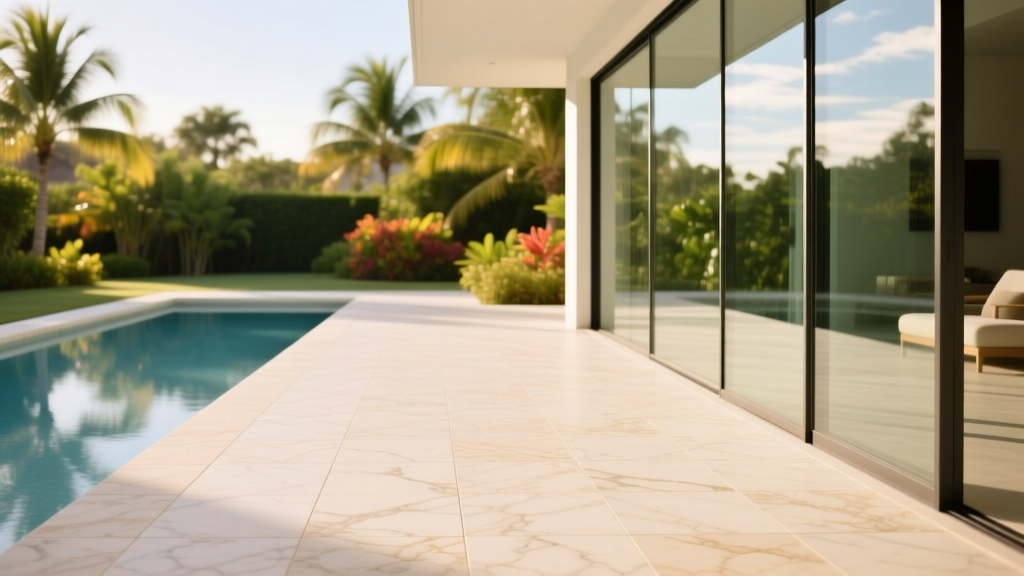
For pool deck applications, the correct terminology and material category is thin stone pavers or gauged stone overlay panels. These are natural stones (or high-density porcelain stone-look alternatives) precision-cut to thicknesses between 1/2-inch and 3/4-inch. They are designed to be thin-set directly over an existing, structurally sound concrete pool deck slab. This approach allows you to achieve the luxurious aesthetic of full-thickness natural stone without the immense weight, structural reinforcement requirements, or the need to demolish the existing concrete substrate.
Top Design Styles for Stone Veneer Pool Decks
The visual impact of your pool area is dictated by the stone's finish, edge profile, and color palette. Here are the three dominant design archetypes for 2026 outdoor living spaces.
Mediterranean Retreat: Tumbled Travertine
Tumbled travertine remains the undisputed champion of classic pool deck designs. The tumbling process softens the edges and opens the stone's natural pores, creating a highly textured, slip-resistant surface. From a thermal perspective, travertine is exceptional; its light ivory and walnut tones reflect solar radiation, keeping the deck surface up to 20°F cooler than darker stones or stamped concrete under direct midday sun. For a seamless Mediterranean aesthetic, specify a 'chiseled edge' profile and a dry-laid pattern with tight 1/8-inch joints filled with polymeric sand.
Contemporary Minimalist: Gauged Quartzite & Porcelain
Modern architectural homes demand clean lines and large-format materials. Gauged quartzite panels (typically 24x48 inches) offer a natural cleft texture that provides exceptional grip while maintaining a sleek, linear appearance. Alternatively, 12mm or 20mm gauged porcelain panels with high-definition stone-look prints offer zero water absorption and absolute dimensional stability. Porcelain veneers are ideal for minimalist designs because they can be installed with ultra-narrow 1/16-inch grout joints, creating a nearly monolithic, continuous surface that visually expands the pool area.
Rustic Resort: Natural Cleft Slate
For woodland properties or rustic resort aesthetics, natural cleft slate provides dramatic color variations ranging from deep charcoal to oxidized rust and sea green. Slate's natural cleavage planes create inherent micro-textures that offer superior slip resistance. However, slate must be carefully selected for exterior use; only high-density, non-calcite slates (such as Brazilian or Vermont slate) should be used around pools to prevent acid etching from chlorine splash-out and degradation from freeze-thaw cycles.
Slip-Resistance Matrix: DCOF Standards
When selecting a stone veneer overlay for a wet pool deck, always request the Dynamic Coefficient of Friction (DCOF) test results per ANSI A326.3 standards. While interior wet areas require a minimum DCOF of 0.42, exterior pool decks demand higher thresholds due to algae growth, sunscreen oils, and sloped drainage planes.
- Tumbled Travertine: DCOF 0.60 - 0.75 (Excellent)
- Natural Cleft Slate: DCOF 0.65 - 0.80 (Excellent)
- Honed Quartzite: DCOF 0.45 - 0.55 (Marginal when wet; requires textured sealer)
- Polished Stone: DCOF < 0.30 (Dangerous; never use on pool decks)
2026 Material & Cost Breakdown
Budgeting for a stone veneer pool deck overlay requires accounting for both the thin-set materials and the specialized exterior installation labor. The pricing below reflects current 2026 market averages for residential projects ranging from 400 to 800 square feet.
| Material Type | Thickness | Material Cost (per sq. ft.) | Installed Cost (per sq. ft.) | Best Application |
|---|---|---|---|---|
| Tumbled Travertine | 1/2' to 3/4' | $8.00 - $14.00 | $19.00 - $28.00 | Classic, high-heat areas |
| Gauged Quartzite | 3/8' to 1/2' | $11.00 - $18.00 | $24.00 - $35.00 | Modern, large-format layouts |
| Porcelain Stone-Look | 12mm (1/2') | $6.00 - $12.00 | $18.00 - $26.00 | Low-maintenance, freeze-thaw |
| Natural Cleft Slate | 1/2' to 3/4' | $10.00 - $16.00 | $22.00 - $32.00 | Rustic, high-slip-resistance |
Note: Installed costs include surface preparation (shot-blasting or grinding the existing concrete), premium exterior thin-set mortar, grouting, and initial penetrating sealer application.
Critical Installation Protocols for Wet Environments
The Association of Pool & Spa Professionals (APSP) and the Tile Council of North America (TCNA) outline strict guidelines for exterior horizontal stone overlays. The primary enemy of a stone veneer pool deck is hydrostatic pressure and thermal expansion. If your installer skips the following protocols, the stone will delaminate within two seasons.
- Substrate Profiling and Leveling: The existing concrete deck must be shot-blasted or scarified to remove sealers, paint, and laitance, achieving a minimum Concrete Surface Profile (CSP) of 3 to 4. Any cracks in the existing slab must be treated with an anti-fracture membrane (such as a liquid-applied elastomeric coating) to prevent reflective cracking from telegraphing through the thin stone veneer.
- Mortar Selection (ANSI A118.15): Standard thin-set is insufficient for exterior pool decks. You must specify an ANSI A118.15 rated 'Improved Modified Dry-Set Cement Mortar' (e.g., Laticrete 254 Platinum or MAPEI Ultraflex LFT). These high-polymer mortars offer superior bond strength and flexibility to accommodate the extreme thermal cycling of sun-baked pool decks.
- Hydrostatic Relief and Slope: The deck must maintain a minimum slope of 1/4-inch per 12 inches away from the pool coping. If the substrate lacks proper drainage, weep holes must be drilled through the concrete slab at the lowest elevations before overlay installation to prevent trapped water from vaporizing under the summer sun and blowing the stone off the substrate.
- Expansion Joint Preservation: Never grout over existing concrete control joints. The stone veneer layout must be planned so that a joint in the stone aligns perfectly with the substrate's control joint. These gaps must be filled with a high-quality, UV-stable, color-matched polyurethane sealant rather than rigid grout.
Sealing and Long-Term Maintenance
Natural stone veneer overlays around pools are constantly bombarded by chlorine, salt, UV radiation, and organic debris. According to the Natural Stone Institute, selecting the correct sealer is just as important as selecting the stone itself.
Avoid topical, film-forming sealers (like acrylics or urethanes) at all costs. While they provide a temporary 'wet look' that enhances color, they trap moisture vapor beneath the surface, leading to cloudy white efflorescence, and they create a dangerous, slippery plastic-like film when wet. Furthermore, UV degradation will cause topical sealers to yellow and peel, requiring expensive chemical stripping.
'The gold standard for exterior pool deck stone is a breathable, penetrating silane/siloxane sealer. These sealers react chemically with the silica in the stone to create a hydrophobic barrier below the surface. They repel water, salt, and chlorine without altering the stone's natural texture or slip-resistance, and they do not trap vapor transmission.'
For routine maintenance, avoid acidic cleaners (like muriatic acid or vinegar-based solutions), which will instantly etch calcite-based stones like travertine, marble, and limestone, leaving dull, rough patches. Instead, use pH-neutral stone cleaners specifically formulated for exterior hardscapes. Reapply your penetrating silane/siloxane sealer every 18 to 24 months, depending on local weather conditions and pool usage frequency, to maintain optimal stain resistance and color vibrancy.
Written by
Priya KapoorPriya Kapoor is a real estate market analyst and construction economics researcher with expertise in housing affordability, development feasibility, and infrastructure investment. She holds a Master of Regional Planning from Cornell University and previously worked as a senior analyst at CBRE's Investment Properties group, where she modeled returns for $4B in mixed-use development pipelines. Priya now runs an independent research practice advising developers, municipalities, and REITs on construction cost forecasting and market timing. She publishes the quarterly "BuildMat Market Pulse" report tracking material price indices across 12 commodity categories. Based in Austin, TX, Priya serves on the board of Habitat for Humanity Austin and is a marathon runner.
More from Priya Kapoor
View all
Construction Cost
Cost to Build a 1600 Sq Ft Home in 2026: Full Breakdown
Accurate 2026 cost to build a 1600 sq ft home—material, labor, and regional pricing breakdowns included. Plan your budget with real-time estimates.
Aug 11, 2026

Wood & Lumber
Name the Types of Wood for Pressure Treatment and Preservation
Learn how to name the types of wood best suited for pressure treatment. Compare species treatability, chemical retention levels, and 2026 preservation costs.
Aug 4, 2026

Stone & Masonry
Stone Veneer Suppliers Lindenhurst: 2026 Cost Analysis
Analyze 2026 stone veneer costs in Lindenhurst, NY. Compare local supplier pricing, delivery fees, and Suffolk County installation labor rates.
Aug 4, 2026