Rock Faux Stone Veneer Panels: 2026 Cost & Install Guide
Analyze the 2026 costs for rock faux stone veneer panels. Compare material pricing, labor rates, top brands, and hidden installation expenses.

The Economics of Rock Faux Stone Veneer Panels
When evaluating exterior cladding or interior accent walls, rock faux stone veneer panels have emerged as a dominant alternative to traditional masonry. Manufactured primarily from high-density polyurethane (HDPU) or fiber-reinforced polymers, these panels replicate the texture, color variation, and shadow lines of natural stone while eliminating the need for structural footings, mortar, and specialized masons. For contractors and homeowners budgeting a 2026 renovation, understanding the true cost of these systems requires looking beyond the per-panel retail price to factor in substrate preparation, specialized adhesives, and linear accessory trims.
• Average Material Cost: $7.50 – $13.00 per sq. ft.
• Professional Installation: $4.00 – $9.00 per sq. ft.
• Total Installed Average: $12.50 – $22.00 per sq. ft.
• Typical DIY Savings: 40% – 55% compared to hired masonry labor.
Material vs. Labor: 2026 Pricing Matrix
Unlike natural stone, which requires a scratch coat, metal lath, mortar, and grout bags, rock faux stone veneer panels utilize a mechanical fastener and construction adhesive hybrid system. This drastically reduces labor hours. The following matrix breaks down the anticipated 2026 costs for a standard 500-square-foot exterior facade project.
| Cost Category | Unit | Low Estimate | High Estimate | Notes |
|---|---|---|---|---|
| HDPU Panels | Per Sq. Ft. | $7.50 | $11.00 | Varies by brand and profile complexity |
| Fiber-Reinforced Panels | Per Sq. Ft. | $10.50 | $14.00 | Heavier, requires more structural support |
| Outside Corners | Per Lin. Ft. | $16.00 | $28.00 | Major budget variable; sold by piece/LF |
| Adhesive & Fasteners | Per Sq. Ft. | $1.25 | $2.50 | PL Premium 3X + 2.5" exterior screws |
| Substrate Prep | Per Sq. Ft. | $0.50 | $3.00 | Includes house wrap, furring, or siding removal |
| Professional Labor | Per Sq. Ft. | $4.00 | $9.00 | Carpentry rates; no masonry union rates required |
Top Brand Cost Comparison and Specifications
Not all faux stone panels are engineered equally. The market is segmented primarily by the polymer base and the molding process. Selecting the right brand dictates both your upfront material budget and the long-term UV resistance of the facade.
GenStone (High-Density Polyurethane)
GenStone remains the market leader for DIY and contractor-grade HDPU panels. Their flagship Stratford and Dry Stack profiles measure 41.5 inches by 12.5 inches, yielding exactly 3.6 square feet of coverage per panel. In 2026, retail pricing hovers between $34.00 and $38.00 per panel, translating to approximately $9.44 to $10.55 per square foot. GenStone panels feature a built-in 1.5-inch nailing flange and interlocking shiplap edges, which reduces adhesive consumption by roughly 15% compared to flat-back alternatives.
NextStone (Polyurethane with Composite Core)
NextStone’s Slatestone and Country Ledgestone lines offer a slightly denser composite core. Panels typically measure 43.5 inches by 14.5 inches (4.3 square feet coverage). Pricing is highly competitive, often landing between $32.00 and $36.00 per panel ($7.44 to $8.37 per square foot). The trade-off is a slightly more rigid panel that requires precise cutting with a fine-tooth carbide blade to avoid edge chipping during installation.
EVOLVE Stone (Fiber-Reinforced Polymer)
EVOLVE Stone departs from traditional foam-like HDPU, utilizing a fiber-reinforced polymer that mimics the acoustic density and weight of real stone (approx. 3.5 lbs per sq. ft.). Because it can be cut with standard wood-working blades and nailed directly without pre-drilling, labor times are reduced. However, the material cost is premium, ranging from $11.00 to $14.50 per square foot. It is the preferred choice for high-end commercial exteriors where the 'hollow sound' of HDPU panels is a concern.
Hidden Costs: The Accessories and Substrate Trap
The most frequent budgeting error when estimating rock faux stone veneer panels is calculating only the flat wall square footage while ignoring linear accessories and substrate requirements. According to installation guidelines published by GenStone, failing to account for trim components can inflate a project's final material bill by 20% to 35%.
Outside corners are not cut from flat panels; they are manufactured as specialized 90-degree interlocking pieces. A standard 24-inch outside corner piece costs between $18.00 and $26.00. If your project involves wrapping three columns and two building corners (totaling 40 linear feet of outside corners), you will add $360 to $520 to your material cost alone. Always measure linear feet of corners, ledges, and window trims before finalizing your panel order.
Substrate Preparation Realities
Faux stone panels cannot be adhered directly over vinyl siding, cedar shakes, or painted drywall. The substrate must be structurally sound and flat.
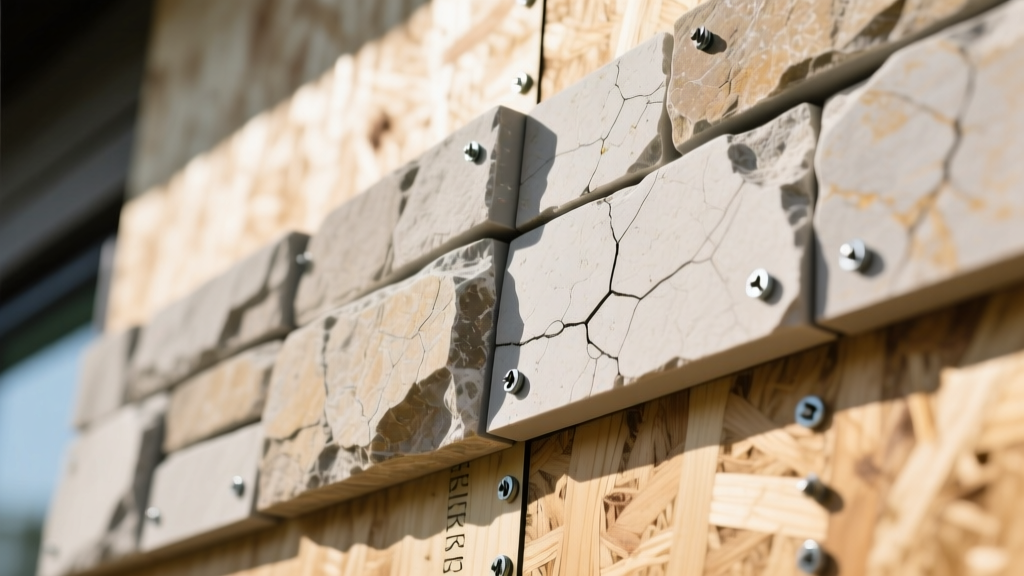
- Over OSB/Plywood: The most cost-effective scenario. Panels can be screwed and glued directly to the wood sheathing. Cost impact: Minimal (just the cost of exterior screws and adhesive).
- Over Existing Brick/Concrete: Requires a powder-actuated tool or Tapcon masonry anchors. You must also install pressure-treated furring strips every 16 inches on center to provide a nailing flange for the panels. Cost impact: Adds $2.50 - $4.00 per sq. ft. in materials and labor.
- Over Vinyl/Wood Siding: Complete tear-off is mandatory. You must strip the existing siding, inspect the sheathing, apply a weather-resistive barrier (like Tyvek HomeWrap), and then install the panels. Cost impact: Adds $1.50 - $3.00 per sq. ft. for demolition and WRB installation.
Installation Variables That Alter Your Budget
While the interlocking nature of these panels is designed for rapid deployment, specific site conditions dictate the speed of installation and, consequently, the labor cost.
- Adhesive Selection and Yield: Manufacturers mandate the use of high-strength polyurethane construction adhesives, specifically Loctite PL Premium 3X or equivalent. A standard 10-ounce tube costs roughly $8.50 and yields enough adhesive for two to three panels, depending on the bead size. Budget $1.25 per square foot strictly for adhesive.
- Fastener Specifications: Panels must be mechanically fastened to wall studs (16" or 24" on center) using 2.5-inch or 3-inch exterior-grade star-drive (Torx) screws. Relying solely on adhesive violates building codes in high-wind zones and voids manufacturer warranties.
- Cutting and Waste Factor: Complex architectural features, such as gables, dormers, and arched windows, require extensive cutting. While HDPU cuts easily with a miter saw, the irregular shapes of the faux stone profile mean off-cuts are rarely reusable. Always apply a 10% to 15% waste factor to your total square footage for complex elevations, compared to a 5% factor for flat, uninterrupted walls.
- Caulking and Touch-Up: Exterior installations require color-matched polyurethane sealant at the bottom courses, window intersections, and rooflines to prevent water intrusion behind the panels. Budget $12 per tube of manufacturer-matched sealant, anticipating one tube per 50 linear feet of joints.
Faux vs. Natural Stone: ROI and Long-Term Value
When deciding between rock faux stone veneer panels and natural stone, the return on investment (ROI) and structural implications are the deciding factors for most property owners. Industry data analyzed by Bob Vila and various remodeling cost-vs-value reports consistently show that stone veneer accents yield one of the highest returns in exterior curb appeal upgrades, often recouping 80% to 95% of the project cost at resale.
However, natural stone requires a structural masonry ledge or footing to support its immense weight (often 35 to 50 lbs per square foot). Pouring a new concrete footing for an existing home can add $3,000 to $8,000 to a project before a single stone is laid. Rock faux stone veneer panels, weighing between 1 and 3.5 lbs per square foot, bypass this requirement entirely. They can be installed on any structurally sound wall, from the foundation line all the way up to the soffit, without requiring engineering approvals for load-bearing capacity.
From a maintenance perspective, modern HDPU panels are cast with integral UV-stable pigments and coated with polyurethane clear coats that resist fading, chalking, and moisture absorption. Unlike manufactured cementitious stone, which can suffer from efflorescence (white salt deposits) or spalling in freeze-thaw cycles, polyurethane panels are entirely impervious to water penetration, eliminating the need for periodic masonry sealers.
Final Budgeting Framework
To accurately budget your 2026 project, follow this sequence: Calculate total flat square footage and add 10% for waste. Measure all outside and inside corners in linear feet. Determine your substrate condition (bare sheathing vs. retrofit). Finally, multiply the flat square footage by $12.50 for a DIY baseline, or by $20.00 for a turnkey professional installation. This framework ensures you account for the hidden linear costs that typically derail faux stone veneer estimates.
Written by
David NakamuraDavid Nakamura is a licensed architect (AIA) and construction technology writer focused on sustainable building methods, mass timber engineering, and high-performance building envelopes. He holds a Master of Architecture from the University of Washington and is a certified Passive House Consultant (CPHC). David spent eight years at the Seattle firm Mithun, where he led the design of three LEED Platinum projects, before founding his own practice specializing in net-zero residential design. He serves on the editorial advisory board of GreenBuilder Magazine and has authored peer-reviewed papers on cross-laminated timber (CLT) connections for the Journal of Structural Engineering. In his spare time, David teaches woodworking at Pratt Fine Arts Center and kayaks the Puget Sound.
More from David Nakamura
View all
Construction Cost
Labor Cost to Build a Deck Per Sq Ft: 2026 Installation Guide
Discover the exact labor cost to build a deck per sq ft in 2026. This installation guide breaks down contractor rates, complexity factors, and hidden fees.
Aug 4, 2026

Construction Cost
How Much Does It Cost to Build a 3 Bedroom House? Financing Guide
Learn exactly how much it costs to build a 3 bedroom house and explore 2026 financing options, construction loan types, and budget frameworks for your build.
Aug 4, 2026

Construction Cost
Cost to Build a Tennis Court: 2026 Guide
How much does it cost to build a tennis court in 2026? Breakdowns for asphalt, concrete, and synthetic surfaces plus fencing and lighting.
Jul 30, 2026