Technical Specs for Stone Veneer Suppliers Babylon NY Projects
Sourcing architectural stone veneer in Babylon, NY? Review critical ASTM standards, freeze-thaw specs, and coastal moisture management requirements.

The Microclimate Factor: Babylon, NY Exposure Zones
Sourcing materials for exterior cladding in the Town of Babylon requires navigating a highly specific microclimate. Situated in Suffolk County and bordered by the Great South Bay and the Atlantic Ocean, Babylon falls into IECC Climate Zone 5A but operates under severe coastal exposure conditions. Structures here face an average of 75 to 85 freeze-thaw cycles annually, compounded by high-velocity Nor'easter wind loads and saline atmospheric exposure.
When evaluating stone veneer suppliers Babylon NY contractors rely on, general aesthetic brochures are insufficient. Project managers and architects must demand rigorous technical data sheets (TDS) that prove the material can withstand coastal salt crystallization and rapid thermal cycling. Specifying the wrong absorption rate or mortar type in this zip code guarantees premature efflorescence, spalling, and substrate rot within three to five years of installation.
Mandatory ASTM Certifications to Demand
Reputable suppliers must provide third-party testing documentation verifying compliance with the latest masonry standards. Do not accept internal manufacturer claims; require independent lab results for the following ASTM protocols:
ASTM C1670: Standard Specification for Adhered Manufactured Stone Masonry Veneer
This is the baseline standard for manufactured stone veneer (MSV). It dictates dimensional tolerances, compressive strength, and flexural load limits. For coastal Long Island projects, ensure the supplier's MSV meets the minimum flexural strength requirements to resist wind-driven shear forces, which can exceed 110 mph in localized Babylon gust zones.
ASTM C170 and C666: Absorption and Freeze-Thaw Durability
Water absorption is the primary vector for veneer failure in freezing climates. While standard MSV allows up to 22% absorption by weight, projects within two miles of the Great South Bay should specify materials testing below 15% absorption per MVMA technical guidelines. Lower absorption prevents salt-laden moisture from penetrating the stone matrix, crystallizing during freezing temperatures, and causing the face to spall off.
Natural stone with high porosity (such as certain unsealed limestones or sandstones) will wick salt from the Babylon coastal air. When the water evaporates, salt crystals expand inside the pore structure. Always demand a 500-hour salt fog test report (ASTM B117) from your supplier if specifying natural stone for oceanfront or bayfront properties.
Technical Matrix: Manufactured vs. Natural Veneer for Coastal Zones
Choosing between manufactured and natural stone requires evaluating structural load limits and moisture dynamics. The following matrix compares technical properties critical for Long Island coastal assemblies.
| Technical Property | Manufactured Stone Veneer (MSV) | Natural Stone (Dense Granite/Bluestone) | Natural Stone (Porous Limestone/Sandstone) |
|---|---|---|---|
| Installed Weight | 10 - 15 lbs / sq ft | 25 - 40 lbs / sq ft | 18 - 25 lbs / sq ft |
| Water Absorption | 12% - 22% (Specify <15% for coast) | < 1% | 8% - 15% |
| Freeze-Thaw (300 Cycles) | < 3% weight loss (ASTM C666) | Negligible degradation | High risk of spalling if unsealed |
| Structural Support Needed | Standard wood/steel stud framing | Requires masonry ledge or steel angles | Reinforced framing + masonry ties |
| Coastal Salt Resistance | Moderate (Depends on mix design) | Excellent | Poor (Requires penetrating silane sealer) |
The Code-Compliant Substrate Assembly
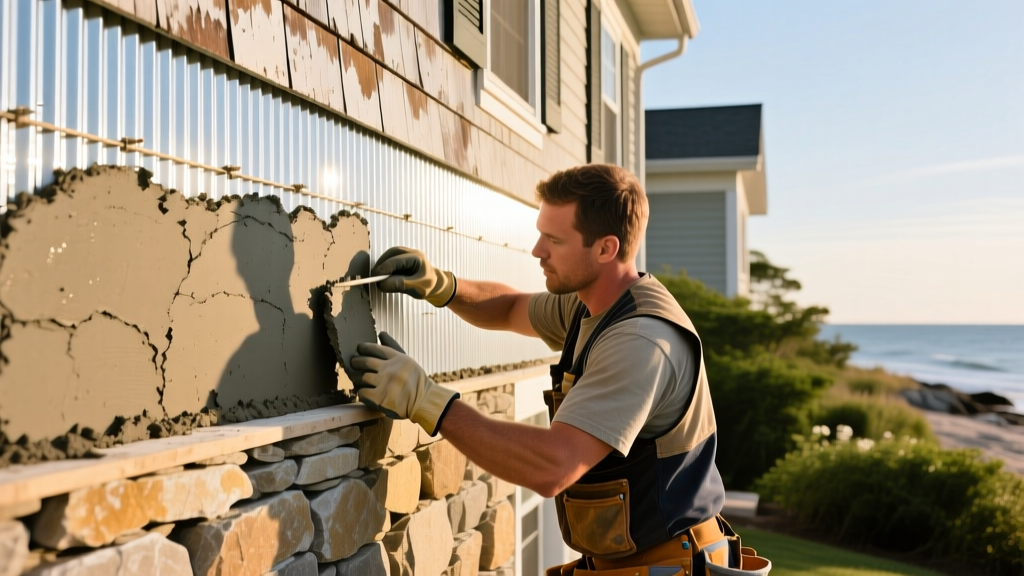
The longevity of stone veneer in Babylon relies entirely on the moisture management assembly behind it. According to the New York State Uniform Fire Prevention and Building Code, adhered masonry veneer must incorporate a continuous drainage plane. Local suppliers should be able to provide compatible accessory products that meet these exact specifications:
- Weather-Resistive Barrier (WRB): Two layers of Grade D building paper or a high-performance fluid-applied membrane (minimum 40 mils wet thickness) over OSB or plywood sheathing. Fluid-applied is highly recommended for Babylon's wind-driven rain zones to eliminate capillary action at fastener penetrations.
- Corrosion-Resistant Lath: 2.5 lb/yd² self-furring galvanized metal lath (ASTM A641). For properties within 1,500 feet of the Great South Bay or Atlantic Ocean, upgrade to stainless steel lath to prevent rust-jacking, which can blow the mortar bed off the wall.
- Scratch Coat: A 1/2-inch thick scratch coat of Type S mortar (ASTM C270). Type S provides higher bond strength and lower permeability than Type N, which is critical for resisting coastal moisture intrusion.
- Weep Screed: A minimum 0.019-inch thick galvanized or PVC weep screed placed at the base of the wall. It must be installed a minimum of 4 inches above earth grade or 2 inches above paved hardscapes to prevent ground moisture wicking and termite entry.
Vetting Stone Veneer Suppliers Babylon NY: The RFI Checklist
When issuing a Request for Information (RFI) to local masonry supply yards, bypass the sales representatives and request direct communication with their technical services department. Use this exact questionnaire to filter out suppliers who lack the inventory depth for rigorous coastal specifications:
- "Can you provide the ICC-ES Evaluation Report (ESR) for the specific MSV product line you are proposing, confirming compliance with ICC-ES AC380?"
- "What is the exact water absorption percentage by weight for this natural stone batch, and do you stock the corresponding silane/siloxane penetrating sealer rated for below-freezing application?"
- "Do you carry stainless steel self-furring lath and stainless steel masonry ties in stock, or is it a special order item with a lead time exceeding four weeks?"
- "Can you supply a polymer-modified adhered veneer mortar that meets ANSI A118.4 standards for high-shear, freeze-thaw environments?"
Coastal sun exposure can rapidly degrade cheap iron-oxide pigments in mortar joints. Demand that your Babylon supplier provides mortar mixtures utilizing synthetic, UV-stable iron-oxide pigments. Request a 12-inch mockup panel, cure it for 28 days, and subject it to a localized pressure wash test to ensure the pigment does not leach or wash out during heavy coastal storms.
Navigating the 2026 NYS Energy Code Updates
As of the latest updates to the New York State Energy Conservation Construction Code (ECCCNYS), continuous exterior insulation (ci) is heavily emphasized to eliminate thermal bridging in wood-framed assemblies. Installing stone veneer over thick exterior rigid foam (such as 2-inch polyisocyanurate) introduces complex structural challenges.
The weight of the veneer cannot be supported by the foam; it must be transferred back to the structural framing. When working with suppliers, request specialized masonry anchoring systems designed for thick-ci assemblies. These typically involve heavy-duty stainless steel screws that penetrate through the foam and anchor deep into the wall studs, coupled with specialized furring channels that hold the lath. Failing to account for this structural transfer is a common cause of inspection failures in modern Babylon residential builds.
"A successful coastal masonry veneer installation is 20% aesthetic selection and 80% moisture management engineering. The supplier's ability to provide the correct accessory components is just as critical as the stone itself."
— Senior Masonry Consultant, Long Island Coastal Building Envelope Division
By enforcing these strict technical specifications, architects and builders can ensure that the materials sourced from local suppliers will perform flawlessly against the harsh environmental realities of the Long Island coastline, protecting both the structural integrity of the building and the investment of the client.
Written by
Priya KapoorPriya Kapoor is a real estate market analyst and construction economics researcher with expertise in housing affordability, development feasibility, and infrastructure investment. She holds a Master of Regional Planning from Cornell University and previously worked as a senior analyst at CBRE's Investment Properties group, where she modeled returns for $4B in mixed-use development pipelines. Priya now runs an independent research practice advising developers, municipalities, and REITs on construction cost forecasting and market timing. She publishes the quarterly "BuildMat Market Pulse" report tracking material price indices across 12 commodity categories. Based in Austin, TX, Priya serves on the board of Habitat for Humanity Austin and is a marathon runner.
More from Priya Kapoor
View all
Construction Cost
Cost to Build a 1600 Sq Ft Home in 2026: Full Breakdown
Accurate 2026 cost to build a 1600 sq ft home—material, labor, and regional pricing breakdowns included. Plan your budget with real-time estimates.
Aug 11, 2026

Wood & Lumber
Name the Types of Wood for Pressure Treatment and Preservation
Learn how to name the types of wood best suited for pressure treatment. Compare species treatability, chemical retention levels, and 2026 preservation costs.
Aug 4, 2026

Stone & Masonry
Stone Veneer Suppliers Lindenhurst: 2026 Cost Analysis
Analyze 2026 stone veneer costs in Lindenhurst, NY. Compare local supplier pricing, delivery fees, and Suffolk County installation labor rates.
Aug 4, 2026