Why Stone Veneer Thin Profiles Dominate 2026 Architecture
Explore 2026 thin stone veneer design trends. Discover interior and exterior styling ideas, material pairings, and installation specs for modern homes.

The Architectural Shift to Lightweight Stone
The transition from full-bed masonry to adhered veneer systems has fundamentally altered residential and commercial architecture. When designers specify stone veneer thin profiles, they are no longer compromising on authenticity; they are optimizing structural loads, expanding design versatility, and accelerating construction timelines. In 2026, the market is distinctly split between Natural Thin Stone Veneer (NTSV) and Manufactured Stone Veneer (MSV), both of which offer high-fidelity aesthetics without the massive structural footprint of traditional full-bed stone.
Full-bed natural stone typically requires a 4-to-6-inch depth, weighs upwards of 40 pounds per square foot (psf), and demands reinforced concrete masonry unit (CMU) back-up or heavily engineered structural footings. By contrast, modern thin stone profiles range from 3/4-inch to 1.5-inches in thickness and weigh between 10 and 15 psf. This dramatic reduction in dead load allows architects to clad cantilevered walls, interior non-load-bearing partitions, and existing wood-framed facades without requiring structural retrofitting.
Data Highlight: Load-Bearing Implications
Full-Bed Limestone: ~45 psf | Requires masonry substrate & reinforced footings.
Manufactured Thin Veneer: ~12 psf | Can be applied directly to wood or steel stud framing with proper sheathing and lath.
Natural Thin Veneer: ~14 psf | Sawn from the back of full-bed stone, retaining 100% natural mineral variation.
2026 Exterior Design Profiles & Material Pairings
Exterior applications of thin stone veneer have evolved beyond the traditional 'skirt' or 'water table' base. Current architectural trends favor large-scale feature walls, mixed-material transitions, and monolithic chimney chases. The success of these designs relies heavily on contrasting textures.
Organic Modern & Japandi Influences
The Organic Modern aesthetic relies on raw, unpolished materials that blend with the natural landscape. For this style, linear and dry-stack thin stone profiles are dominant. Products like Eldorado Stone’s ProFit modular panel systems offer the tight, mortarless joints required for this look. Pairing a charcoal or basalt-toned linear stone with warm cedar cladding or blackened steel (Shou Sugi Ban) creates a striking, high-contrast facade that defines luxury custom builds in 2026.
Transitional & Modern Farmhouse Exteriors
For transitional architecture, the goal is to soften contemporary lines with traditional textures. Dressed fieldstone and chipped-edge profiles provide a timeless, mortar-heavy appearance. Cultured Stone’s Dressed Fieldstone series remains a benchmark for this application, offering the rounded, tactile edges of hand-laid masonry while maintaining a thin, adhered profile. These are frequently paired with smooth-finish fiber cement siding or traditional white lime-washed brick.
| Design Style | Ideal Thin Stone Profile | Recommended Pairing Material | Joint Treatment |
|---|---|---|---|
| Organic Modern | Linear / Ledgestone | Charred Timber, Corten Steel | Dry-Stack (Mortarless) |
| Modern Farmhouse | Dressed Fieldstone | White Fiber Cement, Board & Batten | Standard Mortar (Overgrouted) |
| Contemporary Luxury | Large Format Ashlar | Smooth Troweled Stucco, Glass | Thin Raked Joint |
Interior Statement Walls & Fireplace Surrounds
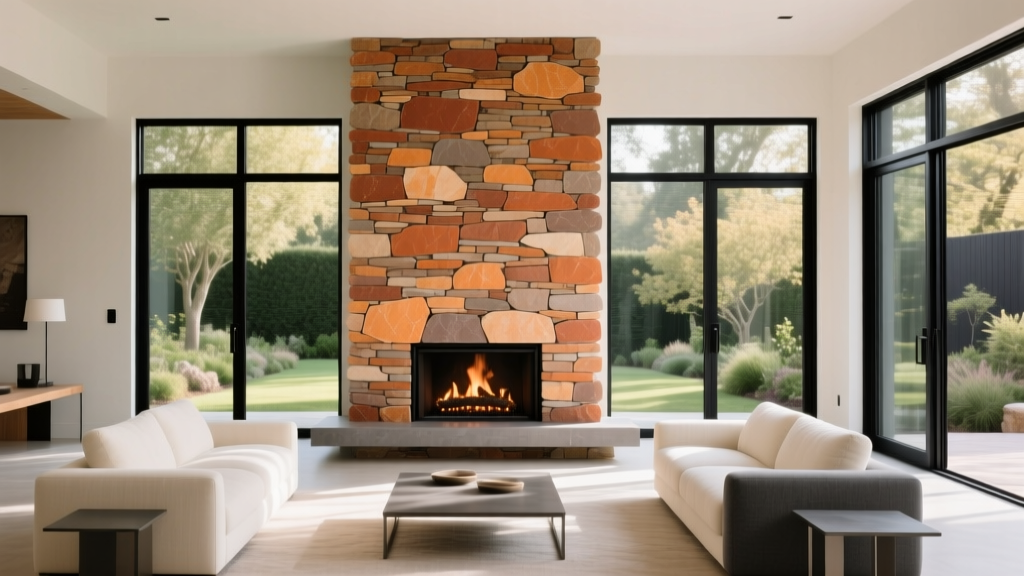
Interior applications bypass the rigorous weather-resistive requirements of exterior cladding, allowing for faster installation and thinner overall wall assemblies. In 2026, floor-to-ceiling fireplace surrounds and localized wet-room accent walls are the primary interior use cases.
Dry-Stack vs. Mortared Joints: A Decision Matrix
Choosing the correct joint treatment dictates both the visual weight of the stone and the installation methodology. Dry-stack systems utilize precise, interlocking modular panels that require no mortar, drastically reducing labor costs and mess during interior renovations.
Dry-Stack Systems
- Best For: Modern interiors, tight spaces, DIY-friendly renovations.
- Installation: Applied directly to a clean, painted drywall or cement board substrate using polymer-modified thin-set mortar (ANSI A118.4 or A118.15).
- Visual Impact: Sleek, shadow-heavy, highly textured.
- Limitation: Not recommended for high-splash exterior zones where water ingress behind the joints could occur.
Mortared Joints
- Best For: Traditional exteriors, rustic interiors, high-moisture areas.
- Installation: Requires metal lath, a scratch coat, and Type S masonry mortar (ASTM C270) for setting and pointing.
- Visual Impact: Classic, grounded, historically accurate masonry appearance.
- Limitation: Requires skilled masons; higher labor cost and longer curing times.
Technical Specifications & Moisture Management
The most critical failure mode for exterior stone veneer thin applications is moisture entrapment. In the 2010s, improper installation of Manufactured Stone Veneer (MSV) led to widespread rot in wood-framed structures. The industry and building codes have since adapted. According to technical guidelines reviewed by The Masonry Society, strict adherence to moisture management protocols is non-negotiable for exterior adhered veneer.
The 2026 Code-Compliant Exterior Assembly
- Weather-Resistive Barrier (WRB): Code typically mandates two layers of Grade D building paper (ASTM D226) or a code-approved equivalent housewrap system over the structural sheathing. The dual-layer creates a drainage plane that allows incidental moisture to flow downward.
- Corrosion-Resistant Weep Screed: A weep screed conforming to ASTM C1063 must be installed at the base of the wall system. It must be placed a minimum of 4 inches above final grade, or 2 inches above paved surfaces like concrete patios, to prevent ground moisture wicking and to allow trapped water to exit the wall cavity.
- Wire Lath: 2.5 lb self-furring galvanized welded wire lath (ASTM C847) is mechanically fastened to the framing studs (not just the sheathing) using corrosion-resistant nails or staples.
- Scratch Coat: A 3/8-inch to 1/2-inch layer of Type S mortar is applied to the lath and horizontally scored to provide a mechanical key for the final stone application.
- Setting Bed: Stones are applied using a fresh bed of Type S mortar, ensuring 100% coverage on the back of the veneer unit to prevent voids where water could pool and freeze.
Cost Analysis & ROI Breakdown
While thin stone veneer eliminates the need for structural footings, the material and specialized labor still represent a premium investment compared to vinyl or standard fiber cement siding. However, the return on investment (ROI) for stone veneer remains one of the highest among exterior upgrades, frequently recouping 90% to 95% of the project cost at resale, driven by the immense curb appeal it generates.
| Cost Component | Manufactured Thin Veneer (MSV) | Natural Thin Stone Veneer (NTSV) |
|---|---|---|
| Material Cost (per sq. ft.) | $8.00 - $14.00 | $12.00 - $22.00 |
| Prep, Lath & WRB (per sq. ft.) | $2.50 - $4.00 | $2.50 - $4.00 |
| Masonry Labor (per sq. ft.) | $14.00 - $20.00 | $18.00 - $28.00 |
| Total Installed Cost | $24.50 - $38.00 / sq. ft. | $32.50 - $54.00 / sq. ft. |
Note: Interior dry-stack installations bypass the WRB, lath, and scratch coat requirements, reducing total installed costs by approximately 30% to 40% compared to exterior applications.
Sourcing and Sustainability Considerations
When specifying stone veneer thin profiles for environmentally conscious projects, consider the embodied carbon of the material. Manufactured stone veneer is primarily composed of Portland cement, lightweight aggregates, and iron oxide pigments. While it avoids the quarrying impact of natural stone, the cement production process is carbon-intensive. To mitigate this, several top-tier manufacturers now offer MSV lines incorporating recycled materials and supplementary cementitious materials (SCMs) like fly ash or slag.
Natural thin stone veneer, conversely, is a product of quarrying. However, because it is sawn to a 1-inch thickness from the back of full-bed stone blocks, it maximizes the yield of the quarry, reducing overall waste. Sourcing natural stone from regional quarries (within a 500-mile radius of the job site) significantly cuts down on transportation-related emissions, making it a highly sustainable choice for regional architectural projects. Always verify that natural stone suppliers adhere to the ANSI/NSC 373 Sustainability Standard for Natural Dimension Stone to ensure responsible quarrying and water management practices.
Written by
Priya KapoorPriya Kapoor is a real estate market analyst and construction economics researcher with expertise in housing affordability, development feasibility, and infrastructure investment. She holds a Master of Regional Planning from Cornell University and previously worked as a senior analyst at CBRE's Investment Properties group, where she modeled returns for $4B in mixed-use development pipelines. Priya now runs an independent research practice advising developers, municipalities, and REITs on construction cost forecasting and market timing. She publishes the quarterly "BuildMat Market Pulse" report tracking material price indices across 12 commodity categories. Based in Austin, TX, Priya serves on the board of Habitat for Humanity Austin and is a marathon runner.
More from Priya Kapoor
View all
Construction Cost
Cost to Build a 1600 Sq Ft Home in 2026: Full Breakdown
Accurate 2026 cost to build a 1600 sq ft home—material, labor, and regional pricing breakdowns included. Plan your budget with real-time estimates.
Aug 11, 2026

Wood & Lumber
Name the Types of Wood for Pressure Treatment and Preservation
Learn how to name the types of wood best suited for pressure treatment. Compare species treatability, chemical retention levels, and 2026 preservation costs.
Aug 4, 2026

Stone & Masonry
Stone Veneer Suppliers Lindenhurst: 2026 Cost Analysis
Analyze 2026 stone veneer costs in Lindenhurst, NY. Compare local supplier pricing, delivery fees, and Suffolk County installation labor rates.
Aug 4, 2026