Translucent Stone Veneer Review: Natural Onyx vs Engineered Panels
Compare natural onyx and engineered translucent stone veneer. Expert analysis on backing systems, LED specs, clear adhesives, and 2026 pricing.

The Mechanics of Light Transmission in Stone
Translucent stone veneer represents one of the most striking intersections of geology and architectural lighting. Unlike opaque granites or basalts, specific sedimentary and metamorphic stones possess a crystalline structure that allows photons to penetrate and scatter through the material. This phenomenon, known as sub-surface scattering, is primarily found in calcite-rich stones like onyx, alabaster, and certain marbles. When sliced to precise thicknesses and paired with high-CRI LED arrays, these materials transform from static wall claddings into luminous architectural features.
However, specifying backlit stone is fraught with technical pitfalls. Natural stone is inherently brittle, heavily veined, and reactive to environmental shifts. To mitigate these physical limitations, the industry has developed engineered composite alternatives and advanced structural backing systems. This comparison review dissects the material science, structural requirements, and lighting specifications necessary to execute a flawless translucent stone veneer installation in 2026.
Core Material Breakdown: Natural Onyx vs. Engineered Composites
The choice between natural and engineered translucent veneer dictates the entire installation methodology, maintenance schedule, and visual outcome. Natural onyx—sourced primarily from quarries in Pakistan, Iran, and Mexico—offers unparalleled visual depth. The random distribution of mineral impurities creates organic banding that cannot be perfectly replicated in a factory. Conversely, engineered translucent panels utilize crushed calcite or quartz aggregates suspended in optically clear polyurethane or epoxy resins.
Natural Onyx Veneer
Natural onyx must be diamond-wire cut and calibrated to a thickness between 15mm and 20mm for structural integrity, though book-matched slabs can be milled down to 10mm when paired with heavy-duty backings. According to technical guidelines published by the Natural Stone Institute, onyx exhibits a high absorption rate and low flexural strength compared to granite. This means natural onyx is highly susceptible to staining from iron-rich water and requires meticulous sealing before being placed in humid environments like spa reception areas or commercial restrooms.
Engineered Translucent Composites
Engineered panels typically measure between 5mm and 8mm in thickness. Because the stone aggregate is bound in a flexible resin matrix, these panels can be thermoformed to wrap around curved walls, columns, and reception desks—a physical impossibility for rigid natural onyx. The primary trade-off is visual uniformity; while high-end engineered panels mimic veining, the pattern repetition becomes apparent across large continuous surfaces.
Material Specification Matrix
| Feature | Natural Onyx Veneer | Engineered Translucent Veneer |
|---|---|---|
| Standard Thickness | 15mm - 20mm | 5mm - 8mm |
| Weight (per sq. ft.) | 12 - 16 lbs | 3 - 5 lbs |
| Light Transmission Rate | 15% - 40% (highly variable) | 60% - 85% (highly consistent) |
| Flexural Strength (ASTM C99) | Low (requires rigid backing) | High (allows mild curvature) |
| UV Stability | Excellent (inorganic) | Poor to Fair (resins may yellow) |
| Material Cost (2026) | $65 - $140 / sq. ft. | $25 - $55 / sq. ft. |
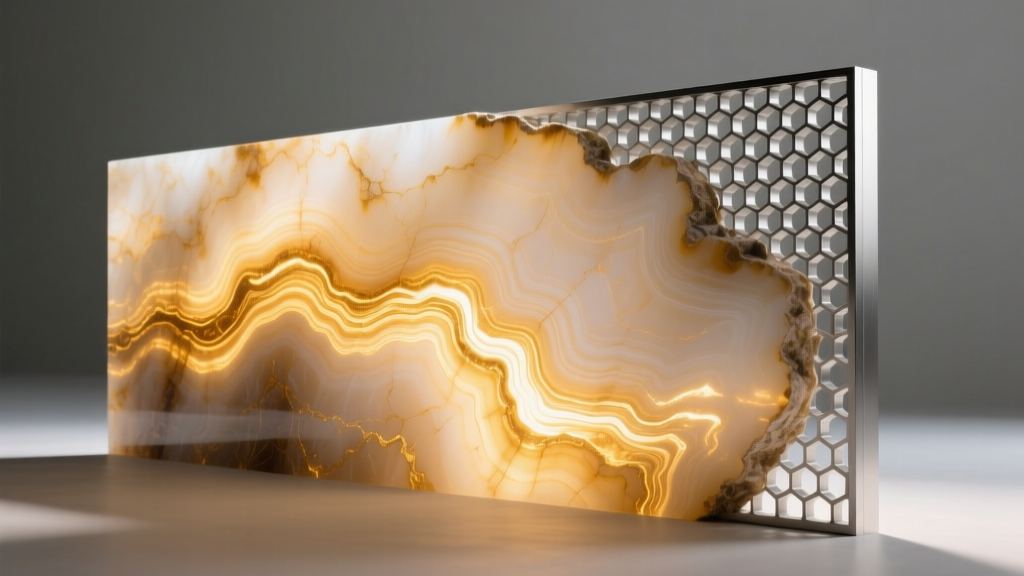
Structural Backing Systems: The Hidden Hero
Because translucent stone must be sliced dangerously thin to allow light penetration, it loses its inherent structural mass. Backing systems are not optional; they are critical load-bearing components that prevent catastrophic failure. The backing material must also be optically clear or highly translucent to avoid blocking the LED array behind it.
Fiberglass Mesh and Clear Epoxy
The most common backing for mid-tier natural onyx is a heavy-duty fiberglass mesh laminated with optically clear epoxy. This setup provides excellent tensile strength, holding the stone together even if micro-fractures develop over time. However, fiberglass mesh does not provide rigidity. If the substrate behind the veneer shifts or bows, the stone will follow the contour and eventually crack.
Aluminum Honeycomb Reinforcement
For commercial applications, elevator cabs, and high-traffic hospitality spaces, aluminum honeycomb backing is the mandatory standard. A 10mm slab of onyx is bonded to a 10mm or 15mm aluminum honeycomb core using aerospace-grade, light-permeable structural adhesives. This creates a composite panel that is incredibly rigid, lightweight, and completely impervious to substrate deflection. The hexagonal cells of the honeycomb allow light to pass through unobstructed while providing a flexural strength that exceeds solid stone by a factor of ten.
Never use standard cementitious thinset or opaque construction adhesives to mount translucent veneer. Any opaque adhesive will create permanent, dark shadow patches visible through the stone. Installers must specify non-yellowing, optically clear epoxies, such as Tenax Akeemi or equivalent UV-stable structural resins, applied in a continuous, troweled layer to prevent air pockets that scatter light unpredictably.
Lighting Integration: LED Specifications for Optimal Glow
The stone is only half of the equation; the lighting array dictates the final aesthetic. Poorly specified LEDs will result in "hot spotting" (visible bright dots behind the stone) and color distortion. Based on standards maintained by the Illuminating Engineering Society (IES), architectural backlighting requires strict adherence to photometric parameters.
- Color Rendering Index (CRI): Specify LEDs with a minimum CRI of 92. Lower CRI diodes will flatten the complex mineral colors in natural onyx, making rich golds and deep reds appear muddy and gray.
- Color Temperature: 3000K (warm white) is the industry standard for natural onyx, as it enhances the golden and amber hues inherent in the calcite. 4000K (neutral white) is preferred for engineered white alabaster composites to maintain a crisp, modern aesthetic.
- LED Pitch and Diffusion: LED strips must have a high diode density (minimum 120 LEDs per meter). Furthermore, a 3mm to 5mm opal acrylic or polycarbonate diffuser sheet must be installed between the LED strips and the back of the stone. This physical separation and diffusion layer is the only reliable way to eliminate hot spotting and create a seamless, uniform glow.
- Thermal Management: LEDs generate heat. If trapped behind a solid slab of stone, temperatures can exceed 120°F, which will degrade the clear epoxy backing and cause premature yellowing. Always specify LED tape with integrated aluminum heat-sink channels.
Installation Realities and Edge Case Failures
Even with premium materials, field installation errors frequently ruin translucent veneer projects. The most common failure mode is moisture entrapment. If natural onyx is installed in a wet area (like a backlit bar backsplash) without a breathable backing or proper edge sealing, water vapor penetrates the porous stone, becomes trapped against the impermeable LED diffuser, and creates permanent cloudy blotches.
Another frequent edge case is thermal expansion mismatch. Natural stone and aluminum honeycomb expand at different rates when exposed to the heat generated by the LED array. If the perimeter of the panel is hard-caulked to adjacent millwork without a flexible expansion joint, the panel will bow outward in the center as it heats up during operation. Always leave a minimum 1/8-inch perimeter gap, concealed by a shadow gap or flexible silicone sealant matched to the stone's edge profile.
Cost Analysis and Project Budgeting
Budgeting for translucent stone requires looking beyond the raw material cost. A comprehensive 2026 cost breakdown for a standard 50-square-foot commercial reception wall reveals the true financial scope:
- Natural Onyx Material (Honeycomb backed): $90 - $130 per sq. ft.
- Engineered Composite Material: $35 - $50 per sq. ft.
- LED Array, Diffusers, and DMX Controllers: $25 - $45 per sq. ft.
- Specialized Fabrication and Clear-Epoxy Installation: $60 - $95 per sq. ft.
When factoring in the mandatory structural backing, high-CRI lighting infrastructure, and specialized clear-adhesive installation labor, a premium natural onyx installation will typically land between $220 and $300 per square foot fully realized. Engineered alternatives reduce this total installed cost to the $130 to $170 per square foot range, primarily due to lower material waste and reduced fabrication complexity.
Final Specification Verdict
Specify natural onyx with aluminum honeycomb backing for flagship hospitality spaces, luxury retail, and executive boardrooms where the irreplaceable, chaotic beauty of natural geology is paramount and budget constraints are secondary. The visual depth of natural calcite interacting with 3000K light remains unmatched by synthetic alternatives.
Specify engineered translucent composites for high-moisture environments, curved architectural elements, and projects requiring strict budget adherence. Engineered panels offer superior flexural strength, predictable light transmission, and eliminate the anxiety of natural stone fracturing during transit or installation. Whichever path you choose, success hinges entirely on the integration of optically clear adhesives, high-CRI diffused lighting, and rigorous thermal management.
Written by
Sarah WhitfieldSarah Whitfield is a chartered quantity surveyor (MRICS) and construction cost analyst with 15 years of experience in material pricing, procurement strategy, and project budgeting. She earned her degree in Construction Management from the University of Reading (UK) and has worked on projects ranging from $2M custom homes to $180M mixed-use developments across North America and Europe. Sarah currently leads cost estimating for BuildMat Insight, maintaining a proprietary database of 4,000+ material price points updated quarterly. She is a frequent contributor to RSMeans cost data panels and has presented at the International Cost Engineering Council (ICEC) congress. Based in Denver, CO, Sarah is an avid trail runner and volunteer mentor for Women in Construction.
More from Sarah Whitfield
View all
Wood & Lumber
What Are the Different Types of Wood? A Builder's Guide
Compare structural softwoods, finish hardwoods, and engineered lumber. Analyze Janka ratings, MOE values, and 2026 pricing for construction.
Aug 4, 2026

Walls & Panels
Steel Framing vs Wood Framing: Corrosion and Moisture Defense
Compare steel framing vs wood framing for moisture resistance. Learn about galvanized coatings, condensation risks, and corrosion protection strategies.
Jul 21, 2026

Stone & Masonry
How to Cut Stone Veneer: Wet Saw vs Grinder Comparison
Compare the best tools for cutting stone veneer. We review wet saws, angle grinders, and chop saws to help you achieve clean, chip-free cuts.
Jul 21, 2026