Wall Veneer Stone Cost Guide: 2026 Pricing & Installation
Comprehensive 2026 cost analysis for wall veneer stone. Compare natural vs. manufactured pricing, labor rates, and hidden installation expenses.

The True Cost of Wall Veneer Stone in 2026
Budgeting for a masonry facade requires looking beyond the sticker price of the stone itself. In 2026, the total installed cost for wall veneer stone ranges from $18 to $45 per square foot, depending on material origin, profile complexity, and regional labor rates. While manufactured options provide a budget-friendly entry point, natural thin veneers command a premium due to quarrying and cutting expenses. Understanding the complete financial scope—from weather-resistive barriers to specialized polymer mortars—prevents severe budget overruns mid-project.
Quick 2026 Cost Summary (Per Square Foot)
- Manufactured Stone Veneer (MSV): $18 – $28 installed
- Natural Thin Stone Veneer: $26 – $45 installed
- Materials Only (MSV): $6 – $14
- Materials Only (Natural): $12 – $28
- Professional Labor: $12 – $18
Material Breakdown: Manufactured vs. Natural Wall Veneer Stone
The primary cost driver is the choice between manufactured stone veneer (MSV) and natural stone. MSV, produced by brands like Eldorado Stone and Cultured Stone, uses Portland cement, lightweight aggregates, and iron oxide pigments to replicate natural textures. Natural thin veneer is sliced from quarried limestone, slate, or fieldstone to a thickness of 0.75 to 1.5 inches. Both adhere to strict weight limitations—typically under 15 pounds per square foot—allowing installation without massive foundation reinforcements, provided the framing is adequate.
| Material Type | Cost Per Sq.Ft. (Material) | Weight Per Sq.Ft. | Best Application |
|---|---|---|---|
| Manufactured Ledge Stone | $6.50 – $9.00 | 10 – 12 lbs | Exterior accent walls, fireplaces |
| Manufactured Fieldstone | $8.00 – $12.00 | 11 – 13 lbs | Full exterior facades, wainscoting |
| Natural Thin Limestone | $14.00 – $19.00 | 12 – 15 lbs | High-end residential, commercial |
| Natural Slate Veneer | $18.00 – $26.00 | 13 – 16 lbs | Modern interiors, feature walls |
| Natural River Rock (Thin) | $16.00 – $22.00 | 12 – 14 lbs | Craftsman exteriors, landscaping |
The 'Hidden' Accessory Costs
Contractors and DIYers frequently underestimate the accessory materials required for a code-compliant installation. According to the Masonry Veneer Manufacturers Association (MVMA), adhered veneer systems require a multi-layer moisture management setup. You must budget for the following components, which add approximately $2.50 to $4.00 per square foot to your material costs:
- Weather-Resistive Barrier (WRB): Two layers of Grade D building paper or a high-performance housewrap like Tyvek HomeWrap ($0.50 – $1.10/sq.ft.).
- Corrosion-Resistant Weep Screed: ASTM C847 compliant galvanized or PVC screed placed at the base to drain moisture ($1.50 – $2.50 per linear foot).
- Metal Lath: 2.5 lb self-furring galvanized welded wire lath is mandatory for cementitious scratch coats ($1.20 – $1.80/sq.ft.).
- Fasteners: Corrosion-resistant nails or screws penetrating structural studs by a minimum of 1 inch ($0.20/sq.ft.).
Labor Rates and Preparation Requirements
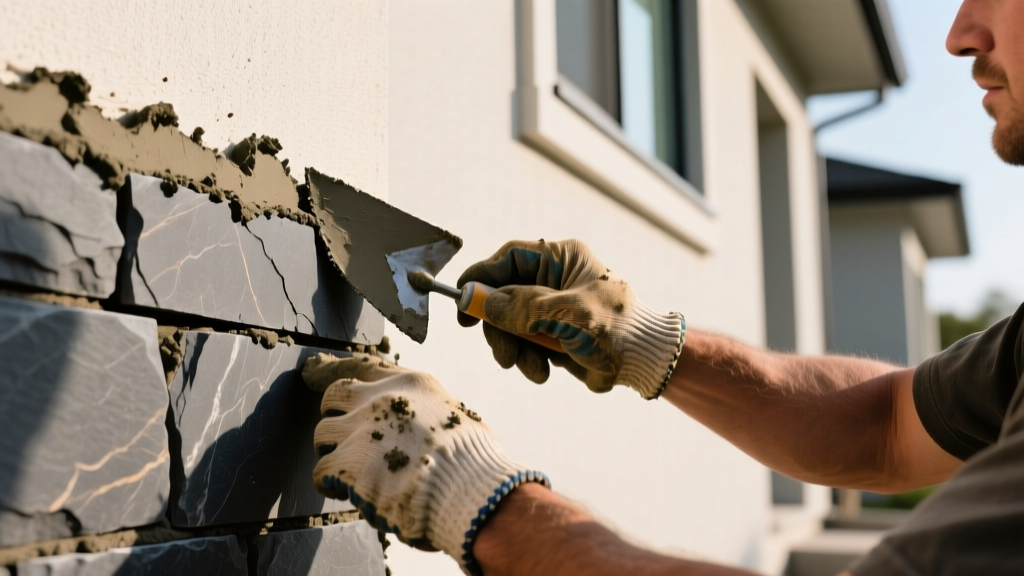
Professional masonry labor in 2026 averages $65 to $95 per hour, translating to $12 to $18 per square foot for veneer installation. Unlike stacking modular blocks, wall veneer stone requires an artistic eye for pattern variation, color blending, and mortar joint tooling. The labor process is strictly sequential and cannot be rushed without risking adhesion failure.
Phase 1: Substrate Prep and Lath (20% of labor cost)
Installing the WRB, flashing, weep screed, and wire lath. This phase is critical; improper lath overlapping (minimum 1-inch horizontal, 2-inch vertical) leads to scratch coat cracking.
Phase 2: The Scratch Coat (15% of labor cost)
Applying a 1/2-inch layer of Type S mortar or a specialized veneer setting mortar. This layer must be scored horizontally to provide a mechanical key for the setting bed and requires 24 to 48 hours of curing time before stone can be applied.
Phase 3: Stone Setting and Pointing (65% of labor cost)
Back-buttering each stone with mortar and pressing it into the setting bed. Complex profiles like dry-stack veneer eliminate the need for pointing (mortar joints), which can actually reduce labor time by 15%, though dry-stack materials often cost 10% more to manufacture.
Expert Warning: Never use standard masonry cement for adhered wall veneer stone. Standard masonry cement lacks the bond strength and flexural adhesion required for thin veneers. Always specify a polymer-modified veneer mortar compliant with ASTM C270, or use a pre-blended product like PROSPEC Veneer Setting Mortar to prevent delamination during freeze-thaw cycles.
Structural Considerations: When Reinforcement is Required
While wall veneer stone is classified as a non-load-bearing cladding, its dead load is substantial. A 100-square-foot wall clad in natural thin slate adds roughly 1,500 pounds to the structure. Standard 2x4 wood framing at 16 inches on center can typically support this weight, but older homes or walls with extensive window cutouts may require structural evaluation.
If you are installing wall veneer stone on an exterior CMU (concrete masonry unit) or poured concrete wall, metal lath and a scratch coat are often bypassed in favor of direct application using a high-strength polymer adhesive, provided the concrete is clean, unpainted, and scored. This can reduce installation labor by up to 25%. However, direct-adhered applications on concrete still require a moisture barrier or penetrating silane/siloxane sealer on the stone face to prevent efflorescence.
DIY vs. Professional Installation: A Financial Decision Matrix
Deciding whether to hire a mason or tackle the project yourself depends on your skill level and the project's visibility. Use this matrix to determine the most financially sound route:
| Project Scenario | DIY Feasibility | Financial Impact | Recommendation |
|---|---|---|---|
| Interior Fireplace Surround (< 40 sq.ft.) | High | Save $600 - $900 | DIY with dry-stack profile to avoid messy mortar joints. |
| Exterior Wainscoting (4ft high, >100 sq.ft.) | Medium | Save $1,500 - $2,500 | DIY if experienced with stucco/tiling; hire pro if dealing with complex corner flashing. |
| Full Two-Story Exterior Facade | Low | Risk of $10k+ in remediation | Hire a licensed mason. Scaffolding, weatherproofing, and load management require professional execution. |
Long-Term ROI and Maintenance Costs
Wall veneer stone is one of the highest-performing exterior materials regarding return on investment. According to industry cost data aggregated by HomeGuide, manufactured stone veneer consistently recoups between 90% and 102% of its installation cost at resale, heavily outperforming vinyl siding or fiber cement alternatives. Natural stone offers similar ROI but appeals to a more luxury-oriented buyer demographic.
Maintenance costs for adhered stone veneer are exceptionally low. Unlike wood or stucco, it does not require painting or sealing. The only recurring expense is an annual inspection of the mortar joints and weep screeds. If efflorescence (white, powdery salt deposits) appears, it can be removed using a specialized masonry cleaner like PROSOCO SureKlean, which costs approximately $45 per gallon and treats up to 400 square feet. Avoid using muriatic acid or high-pressure power washers (>2,000 PSI), as these will degrade the mortar joints and force water behind the WRB.
Final Procurement Advice
When ordering wall veneer stone, always calculate your total square footage and add a 10% to 15% waste factor for cuts, breakage, and pattern matching. Furthermore, purchase all stone from the same manufacturing lot number. Dye-lot variations between batches of manufactured stone can result in stark, unblended color banding across your facade. For natural stone, request 'blended pallets' from the supplier to ensure a natural distribution of color variations upon delivery.
Written by
Marcus ChenMarcus Chen is a licensed structural engineer (PE) and building materials analyst with over 12 years of experience across residential, commercial, and industrial construction. He holds a Master of Science in Civil Engineering from UC Berkeley and spent six years at Thornton Tomasetti before transitioning to independent consulting and technical writing. Marcus specializes in material selection for seismic-prone regions, concrete reinforcement strategies, and lifecycle cost analysis. His work has been cited by the American Concrete Institute (ACI) and the Structural Engineers Association of California (SEAOC). When he is not on a job site or at his desk, you will find him hiking the Sierra Nevada or restoring a 1920s craftsman bungalow in Oakland, CA.
More from Marcus Chen
View all
Construction Cost
How Much Did the Eiffel Tower Cost to Build?
How much did the Eiffel Tower cost to build in 1889? We adjust for inflation and compare its budget to modern skyscraper construction.
Aug 4, 2026

Fire Resistance
What Is a Fire Resistant Material? Testing & Certification Guide
Discover what is a fire resistant material through ASTM and UL testing. Learn how fire ratings, certifications, and assemblies work in construction.
Aug 4, 2026

Construction Cost
How Much Did the Burj Khalifa Cost to Build?
How much did the Burj Khalifa cost to build? We break down the $1.5B project and extract 5 money-saving strategies for your next build.
Jul 30, 2026