Weep Screed Stone Veneer: Preserving High-End Exterior Designs
Discover how weep screed stone veneer installations protect high-end exterior designs from moisture damage, efflorescence, and staining. Expert guide.

The Intersection of Stone Aesthetics and Moisture Management
High-end stone veneer—whether natural limestone, cleft-face slate, or premium manufactured stacked stone—transforms architectural facades. However, the visual impact of these materials is entirely dependent on the hidden moisture management systems behind them. In exterior cladding, water intrusion is the primary enemy of aesthetic longevity. Without a properly integrated weep screed, stone veneer designs rapidly degrade through efflorescence, biological staining, and freeze-thaw spalling.
A weep screed is not merely a code-mandated flashing detail; it is the critical termination point that preserves the visual integrity of your stone investment. This guide explores how to specify, select, and integrate weep screeds into stone veneer designs to ensure your facade remains as flawless in year ten as it was on day one.
Great exterior design relies on drainage planes that remain unseen but function continuously. The weep screed bridges the gap between the weather-resistive barrier (WRB) and the stone veneer, directing incidental moisture out and away from the wall assembly while providing a clean, straight termination line for the mortar bed.
Anatomy of a Weep Screed in Stone Veneer Applications
According to ASTM C1780 (Standard Practice for Installation Methods for Cement-based Manufactured Stone Veneer) and general masonry best practices, a weep screed consists of three functional zones:
- The Attachment Flange: The upper vertical leg (typically 3.5 inches) that laps over the weather-resistive barrier (WRB) and is fastened to the structural sheathing or framing.
- The Sloped Drainage Plane: The angled section that catches water draining down the back of the stone veneer and directs it outward.
- The Weep Holes and Drip Edge: The bottom vertical leg featuring continuous slots or punched holes (minimum 3/16-inch diameter) that allow water to exit, terminating in a drip edge that prevents capillary draw back into the wall.
How Moisture Ruins Stone Veneer Designs (The Ugly Truth)
When designers omit weep screeds or block them with improper landscaping, the aesthetic consequences are severe. Water trapped behind the stone veneer seeks the path of least resistance, often migrating through the porous stone or mortar joints.
| Aesthetic Failure Mode | Visual Impact on Stone | How the Weep Screed Prevents It |
|---|---|---|
| Efflorescence | Chalky, white mineral deposits that ruin the color of dark slate, basalt, or colored manufactured stone. | Vents the cavity, allowing the drainage plane to dry rapidly before salts can migrate through the stone face. |
| Biological Growth | Green algae and black mold thriving in the perpetually damp mortar joints at the base of the wall. | Eliminates the standing water reservoir at the bottom of the wall cavity, keeping the base mortar dry. |
| Spalling & Delamination | The face of natural stone (especially sandstone and limestone) pops off in sheets due to freeze-thaw cycles. | Drains liquid water immediately, preventing saturation of the stone matrix before freezing temperatures hit. |
| Mortar Joint Erosion | Crumbling, recessed mortar lines that make the stone look poorly installed and structurally compromised. | Reduces hydrostatic pressure against the scratch coat and mortar joints from the backside. |
For a deeper understanding of why cavity drainage is non-negotiable for absorbent claddings, building science experts at Building Science Corporation emphasize that stone veneer acts as a massive moisture reservoir; without a drained and vented air space terminated by a weep screed, the wall assembly will inevitably fail.
Selecting the Right Weep Screed Material for Your Stone Palette
The material of the weep screed directly impacts the visual outcome of your stone design, particularly regarding staining. Choosing the wrong metal can introduce rust streaks that bleed onto your carefully selected stone.
1. Galvanized Steel (Standard Duty)
Best for: Dark, rustic stones (e.g., fieldstone, dark manufactured brick) where minor oxidation is visually masked.
Design Warning: The zinc coating eventually degrades. If exposed to constant moisture, the underlying steel will rust, creating orange-brown streaks that will permanently stain light-colored stones like white marble, cream limestone, or light travertine.
2. Extruded PVC (Non-Staining)
Best for: Light-colored natural stones, white manufactured veneers, and high-end modern designs.
Design Advantage: PVC will never oxidize or bleed rust. It is available in white, tan, and gray to blend with the mortar color, making the screed virtually invisible once the stone and mortar are tooled.
3. Stainless Steel (Type 304 or 316 - Premium)
Best for: Coastal environments, heavy rainfall zones, and luxury architectural projects.
Design Advantage: Offers the structural rigidity of metal with the non-staining properties of PVC. Type 316 is mandatory within 10 miles of saltwater coastlines to prevent pitting corrosion, which can roughen the drip edge and cause water to cling rather than drop.
Step-by-Step Integration: Hiding the Screed Without Blocking the Weeps
The most common design flaw in stone veneer installation is burying the weep screed in soil, mulch, or hardscaping to achieve a 'grounded' look. This violates building codes and destroys the drainage function. Here is how to design the base detail correctly:
- Establish the Clearance Baseline: Install the weep screed a minimum of 4 inches above final earth grade, or 2 inches above paved surfaces (concrete patios, walkways). This prevents capillary splash-back and soil blockage.
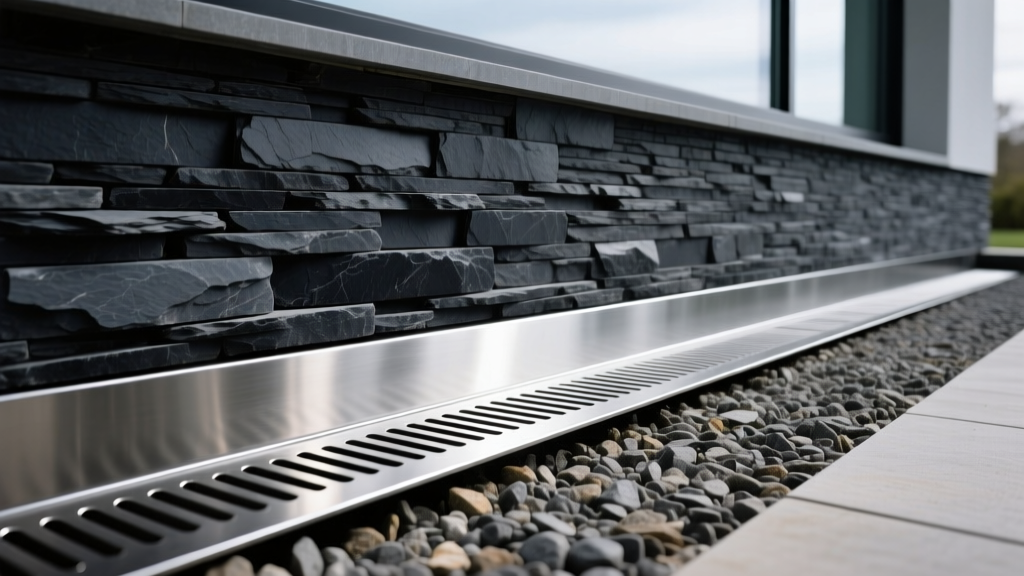
- Design a Recessed Channel (Reglet): For a seamless look where the stone appears to rise directly from the ground, design a concrete or masonry curb with a recessed channel. The weep screed drops into this channel, hiding the attachment flange while keeping the weep holes open to a concealed gravel drainage trench.
- Utilize a Gravel Splash Zone: Instead of mulch, design a 12-inch-wide perimeter trench filled with clean, washed 3/4-inch drainage gravel. This creates a modern, minimalist border that contrasts beautifully with natural stone while ensuring the weep holes remain completely unobstructed.
- Maintain the Mortar Gap: When applying the scratch coat and setting the bottom course of stone, ensure the mortar stops exactly at the top of the weep screed's sloped plane. Do not trowel mortar over the weep holes. Tool the mortar joint to create a slight concave profile that sheds water outward over the drip edge.
Landscape architects frequently specify mounding soil or placing decorative river rock directly against the base of stone veneer walls. If the river rock is smaller than the weep hole spacing, or if soil washes against the screed, the drainage plane is blocked. Always specify a minimum 4-inch vertical air gap between the weep screed and any organic or inorganic landscaping materials in your hardscape plans.
Cost Analysis: Protecting Your Design Investment
Upgrading your weep screed material is one of the highest-ROI decisions in exterior cladding. The cost difference is negligible compared to the price of the stone and the labor to install it.
- Galvanized Steel Screed: $1.00 – $1.80 per linear foot (installed).
- PVC Screed: $1.50 – $2.50 per linear foot (installed).
- Type 316 Stainless Steel Screed: $3.50 – $5.50 per linear foot (installed).
Context: High-end natural stone veneer materials range from $12 to $35 per square foot, with installation labor adding another $15 to $30 per square foot. For a 500-square-foot facade, the total investment is $13,500 to $32,500. Upgrading from galvanized to stainless steel weep screed on a 100-linear-foot perimeter adds roughly $250 to $400 to the total project cost—a fraction of a percent that prevents catastrophic moisture failure and aesthetic degradation.
Expert Troubleshooting: When the Design Compromises the Drainage
Q: The architect designed a stone veneer wall that terminates flush with a concrete patio. How do I install a weep screed without creating a tripping hazard or an ugly metal strip?
A: Use a PVC weep screed with a minimal 1-inch vertical leg, and pour the concrete patio with a 1/2-inch reglet (groove) at the edge. The weep screed sits in the reglet, and the gap is sealed with a flexible, UV-stable polyurethane sealant at the very bottom edge, leaving the weep holes open. Alternatively, use a custom-formed stainless steel screed that integrates into a patio edge drain system.
Q: We are using a dark, iron-rich natural stone. Will the weep screed material affect the stone's color over time?
A: Yes. If you use galvanized steel, the galvanic reaction between the zinc/steel and the iron-rich stone in the presence of moisture can cause severe, dark metallic staining. Always isolate the stone from metal flashings using a peel-and-stick membrane or specify PVC/Stainless Steel to prevent galvanic corrosion and mineral bleeding.
Mastering the weep screed stone veneer detail is what separates amateur installations from legacy-grade architectural facades. By treating the drainage plane as a core component of your design strategy—rather than an afterthought—you ensure that the texture, color, and structural integrity of your stone cladding endure for decades.
Written by
Marcus ChenMarcus Chen is a licensed structural engineer (PE) and building materials analyst with over 12 years of experience across residential, commercial, and industrial construction. He holds a Master of Science in Civil Engineering from UC Berkeley and spent six years at Thornton Tomasetti before transitioning to independent consulting and technical writing. Marcus specializes in material selection for seismic-prone regions, concrete reinforcement strategies, and lifecycle cost analysis. His work has been cited by the American Concrete Institute (ACI) and the Structural Engineers Association of California (SEAOC). When he is not on a job site or at his desk, you will find him hiking the Sierra Nevada or restoring a 1920s craftsman bungalow in Oakland, CA.
More from Marcus Chen
View all
Construction Cost
How Much Did the Eiffel Tower Cost to Build?
How much did the Eiffel Tower cost to build in 1889? We adjust for inflation and compare its budget to modern skyscraper construction.
Aug 4, 2026

Fire Resistance
What Is a Fire Resistant Material? Testing & Certification Guide
Discover what is a fire resistant material through ASTM and UL testing. Learn how fire ratings, certifications, and assemblies work in construction.
Aug 4, 2026

Construction Cost
How Much Did the Burj Khalifa Cost to Build?
How much did the Burj Khalifa cost to build? We break down the $1.5B project and extract 5 money-saving strategies for your next build.
Jul 30, 2026