What Is Stone Veneer Made Of? Technical Composition & ASTM Specs
A technical breakdown of what stone veneer is made of, covering manufactured mix ratios, natural geology, ASTM C1670 specs, and structural weight loads.

The Core Distinction: Architectural vs. Natural Stone Veneer
When specifying cladding for exterior envelopes or interior feature walls, understanding exactly what stone veneer is made of dictates everything from structural load calculations to moisture management strategies. The term 'stone veneer' encompasses two fundamentally different material categories: Manufactured Stone Veneer (MSV), often referred to as Architectural Stone Veneer (ASV), and Natural Stone Veneer. While both serve the same aesthetic function, their chemical compositions, manufacturing tolerances, and failure modes are entirely distinct. As of 2026, advancements in lightweight aggregates and integral water repellents have significantly narrowed the performance gap between the two, but the technical specifications required for proper installation remain divergent.
Manufactured Stone Veneer (MSV): The Exact Material Matrix
Manufactured stone veneer is a highly engineered cementitious composite designed to replicate the texture, color, and density of natural quarried stone while reducing structural weight. The composition is not merely 'concrete poured into molds'; it is a precisely calibrated matrix governed by strict volumetric ratios.
Primary Components and Mix Proportions
The structural integrity and aesthetic longevity of MSV rely on four primary components. According to guidelines published by the Masonry Veneer Manufacturers Association (MVMA), high-quality MSV must adhere to specific material standards to prevent premature degradation.
| Component | ASTM Specification | Technical Function | Typical Volume % |
|---|---|---|---|
| Portland Cement | ASTM C150 (Type I/II) | Primary binder matrix; provides compressive strength and alkalinity. | 15% - 20% |
| Lightweight Aggregate | ASTM C331 / ESCS | Bulk filler; expanded shale, clay, or slate (ESCS) reduces overall unit weight while maintaining internal curing properties. | 45% - 55% |
| Silica Sand | ASTM C33 | Micro-filler; increases density and surface abrasion resistance. | 15% - 25% |
| Iron Oxide Pigments | ASTM C979 | UV-stable coloration; synthetic iron oxides (Fe2O3) are integrated throughout the mix and surface-coated for variegation. | 2% - 5% |
| Admixtures | ASTM C260 / C494 | Air-entraining agents and plasticizers to improve workability and freeze-thaw durability. | < 1% |
The Role of ESCS Aggregates
The defining characteristic of modern MSV is the use of Expanded Shale, Clay, and Slate (ESCS) aggregates. These materials are fired in rotary kilns at temperatures exceeding 2,000°F, causing them to expand and become highly porous. This porosity serves a dual purpose: it drastically reduces the weight of the veneer (keeping it under 15 lbs per square foot) and provides internal curing. The porous aggregates absorb mixing water and slowly release it back into the cement paste during the hydration process, reducing shrinkage cracking and increasing long-term compressive strength.
Natural Stone Veneer: Geological Composition & Slicing Tolerances
Natural stone veneer is quarried directly from the earth and sliced into thin profiles, typically ranging from 3/4 inch to 1.5 inches in thickness. Its composition is entirely dependent on its geological origin, which dictates its porosity, flexural strength, and chemical reactivity.
- Sedimentary (Limestone & Sandstone): Composed primarily of calcium carbonate (CaCO3) or quartz grains bound by silica or calcite cement. These stones are highly porous and susceptible to acid rain etching. Sandstone veneer typically exhibits a water absorption rate of 4% to 8%, requiring specialized penetrating sealers in freeze-thaw climates.
- Metamorphic (Slate & Quartzite): Formed under extreme heat and pressure, resulting in a foliated or granular crystalline structure. Slate is composed of microscopic clay minerals (like illite and chlorite) that align into cleavage planes, allowing it to be split into remarkably thin, uniform veneer sheets with water absorption rates often below 0.5%.
- Igneous (Granite & Basalt): Composed of interlocking feldspar, quartz, and mica crystals. Igneous veneers offer the highest compressive strengths (often exceeding 20,000 psi) and the lowest absorption rates, but their extreme density makes them heavier and more difficult to anchor mechanically.
To achieve veneer thicknesses, quarries utilize diamond-tipped wire saws and gang saws. The Natural Stone Institute mandates strict thickness tolerances; for example, a specified 1-inch natural veneer must not deviate by more than ±1/8 inch to ensure consistent mortar joint depths and structural load predictability.
ASTM Standards Governing Veneer Composition
Specifiers cannot rely on visual inspection to determine material quality. Both MSV and natural stone must pass rigorous laboratory testing to verify their composition can withstand environmental stressors.
Critical Testing Standards for Stone Veneer
- ASTM C1670 / C1670M: The governing standard for Manufactured Stone Masonry Veneer. It dictates minimum flexural strength, dimensional tolerances, and requires freeze-thaw testing.
- ASTM C97 / C99: Standard test methods for absorption and bulk specific gravity, and modulus of rupture for dimension stone (Natural Veneer).
- ASTM C666 / C1645: Freeze-thaw durability testing. Veneers are subjected to 50 rapid freeze-thaw cycles. To pass, the material must exhibit a weight loss of less than 3% and show no signs of spalling, cracking, or delamination.
Freeze-Thaw Mechanics and Air Entrainment
The most critical vulnerability of any cementitious or porous stone material is freeze-thaw cycling. When water trapped in the capillary pores of the veneer freezes, it expands by approximately 9%. If the material composition lacks microscopic air voids to accommodate this expansion, the internal hydraulic pressure exceeds the tensile strength of the matrix, causing the face of the stone to spall or pop off. The Portland Cement Association emphasizes that incorporating air-entraining admixtures to create a network of microscopic, disconnected air bubbles (typically 4% to 7% total air content by volume) is non-negotiable for MSV installed in northern climates.
Weight Specifications & Structural Load Calculations
The primary engineering advantage of specifying veneer over full-thickness masonry is the reduction in dead load. Understanding the exact weight of the material composition is vital for designing the underlying structural supports, lintels, and foundation footings.
| Veneer Type | Average Thickness | Dead Load (lbs/sq ft) | Structural Implication |
|---|---|---|---|
| Manufactured Stone (MSV) | 1.0" - 2.5" | 10 - 12 psf | Can typically be supported by standard wood or steel stud framing with cement backer board; no foundation footing required for single-story applications. |
| Natural Limestone/Sandstone | 0.75" - 1.5" | 10 - 15 psf | Similar to MSV, but heavier anchor systems (corrosion-resistant stainless steel ties) are required due to lower inherent flexural strength. |
| Natural Granite/Quartzite | 1.0" - 2.0" | 16 - 22 psf | Requires engineered steel angle supports at every floor line; standard wood framing may deflect under the concentrated dead load. |
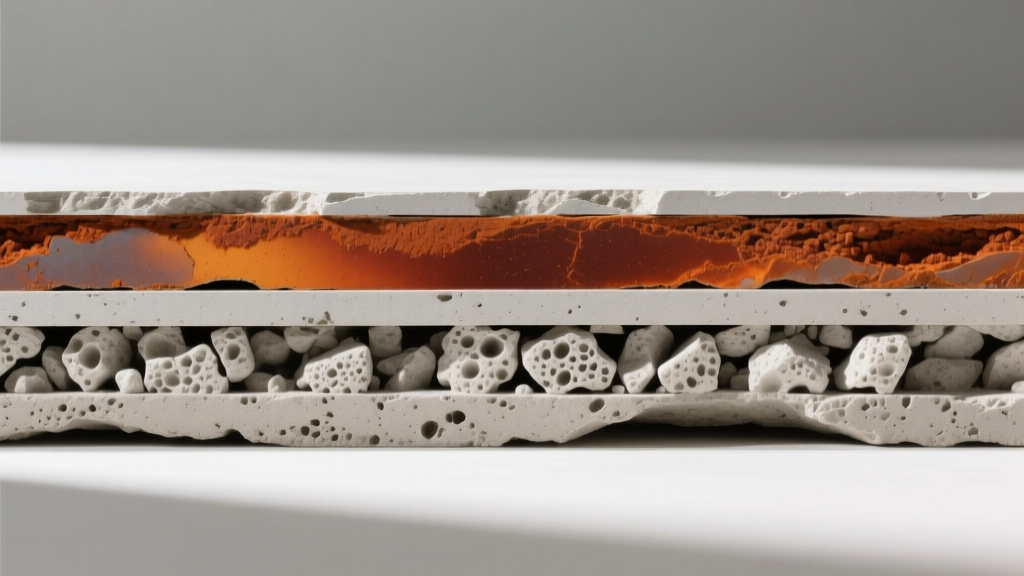
Composition-Driven Failure Modes & Specification Fixes
Even when installed perfectly, stone veneer can fail if the underlying material composition is flawed or improperly specified for the microclimate. Recognizing these chemistry-driven failure modes allows architects and builders to write better specifications.
1. Efflorescence and Alkali-Silica Reaction (ASR)
The Problem: White, powdery deposits on the surface of MSV are caused by water-soluble alkalis (sodium and potassium) present in the Portland cement. When moisture migrates through the veneer, it dissolves these salts and deposits them on the surface as it evaporates. In severe cases, reactive silica in the sand aggregate can react with these alkalis, causing internal expansion and cracking (ASR).
The Specification Fix: Specify low-alkali Portland cement (ASTM C150 Option R, limiting Na2O equivalent to 0.60%) and require the manufacturer to include an integral hydrophobic admixture (like stearates or silanes) that reduces the capillary action of water through the cement matrix.
2. Pigment Fading and UV Degradation
The Problem: Veneer that loses its color variance and turns a uniform, washed-out gray over 5 to 10 years. This occurs when manufacturers use organic dyes or low-grade carbon blacks instead of synthetic iron oxides, or when the pigment is only applied as a surface slurry rather than integrally mixed.
The Specification Fix: Mandate that all colorants meet ASTM C979 for pigments for integrally colored concrete. Require a 'through-body' color specification, meaning the core of the veneer must match the surface hue, ensuring that minor surface abrasion does not reveal a gray cementitious core.
3. Delamination in Natural Stone
The Problem: Sedimentary stones like sandstone and certain slates are composed of horizontal bedding planes. If the stone is quarried and installed 'on edge' (vertically oriented bedding planes) rather than on its natural bed, water infiltration will cause the layers to separate and flake off (delamination).
The Specification Fix: Explicitly state in the procurement documents that all natural sedimentary veneer must be 'quarried and installed on its natural bed.' The supplier must mark the bedding orientation on the crates prior to shipping.
'The longevity of a stone veneer installation is determined long before the first trowel of mortar is mixed. It is decided in the kiln where the aggregates are expanded, in the batch plant where the air-entrainment is calibrated, and in the quarry where the bedding planes are mapped. Specifying the exact material composition is the only defense against environmental degradation.'
— Technical Advisory Board, Masonry Veneer Manufacturers Association
Summary: Specifying the Right Composition
Understanding what stone veneer is made of transitions the selection process from a purely aesthetic choice to a rigorous technical decision. For projects requiring strict weight limits, uniform sizing, and high freeze-thaw resistance, an MSV composed of ESCS aggregates, Type I/II cement, and integral air-entrainment is the optimal choice. For projects demanding geological authenticity and ultra-low maintenance, a natural igneous or metamorphic veneer, sliced to precise tolerances and anchored with stainless steel ties, provides unparalleled durability. In both cases, referencing the correct ASTM standards in your project manual is the only way to guarantee the material delivered to the job site matches the engineering requirements of the building envelope.
Written by
Sarah WhitfieldSarah Whitfield is a chartered quantity surveyor (MRICS) and construction cost analyst with 15 years of experience in material pricing, procurement strategy, and project budgeting. She earned her degree in Construction Management from the University of Reading (UK) and has worked on projects ranging from $2M custom homes to $180M mixed-use developments across North America and Europe. Sarah currently leads cost estimating for BuildMat Insight, maintaining a proprietary database of 4,000+ material price points updated quarterly. She is a frequent contributor to RSMeans cost data panels and has presented at the International Cost Engineering Council (ICEC) congress. Based in Denver, CO, Sarah is an avid trail runner and volunteer mentor for Women in Construction.
More from Sarah Whitfield
View all
Wood & Lumber
What Are the Different Types of Wood? A Builder's Guide
Compare structural softwoods, finish hardwoods, and engineered lumber. Analyze Janka ratings, MOE values, and 2026 pricing for construction.
Aug 4, 2026

Walls & Panels
Steel Framing vs Wood Framing: Corrosion and Moisture Defense
Compare steel framing vs wood framing for moisture resistance. Learn about galvanized coatings, condensation risks, and corrosion protection strategies.
Jul 21, 2026

Stone & Masonry
How to Cut Stone Veneer: Wet Saw vs Grinder Comparison
Compare the best tools for cutting stone veneer. We review wet saws, angle grinders, and chop saws to help you achieve clean, chip-free cuts.
Jul 21, 2026