Cultured Stone Veneer Design Guide: Profiles, Palettes and Styles
Explore cultured stone veneer design options. Compare ledgestone, fieldstone, and ashlar profiles, color palettes, and architectural styles.

The Structural and Aesthetic Advantage of Manufactured Stone
Cultured stone veneer, technically classified as manufactured stone veneer (MSV), has fundamentally altered architectural cladding. Unlike natural stone, which requires heavy structural reinforcement due to weights exceeding 25 to 30 pounds per square foot, MSV is engineered from Portland cement, lightweight natural aggregates, and iron oxide pigments. The resulting product weighs between 10 and 12 pounds per square foot. This 60% weight reduction allows designers to specify stone aesthetics on standard wood or steel stud framing, interior partition walls, and non-load-bearing exterior facades without engineering costly structural upgrades.
Beyond structural flexibility, the design versatility of cultured stone veneer stems from its mold-casting process. Manufacturers extract molds directly from natural stone outcroppings, capturing microscopic fissures, tooling marks, and mineral stratifications. When specified correctly, MSV provides indistinguishable visual parity with quarried stone while offering highly controlled color consistency across large-scale commercial and residential projects.
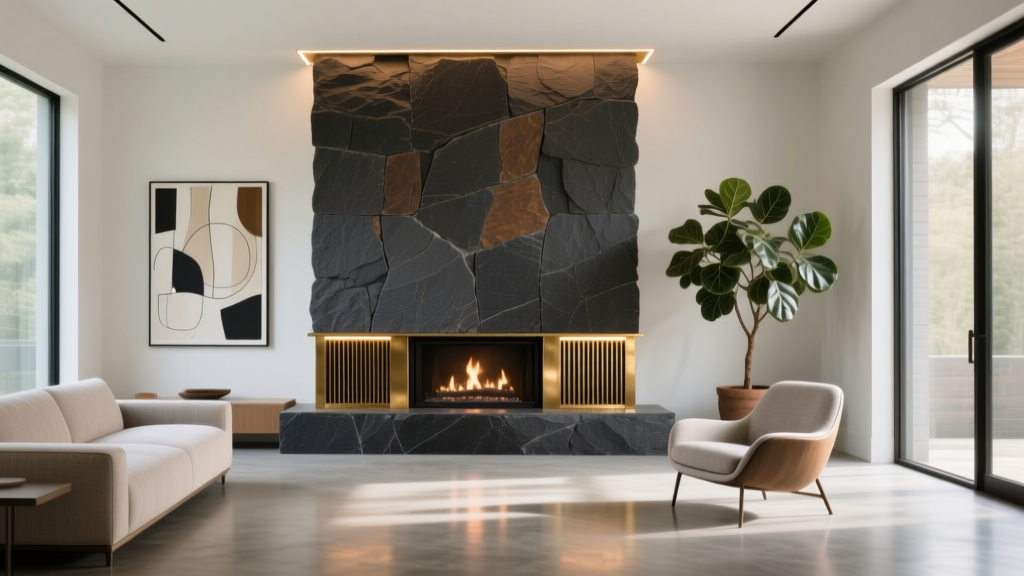
Core Profile Categories and Architectural Pairings
Selecting the correct stone profile is the most critical design decision in an MSV specification. The profile dictates the shadow lines, visual weight, and architectural compatibility of the installation.
Ledgestone and Linear Profiles
Characterized by long, horizontal rectangular cuts, ledgestone profiles typically range from 2 to 6 inches in height and 6 to 24 inches in length. This profile emphasizes horizontal lines, drawing the eye across the facade and making spaces appear wider.
- Design Application: Modern, contemporary, and mid-century modern architectures. Ideal for creating a sleek, uninterrupted ribbon of texture on exterior feature walls or interior media centers.
- Specification Note: For a highly contemporary look, specify dry-stack installation (zero mortar joint) with tight, uniform 1/16-inch tolerances between units.
Fieldstone and Cobble Profiles
Fieldstone profiles mimic naturally rounded, water-tumbled, or glacially deposited rocks. Individual stone diameters vary wildly, typically ranging from 3 to 14 inches. The organic, asymmetrical geometry creates a highly textured, rugged surface with deep shadow pockets.
- Design Application: Rustic, craftsman, farmhouse, and traditional mountain architecture. Best utilized on exterior chimneys, foundation wainscoting, and heavy timber-framed interiors.
- Specification Note: Requires a standard or over-grouted mortar joint (1/2-inch to 1-inch) to visually bind the irregular shapes. Specifying a contrasting mortar color highlights the individual geometry of each stone.
Ashlar and Cut Stone Profiles
Ashlar profiles replicate quarried, dressed stone blocks with relatively flat faces and squared edges. Heights generally range from 4 to 8 inches, with varied lengths. The aesthetic is formal, structured, and highly ordered.
- Design Application: Transitional, colonial, and classic European styles. Frequently used for exterior estate walls, formal entryway pillars, and high-end interior library or wine cellar cladding.
- Specification Note: Best installed with a flush or slightly recessed standard mortar joint to emphasize the masonry grid and precision of the cuts.
Color Palette Matrix: Matching Veneer to Design Themes
Color selection in MSV is driven by the blend of iron oxide pigments applied during the casting process. Top-tier manufacturers utilize multi-coat pigment applications to ensure the color penetrates the entire thickness of the veneer, preventing fading or chipping exposure. Below is a decision matrix for aligning color families with specific design objectives.
| Color Family | Undertones & Characteristics | Best Architectural Style | Recommended Pairing Materials |
|---|---|---|---|
| Monochromatic Charcoal/Slate | Cool grays, deep blacks, minimal variegation. High contrast against light surroundings. | Ultra-Modern, Industrial, Minimalist | Matte black steel, warm walnut wood, polished concrete floors. |
| Earth-Tone Blend | Mix of tans, browns, and subtle rusts. Mimics natural sandstone and limestone weathering. | Craftsman, Transitional, Prairie | Cedar siding, bronze hardware, natural flagstone paving. |
| Warm Desert/Sand | Light creams, pale tans, soft ochres. Reflects high ambient light, reduces heat absorption. | Mediterranean, Southwestern, Coastal | White stucco, terracotta roofing, wrought iron accents. |
| High-Contrast Variegated | Extreme variation from deep charcoal to bright white within a single profile. Highly active visual. | Rustic, Mountain, Lodge | Heavy timber beams, river rock landscaping, copper roofing. |
Lighting Design: Manipulating Texture and Shadow
The visual impact of cultured stone veneer is entirely dependent on how light interacts with its topography. Poor lighting design can flatten a highly textured fieldstone profile, while strategic lighting can elevate a subtle ashlar profile.
Pro-Tip: Grazing vs. Washing Illumination
To maximize the three-dimensional texture of MSV, specify grazing light rather than washing light. Place LED fixtures exactly 12 to 18 inches away from the stone surface, aiming the beam parallel to the wall. This creates deep, dramatic shadows in the stone's fissures. Conversely, placing a fixture 36 inches away (washing) will flatten the texture and obscure the profile details. For interior applications, specify 2700K to 3000K color temperature LEDs to enhance the warmth of earth-tone pigments.
The Hidden Design Variable: Grout Joint Techniques
Designers frequently overlook the mortar joint, yet it accounts for up to 20% of the visible surface area in standard installations. The joint profile and color fundamentally alter the perceived scale and style of the veneer.
- Dry-Stack (Zero Joint): Stones are placed tightly together with no visible mortar. This creates a continuous, unified surface that emphasizes the linear geometry of ledgestone profiles. Requires highly precise, factory-toleranced veneer units.
- Standard Raked Joint (1/2-inch to 1-inch): The traditional masonry look. The mortar is recessed slightly from the stone face, creating a distinct grid that highlights the individual shape of each stone. Ideal for fieldstone and ashlar.
- Over-Grouted (Smear/Flush): Mortar is pushed flush with or slightly over the stone face, often with a slight smear left on the edges. This technique mimics centuries-old, weathered European masonry and softens the hard edges of the stone, heavily utilized in rustic and old-world designs.
Specification Note: Always specify National Veneer Masonry Association (NVMA) compliant Type N mortar for MSV. For colored joints, mandate integral iron oxide pigments mixed directly into the mortar batch rather than surface-applied stains, ensuring long-term UV stability and consistent color throughout the joint depth.
Sourcing and Specification: Navigating 2026 Collections
When specifying cultured stone veneer, relying on generic descriptions leads to inconsistent results. Designers must reference specific manufacturer collections and colorways to guarantee the aesthetic intent is realized. The market is dominated by three primary manufacturers, each offering distinct design strengths:
- Boral Building Products (Cultured Stone®): The originator of the category. Their 'Northern Stacked Stone' and 'Country Ledgestone' profiles remain industry benchmarks for linear, modern applications. Their 2026 colorways feature highly sophisticated, low-variegation palettes tailored for contemporary architecture.
- Eldorado Stone®: Renowned for exceptional mold depth and realistic weathering. Their 'Cliffstone' and 'RoughCut' profiles offer aggressive shadow lines perfect for large-scale exterior facades. Consult the Eldorado Stone design archives for exact architectural pairing guides.
- Coronado Stone Products®: Offers highly specialized, niche profiles such as 'Specialty Cut Coarse Stone' and 'Classic Brick', bridging the gap between traditional masonry and natural stone aesthetics.
Common Design Pitfalls and How to Avoid Them
Even with premium materials, poor execution can compromise the design. Avoid these frequent specification and installation errors:
1. The 'Stamping' Effect (Pattern Repetition)
Because MSV is cast from a finite number of molds, inexperienced installers may inadvertently repeat the exact same stone shape and color in close proximity, creating an obvious, artificial pattern known as 'stamping.' Solution: Mandate in the project specifications that the installer must blend stones from a minimum of four to six different pallets simultaneously and rotate mold patterns to ensure organic randomization.
2. Ignoring Corner Transitions
Returning a thin veneer around an outside corner without specialized pieces destroys the illusion of solid masonry. Solution: Always specify factory-manufactured corner units that wrap 90 degrees, featuring varying return depths (e.g., 3 inches on one side, 6 inches on the other) to mimic the natural stagger of quarried stone blocks.
3. Exterior Moisture Trapping
Designing MSV directly to grade or over wood framing without a drainage plane leads to catastrophic moisture intrusion and efflorescence (white salt deposits on the stone face). Solution: Specify a code-compliant weather-resistive barrier (WRB), metal lath, and a weep screed installed a minimum of 4 inches above grade or 2 inches above hardscapes, in strict accordance with ASTM C1063 standards.
"The success of manufactured stone veneer in high-end design relies entirely on the intersection of precise profile selection, intentional lighting, and rigorous installation standards. When treated as a premium architectural cladding rather than a simple decorative afterthought, MSV delivers unparalleled aesthetic versatility."
Written by
Priya KapoorPriya Kapoor is a real estate market analyst and construction economics researcher with expertise in housing affordability, development feasibility, and infrastructure investment. She holds a Master of Regional Planning from Cornell University and previously worked as a senior analyst at CBRE's Investment Properties group, where she modeled returns for $4B in mixed-use development pipelines. Priya now runs an independent research practice advising developers, municipalities, and REITs on construction cost forecasting and market timing. She publishes the quarterly "BuildMat Market Pulse" report tracking material price indices across 12 commodity categories. Based in Austin, TX, Priya serves on the board of Habitat for Humanity Austin and is a marathon runner.
More from Priya Kapoor
View all
Construction Cost
Cost to Build a 1600 Sq Ft Home in 2026: Full Breakdown
Accurate 2026 cost to build a 1600 sq ft home—material, labor, and regional pricing breakdowns included. Plan your budget with real-time estimates.
Aug 11, 2026

Wood & Lumber
Name the Types of Wood for Pressure Treatment and Preservation
Learn how to name the types of wood best suited for pressure treatment. Compare species treatability, chemical retention levels, and 2026 preservation costs.
Aug 4, 2026

Stone & Masonry
Stone Veneer Suppliers Lindenhurst: 2026 Cost Analysis
Analyze 2026 stone veneer costs in Lindenhurst, NY. Compare local supplier pricing, delivery fees, and Suffolk County installation labor rates.
Aug 4, 2026