Certifying Ecologically Friendly Building Materials: LEED Guide
Master the certification of ecologically friendly building materials. Navigate LEED v4.1 MR credits, EPDs, and C2C standards with expert data.

The Verification Imperative for Green Construction
Specifying ecologically friendly building materials is no longer a matter of taking manufacturer claims at face value. As greenwashing scrutiny intensifies and regulatory frameworks tighten, project teams must rely on third-party verified data to prove environmental efficacy. Whether targeting LEED v4.1, BREEAM, or the Living Building Challenge, the burden of proof rests on standardized documentation. This guide decodes the certification landscape, providing exact submittal requirements, cost baselines, and audit strategies for validating sustainable materials in commercial and high-end residential construction.
Certification Matrix: Comparing Material Standards
Not all certifications measure the same environmental vectors. Selecting the right framework depends on your project's specific sustainability goals and the client's operational priorities. Below is a comparative matrix of the dominant certification bodies evaluating ecologically friendly building materials.
| Certification Body | Primary Focus | Material Scope | Audit Rigor | Typical Cost / Timeline |
|---|---|---|---|---|
| LEED v4.1 (MR Credits) | Life-cycle impact, supply chain transparency | Structural, enclosure, interior finishes | High (Requires ISO-compliant EPDs) | Project-based; $15k-$50k+ registration |
| Cradle to Cradle (C2C) | Material health, circularity, social fairness | Interior finishes, furniture, textiles | Extreme (Chemical inventory to 100ppm) | $20k-$40k per product line; 6-9 months |
| BREEAM (Mat 01) | Life Cycle Assessment (LCA) scoring | Core building elements (substructure to roof) | High (Requires BRE IMPACT data) | Project-based; varies by region/assessor |
| Living Building Challenge | Red List chemical avoidance, net-positive | All materials on site | Extreme (Zero Red List chemicals) | $10k-$25k+ for material advocacy/sourcing |
Decoding LEED v4.1 Material and Resources (MR) Credits
The U.S. Green Building Council structures its material validation primarily through the MR Credit: Building Product Disclosure and Optimization. To successfully claim points for ecologically friendly building materials, project teams must navigate two distinct pathways.
Pathway 1: Environmental Product Declarations (EPDs)
An EPD is a standardized document (governed by ISO 14025) that quantifies a product's environmental impact across its life cycle. Under LEED v4.1, products with Type III EPDs are incentivized, but the nuance lies in the scope and specificity of the declaration.
- Product-Specific EPDs: These are unique to a single manufacturer's exact product line and facility. LEED values these at 1.0 full product credit.
- Industry-Wide EPDs: These represent an average across multiple manufacturers in a specific sector (e.g., generic North American gypsum board). LEED values these at only 0.5 product credit.
- Cost to Generate: If you are a manufacturer looking to certify a product, generating a product-specific, cradle-to-grave Type III EPD via a program operator like the International EPD System typically costs between $14,000 and $28,000, plus annual verification fees of $2,500.
Pathway 2: Sourcing of Raw Materials
This credit rewards the extraction and manufacturing practices behind the materials. Validating ecologically friendly building materials here requires strict chain-of-custody documentation.
- FSC-Certified Wood: To claim credit, wood products must carry the Forest Stewardship Council (FSC) label. Crucially, the supplier must possess an active FSC Chain of Custody (CoC) certificate. If a distributor buys FSC wood but lacks CoC certification, the material is legally disqualified from LEED submittals.
- Recycled Content: Calculated using ISO 14021. Post-consumer recycled content is valued at 100% of its cost, while pre-consumer (post-industrial) content is valued at only 50%.
Navigating Cradle to Cradle (C2C) Material Health
While LEED focuses heavily on carbon and life-cycle assessment, the Cradle to Cradle Products Innovation Institute prioritizes human and ecological toxicity. For interior designers specifying ecologically friendly building materials, C2C is the gold standard for indoor air quality and chemical safety.
To achieve C2C Gold or Platinum certification, manufacturers must inventory 100% of a product's chemical ingredients down to 100 parts per million (ppm). Furthermore, the material must contain zero chemicals listed on the C2C Banned Substances List. If you are sourcing acoustic panels or carpet tiles, demand the C2C Material Health Certificate—it guarantees the product has undergone rigorous toxicological screening far beyond standard VOC testing.
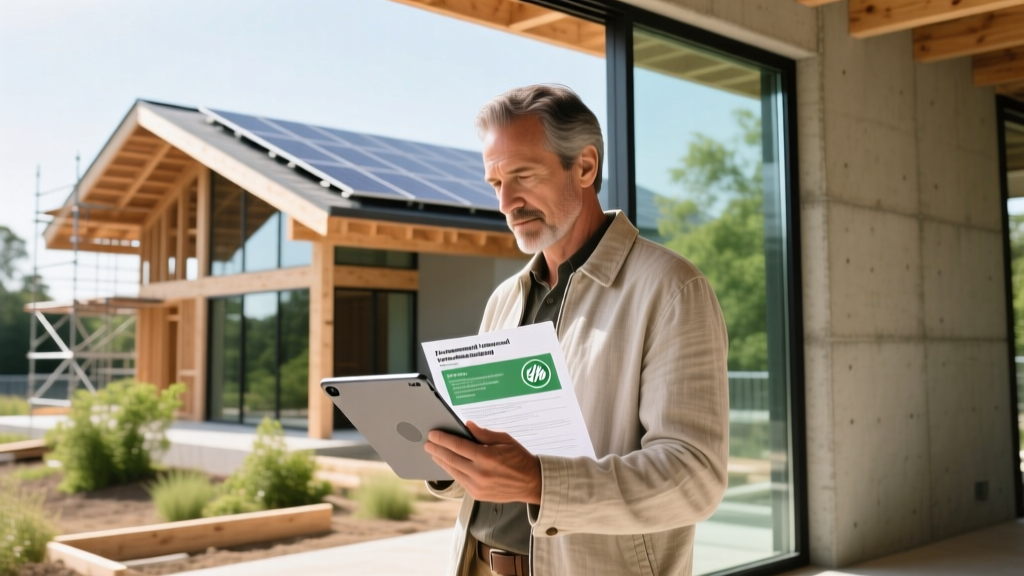
Step-by-Step Material Submittal Workflow
Procuring certified ecologically friendly building materials requires a disciplined workflow to prevent documentation bottlenecks during the final LEED audit. Implement this four-step protocol:
- Pre-Design Material Charrette: Map out the exact MR credits targeted. Establish a baseline of required products (e.g., 20 permanently installed products for EPD credit). Use platforms like Mindful Materials or UL SPOT to pre-vet manufacturers.
- Specification Writing (MasterSpec Integration): Embed explicit certification requirements into Division 01 (General Requirements) and specific product divisions. Example: "Section 09 68 00 - Carpeting: Products must possess a product-specific Type III EPD conforming to ISO 14025 and meet CDPH Standard Method v1.2-2017 for VOC emissions."
- Procurement and Tracking: Require subcontractors to submit EPDs, HPDs (Health Product Declarations), and FSC invoices alongside their standard shop drawings. Reject submittals that lack verifiable certificate numbers.
- LEED Online Upload: Organize documentation by CSI MasterFormat divisions. Ensure the total cost of compliant materials is accurately reflected in the Materials Calculator to maximize the financial weighting of the credits.
Common Audit Failures and How to Avoid Them
Even experienced sustainability consultants encounter pushback during the GBCI (Green Business Certification Inc.) design and construction reviews. Anticipate these specific failure modes when documenting ecologically friendly building materials.
The Trap: Manufacturers submit VOC test results based on the older CDPH Standard Method v1.1 or generic GreenGuard certificates that do not specify the exact testing parameters required by LEED v4.1.
The Fix: Mandate that all interior adhesives, sealants, paints, and flooring comply explicitly with CDPH Standard Method v1.2-2017 (or the latest v1.3). Ensure the testing lab report explicitly lists the formaldehyde emission limit as ≤ 0.05 ppm.
The Trap: A manufacturer provides a cradle-to-gate EPD for a product like structural steel, but the LEED credit requires cradle-to-grave data to claim the full 1.0 product value.
The Fix: Review the "Scope" section on the first page of the EPD. If it only covers A1-A3 (Production), it is cradle-to-gate. You must either accept the 0.5 credit penalty or source an alternative product with an EPD covering modules A1-C4 (Production, Construction, Use, and End-of-Life).
FAQ: Ecologically Friendly Building Materials Certification
Can a product be LEED certified?
No. The USGBC explicitly states that products are not "LEED Certified." Rather, ecologically friendly building materials possess specific attributes (like EPDs, HPDs, or FSC labels) that contribute to a building project earning LEED certification. Beware of manufacturers using "LEED Compliant" as a marketing crutch; always ask for the underlying ISO or third-party documentation.
What is the difference between an EPD and an LCA?
A Life Cycle Assessment (LCA) is the underlying scientific study and methodology used to calculate environmental impacts. An Environmental Product Declaration (EPD) is the standardized, third-party verified summary report of that LCA, formatted for public consumption and regulatory submittals. You cannot submit a raw LCA report for LEED credit; it must be published as an EPD.
How do I verify if a manufacturer's FSC certificate is valid?
Do not rely on a printed certificate provided by the sales representative. FSC certificates are frequently suspended or expire. Use the official info.fsc.org certificate database. Search the supplier's exact legal entity name or their CoC code (which starts with FSC-C, followed by six digits) to verify their active status on the day of procurement.
Written by
Priya KapoorPriya Kapoor is a real estate market analyst and construction economics researcher with expertise in housing affordability, development feasibility, and infrastructure investment. She holds a Master of Regional Planning from Cornell University and previously worked as a senior analyst at CBRE's Investment Properties group, where she modeled returns for $4B in mixed-use development pipelines. Priya now runs an independent research practice advising developers, municipalities, and REITs on construction cost forecasting and market timing. She publishes the quarterly "BuildMat Market Pulse" report tracking material price indices across 12 commodity categories. Based in Austin, TX, Priya serves on the board of Habitat for Humanity Austin and is a marathon runner.
More from Priya Kapoor
View all
Construction Cost
Cost to Build a 1600 Sq Ft Home in 2026: Full Breakdown
Accurate 2026 cost to build a 1600 sq ft home—material, labor, and regional pricing breakdowns included. Plan your budget with real-time estimates.
Aug 11, 2026

Wood & Lumber
Name the Types of Wood for Pressure Treatment and Preservation
Learn how to name the types of wood best suited for pressure treatment. Compare species treatability, chemical retention levels, and 2026 preservation costs.
Aug 4, 2026

Stone & Masonry
Stone Veneer Suppliers Lindenhurst: 2026 Cost Analysis
Analyze 2026 stone veneer costs in Lindenhurst, NY. Compare local supplier pricing, delivery fees, and Suffolk County installation labor rates.
Aug 4, 2026