Innovative Eco Friendly Flooring Options Transforming 2026 Homes
Explore cutting-edge eco friendly flooring options for 2026, including mycelium composites, algae linoleum, and carbon-negative cork with real costs.

The Bio-Material Revolution in Floor Coverings
The specification of sustainable floor coverings has evolved far beyond reclaimed hardwood and recycled-content carpet tiles. In 2026, the most advanced eco friendly flooring options are defined by regenerative life cycles, carbon sequestration, and bio-fabrication. According to the U.S. Environmental Protection Agency, prioritizing bio-based materials can reduce a building's embodied carbon footprint by up to 40% compared to traditional petrochemical vinyl or ceramic alternatives. This shift requires architects and homeowners to evaluate flooring not just by its surface durability, but by its upstream agricultural impact and end-of-life compostability.
Meeting the rigorous Material Ingredients and Environmental Product Declaration (EPD) requirements of LEED v4.1 demands verifiable data. The innovations spotlighted below represent the current apex of bio-engineered flooring, moving past simple recycling into active carbon drawdown.
Innovation Matrix: Next-Generation Eco Friendly Flooring Options
| Material Category | Primary Bio-Base | Embodied Carbon Status | Avg. Cost (per sq. ft.) | Commercial/Residential Rating | Required Wear Layer |
|---|---|---|---|---|---|
| Mycelium Composites | Fungal root structures & hemp hurd | Carbon Negative | $9.00 - $14.00 | Residential / Light Commercial | Bio-epoxy or UV-cured urethane |
| Algae-Infused Linoleum | Linseed oil, wood flour, algae pigments | Carbon Neutral | $4.50 - $7.50 | Heavy Commercial / Residential | Integral (homogeneous) |
| Engineered Cork | Quercus suber bark, bio-resins | Carbon Negative | $5.50 - $8.50 | Residential / Commercial | Ceramic-bead UV finish |
| Hempcrete Tiles | Hemp shiv & lime binder | Carbon Negative | $7.00 - $11.00 | Residential (Dry areas) | Penetrating hard-wax oil |
Spotlight: Mycelium and Fungal Composites
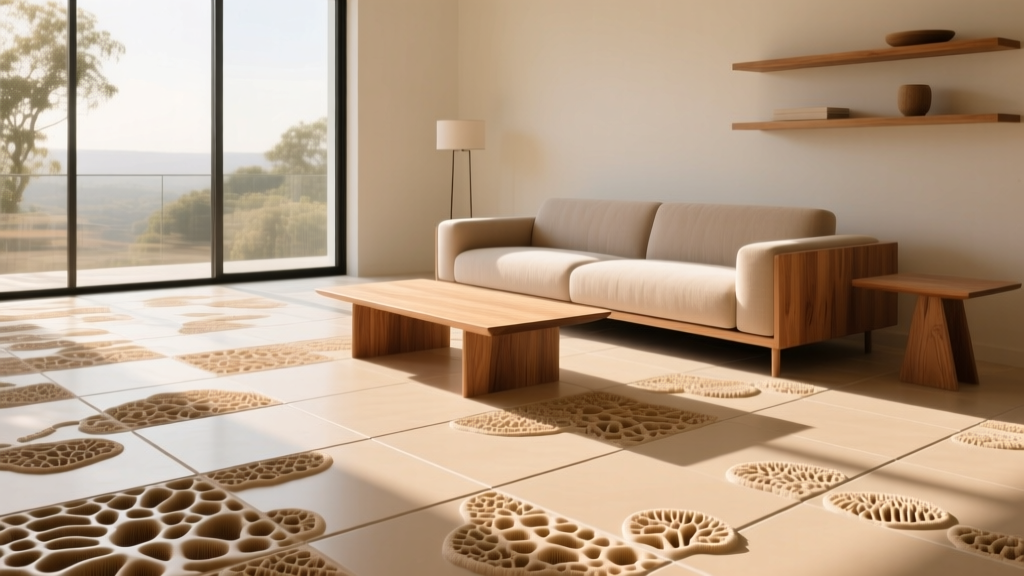
Mycelium—the vegetative root structure of fungi—has transitioned from packaging insulation to high-end architectural finishes. Companies like Ecovative Design have pioneered MycoComposite technology, where mycelium is grown around agricultural waste (like hemp hurd or corn stover) in custom molds. For flooring, this results in a highly acoustic, thermally insulating substrate.
Technical Realities and Edge Cases
Raw mycelium lacks the abrasion resistance required for foot traffic. To function as flooring, mycelium tiles must be compressed under high PSI and sealed. In 2026, the industry standard is capping the mycelium core with a 2mm bio-based epoxy wear layer derived from epoxidized soybean oil.
- Dimensional Stability: Mycelium tiles exhibit a moisture expansion rate of less than 0.2% when properly sealed, but the unsealed edges during installation must be kept in a climate-controlled environment (65°F–75°F, 35%–55% RH).
- Acoustic Performance: Delivers an Impact Insulation Class (IIC) rating of 55 or higher without additional underlayment, making it ideal for multi-family residential builds.
- Failure Mode: If the bio-epoxy wear layer is scratched down to the mycelium core and exposed to standing water, the organic substrate will rapidly absorb moisture and degrade. Immediate spot-repair with UV-cured resin is mandatory.
Spotlight: Algae-Infused Biopolymers and Advanced Linoleum
Traditional linoleum is already a staple of green building, composed of linseed oil, pine rosin, wood flour, and jute. However, the latest iterations from manufacturers like Forbo (Marmoleum) and Tarkett have integrated algae biomass into the formulation. Algae is harvested from waterways—simultaneously cleaning aquatic ecosystems—and processed to replace petroleum-based pigments and synthetic drying agents.
Performance Metrics for Algae-Linoleum
Unlike luxury vinyl tile (LVT) which relies on plasticizers that can off-gas, algae-linoleum cures through oxidation, creating a naturally bacteriostatic surface. The linseed oil base inherently inhibits the growth of MRSA and C. diff, making it the premier eco friendly flooring option for healthcare and educational facilities.
Lifecycle Data: Forbo Marmoleum Real
- Embodied Carbon: 3.2 kg CO2e per square meter (cradle-to-gate).
- Sequestered Carbon: The flax and jute backing sequester approximately 4.1 kg CO2e per square meter during growth.
- Net Result: Carbon negative at the point of installation.
- Lifespan: 30–40 years with periodic diamond-pad burnishing (no chemical stripping required).
Spotlight: Carbon-Sequestering Engineered Cork
Cork harvesting does not kill the tree; the bark of the Quercus suber (cork oak) is stripped every nine years, a process that actually accelerates the tree's carbon absorption rate by up to five times. Amorim Wise has engineered 100% cork flooring lines that utilize zero artificial binders, relying instead on the natural suberin resin within the cork cells, activated by precise thermal expansion and compression.
For high-traffic residential applications, specify engineered cork planks with a high-density fiberboard (HDF) core made from FSC-certified recycled wood fibers, topped with a 4mm cork wear layer finished with a ceramic-bead UV coating. This provides an AC4 abrasion rating while maintaining the natural shock-absorption and thermal properties of the cork.
The Hidden Carbon: Subfloor Prep and Adhesives
Selecting a bio-based floor covering is only half the equation. The adhesives and subfloor preparations used to install these materials can negate their environmental benefits through high VOC emissions and petrochemical reliance.
Critical Subfloor Moisture Thresholds
Bio-based flooring (especially linoleum and cork) is highly susceptible to alkaline hydrolysis if installed over damp concrete. Before applying any low-VOC adhesive, perform a calcium chloride test (ASTM F1869). The moisture vapor emission rate (MVER) must not exceed 3.0 lbs per 1,000 square feet per 24 hours. If readings exceed this, a reactive penetrating silane sealer is mandatory to prevent adhesive breakdown and mold growth beneath the bio-materials.
Specifying the Right Adhesive
For 2026 installations, avoid solvent-based contact cements entirely. Specify silane-terminated polymer (STP) adhesives, such as Bostik GreenForce or AFM Safecoat 3-in-1. These formulations are moisture-curing, contain zero isocyanates, and possess VOC levels below 10 g/L. Furthermore, STP adhesives remain flexible after curing, accommodating the natural thermal expansion and contraction of bio-based planks without shearing the bond.
Lifecycle Cost Analysis: Upfront vs. 20-Year ROI
While innovative eco friendly flooring options often carry a higher initial material cost compared to mass-produced LVT or laminate, the 20-year Total Cost of Ownership (TCO) tells a different story. Bio-based materials generally require less aggressive chemical maintenance and offer superior durability when properly specified.
| Cost Factor | Premium LVT (Petrochemical) | Algae-Linoleum (Bio-Based) | Engineered Cork (Bio-Based) |
|---|---|---|---|
| Initial Material Cost | $2.50 - $4.00 / sq ft | $4.50 - $7.50 / sq ft | $5.50 - $8.50 / sq ft |
| Annual Maintenance (Chemicals/Labor) | $1.20 / sq ft (Strip & Wax) | $0.35 / sq ft (Dry buffing) | $0.45 / sq ft (Re-oil/Screen) |
| Expected Replacement Cycle | 10 - 15 Years | 30 - 40 Years | 20 - 25 Years |
| 20-Year TCO (per sq ft) | $28.00 - $45.00 | $11.50 - $21.50 | $14.50 - $26.00 |
When factoring in the elimination of toxic stripping chemicals, reduced HVAC load due to cork's thermal insulation, and the avoidance of a mid-cycle replacement, bio-based options deliver a significantly lower lifecycle cost while actively contributing to a building's LEED certification points.
Frequently Asked Questions
Can mycelium or cork flooring be installed over radiant heat systems?
Yes, but with strict limitations. Engineered cork is highly compatible with hydronic radiant heat systems due to its thermal stability, provided the surface temperature of the subfloor never exceeds 85°F (29°C). Mycelium composites are naturally insulating, which can reduce the efficiency of radiant heat transfer; therefore, they are generally not recommended for installation directly over heated subfloors unless the system is specifically designed for high-R-value floor coverings.
How do bio-based floors handle pet accidents and high humidity?
Algae-linoleum and properly sealed cork are highly resistant to moisture and biological staining. The natural bacteriostatic properties of linseed oil prevent urine from fermenting and causing odors. However, standing water left for more than 12 hours can penetrate the micro-seams of click-lock floating floors, causing the HDF core to swell. For wet areas or homes with prone-to-accident pets, glue-down linoleum sheets or tiles with welded seams are the only recommended application.
Are these materials eligible for LEED Material Ingredient credits?
Absolutely. Products like Forbo Marmoleum and Amorim Wise hold comprehensive Environmental Product Declarations (EPDs) and Health Product Declarations (HPDs). Specifying these materials directly contributes to the LEED v4.1 Building Product Disclosure and Optimization (BPDO) credits, specifically for Material Ingredients and Sourcing of Raw Materials, aiding projects in achieving Silver, Gold, or Platinum certification tiers.
Written by
Marcus ChenMarcus Chen is a licensed structural engineer (PE) and building materials analyst with over 12 years of experience across residential, commercial, and industrial construction. He holds a Master of Science in Civil Engineering from UC Berkeley and spent six years at Thornton Tomasetti before transitioning to independent consulting and technical writing. Marcus specializes in material selection for seismic-prone regions, concrete reinforcement strategies, and lifecycle cost analysis. His work has been cited by the American Concrete Institute (ACI) and the Structural Engineers Association of California (SEAOC). When he is not on a job site or at his desk, you will find him hiking the Sierra Nevada or restoring a 1920s craftsman bungalow in Oakland, CA.
More from Marcus Chen
View all
Construction Cost
How Much Did the Eiffel Tower Cost to Build?
How much did the Eiffel Tower cost to build in 1889? We adjust for inflation and compare its budget to modern skyscraper construction.
Aug 4, 2026

Fire Resistance
What Is a Fire Resistant Material? Testing & Certification Guide
Discover what is a fire resistant material through ASTM and UL testing. Learn how fire ratings, certifications, and assemblies work in construction.
Aug 4, 2026

Construction Cost
How Much Did the Burj Khalifa Cost to Build?
How much did the Burj Khalifa cost to build? We break down the $1.5B project and extract 5 money-saving strategies for your next build.
Jul 30, 2026