What Are Sustainable Building Materials? A Certification Guide
Discover what are sustainable building materials through the lens of LEED, EPDs, and HPDs. A technical certification guide for architects and builders.
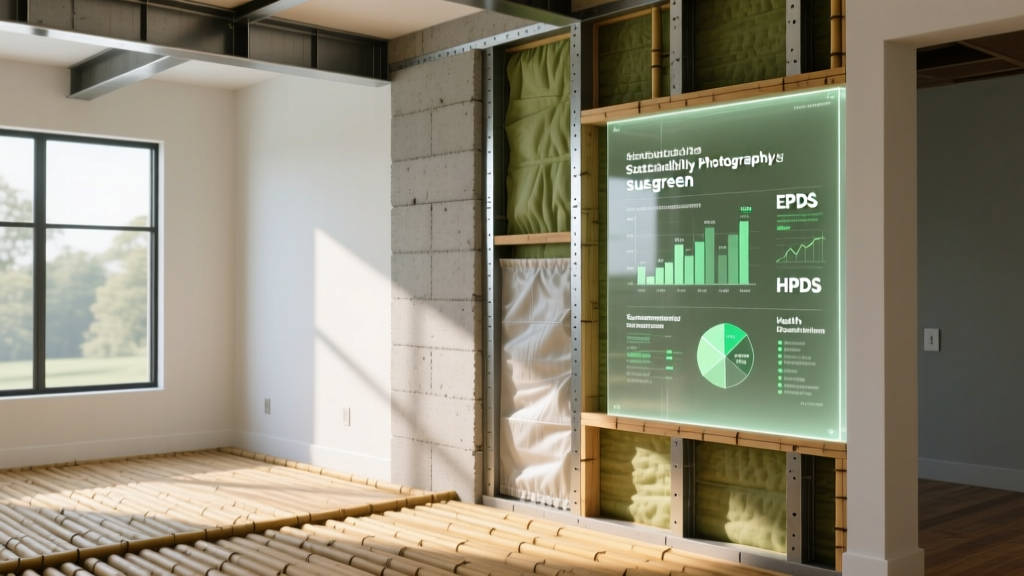
Defining the Baseline: What Are Sustainable Building Materials?
When architects, engineers, and specifiers ask what are sustainable building materials, the answer extends far beyond marketing buzzwords like "eco-friendly" or "green." In professional construction, a sustainable building material is strictly defined by its quantifiable environmental and human health impacts across its entire life cycle—from raw material extraction (cradle) to end-of-life disposal or reuse (grave).
Rather than relying on manufacturer claims, the industry relies on rigorous, third-party certification frameworks to verify these impacts. A material is only as sustainable as the data proving its Global Warming Potential (GWP), embodied carbon, and chemical emissions. This guide breaks down the exact certifications that define sustainable materials in modern commercial and residential construction.
The Core Certification Frameworks for Green Materials
To separate verified sustainable materials from greenwashing, specifiers must look for specific, standardized declarations. The following three frameworks form the foundation of material sustainability verification.
1. Environmental Product Declarations (EPDs)
An EPD is a standardized document (governed by ISO 14025) that reports the environmental impacts of a product based on a comprehensive Life Cycle Assessment (LCA). EPDs do not judge whether a product is "good" or "bad"; rather, they provide transparent, apples-to-apples data. Key metrics reported in an EPD include:
- Global Warming Potential (GWP): Measured in kg CO2e, indicating embodied carbon.
- Acidification Potential (AP): Measured in kg SO2e.
- Eutrophication Potential (EP): Measured in kg PO4e.
- Ozone Depletion Potential (ODP): Measured in kg CFC-11e.
For a material to contribute to LEED v4.1 credits, the EPD must be Type III (third-party verified) and conform to the relevant Product Category Rules (PCRs).
2. Health Product Declarations (HPDs)
While EPDs focus on planetary health, HPDs focus on human health. Managed by the HPD Collaborative, an HPD provides a full inventory of a product's ingredients and their associated health hazards. Specifiers use HPDs to ensure materials are free from Red List chemicals (such as phthalates, halogenated flame retardants, and formaldehyde) and to verify low Volatile Organic Compound (VOC) emissions.
3. Cradle to Cradle Certified (C2C)
C2C is a multi-attribute standard that evaluates products across five categories: Material Health, Product Circularity, Clean Air & Climate Protection, Water & Soil Stewardship, and Social Fairness. Materials achieving C2C Gold or Platinum are heavily weighted in advanced green building codes like the Living Building Challenge.
When sourcing materials, verify whether the EPD is industry-wide (an average of all manufacturers in a sector) or product-specific (tied to a specific manufacturer's plant). LEED v4.1 awards double credit value for product-specific EPDs because they incentivize individual manufacturers to optimize their supply chains and lower their specific carbon footprints.
How LEED v4.1 Scores Material Sustainability
The U.S. Green Building Council (USGBC) structures the LEED rating system to financially and structurally reward the use of verified sustainable materials. Under the Materials and Resources (MR) category, projects earn points by aggregating certified products. Below is the matrix for achieving MR credits in LEED v4.1 Building Design and Construction (BD+C).
| LEED v4.1 Credit | Core Requirement | Acceptable Certifications / Standards |
|---|---|---|
| Environmental Product Declarations | Use at least 20 different permanently installed products from at least 5 different manufacturers. | Type III EPDs (ISO 14025), USGBC-approved LCA reports. |
| Sourcing of Raw Materials | Use products that demonstrate sustainable extraction and supply chain transparency. | FSC Certification, Recycled Content (ISO 14021), Responsible Sourcing (BS 8901). |
| Material Ingredients | Use at least 20 products that disclose chemical inventory and hazard optimization. | HPD, Cradle to Cradle, Declare Labels, GREENGUARD Gold. |
| Construction Waste Management | Divert 50% to 75% of construction debris from landfills. | Waste diversion reports, certified recycling facility documentation. |
Evaluating Specific Material Categories (With Certification Targets)
Understanding what are sustainable building materials requires looking at how different structural and finish materials achieve certification in the real world.
Mass Timber and Engineered Wood
Cross-Laminated Timber (CLT) and Glulam store biogenic carbon, effectively acting as carbon sinks. However, timber is only considered sustainable if the forest management practices prevent deforestation and biodiversity loss.
- Required Certification: Forest Stewardship Council (FSC) 100% or FSC Mix. The project team must track the Chain of Custody (CoC) from the forest to the job site using FSC-STD-40-004 standards.
- Performance Edge: FSC-certified CLT panels typically show a GWP of -1.5 to -2.0 kg CO2e per kg of material in cradle-to-gate EPDs, meaning they sequester more carbon than is emitted during harvesting and manufacturing.
Low-Carbon Concrete
Traditional Portland cement is highly carbon-intensive. Sustainable concrete relies on Supplementary Cementitious Materials (SCMs) like fly ash, slag, or calcined clay, and utilizes Portland-Limestone Cement (PLC).
- Required Certification: Product-specific EPDs verifying a minimum 10% to 20% reduction in GWP compared to the industry baseline. Material must comply with ASTM C595 (Type IL) for PLC.
- Procurement Specifics: Specify mix designs with 20-30% slag replacement (ASTM C989) or 15-25% Class F fly ash (ASTM C618). Demand the batch plant's specific EPD rather than the regional average.
Recycled Steel and Aluminum
Metals are infinitely recyclable, but the energy source used to melt them dictates their sustainability. Steel produced in an Electric Arc Furnace (EAF) using renewable energy has a drastically lower carbon footprint than Basic Oxygen Furnace (BOF) steel.
- Required Certification: ISO 14021 self-declared claims for post-consumer and pre-consumer recycled content, backed by mill certificates.
- Performance Edge: EAF structural steel typically contains 90%+ recycled content and achieves a GWP of roughly 0.8 kg CO2e per kg, compared to over 2.5 kg CO2e for virgin BOF steel.

The Procurement Checklist: Sourcing Certified Materials
Specifying a sustainable material is only half the battle; verifying it upon delivery is where most projects fail. Implement this 4-step procurement workflow to ensure compliance:
- Embed Requirements in Division 01: Update the general requirements (Division 01 60 00) to mandate that all submittals for structural, envelope, and interior finish materials include current EPDs and HPDs as a condition of approval.
- Pre-Qualify Vendors: Before bidding, require suppliers to submit a "Sustainability Data Sheet" proving they hold active FSC Chain of Custody certificates or have published product-specific EPDs on the EPA's green building databases or the International EPD System.
- Track Submittals via Cloud Logs: Use platforms like Procore or PlanGrid to create a specific "Green Material Log." Do not approve shop drawings until the corresponding EPD/HPD PDF is attached and verified against the specified PCR.
- Audit Deliveries: For materials like FSC wood, the delivery ticket and invoice must explicitly state the FSC claim (e.g., "FSC 100%") and the supplier's CoC certificate number. If the paperwork is missing, reject the shipment.
Frequently Asked Questions
Can a material be considered sustainable without an EPD?
Technically, yes, if it is a naturally occurring, minimally processed material like local rammed earth or salvaged brick. However, for commercial projects pursuing LEED, BREEAM, or WELL certifications, third-party verified data (EPDs/HPDs) is mandatory to earn credits and prove compliance with embodied carbon limits.
What is the difference between a Declare Label and an HPD?
Both disclose material ingredients, but they serve slightly different purposes. The Declare Label, run by the International Living Future Institute, is a consumer-facing "nutrition label" that specifically calls out Red List Free status. An HPD is a more granular, technical document used by architects and toxicologists to assess exact chemical concentrations and hazard classifications.
How do I verify if an EPD is still valid?
EPDs are generally valid for five years from the date of publication. Always check the "Date of Publication" and "Valid Until" fields on the first page of the document. If the EPD has expired, the manufacturer must commission a new LCA to reflect current manufacturing processes and energy grids.
Written by
Sarah WhitfieldSarah Whitfield is a chartered quantity surveyor (MRICS) and construction cost analyst with 15 years of experience in material pricing, procurement strategy, and project budgeting. She earned her degree in Construction Management from the University of Reading (UK) and has worked on projects ranging from $2M custom homes to $180M mixed-use developments across North America and Europe. Sarah currently leads cost estimating for BuildMat Insight, maintaining a proprietary database of 4,000+ material price points updated quarterly. She is a frequent contributor to RSMeans cost data panels and has presented at the International Cost Engineering Council (ICEC) congress. Based in Denver, CO, Sarah is an avid trail runner and volunteer mentor for Women in Construction.
More from Sarah Whitfield
View all
Wood & Lumber
What Are the Different Types of Wood? A Builder's Guide
Compare structural softwoods, finish hardwoods, and engineered lumber. Analyze Janka ratings, MOE values, and 2026 pricing for construction.
Aug 4, 2026

Walls & Panels
Steel Framing vs Wood Framing: Corrosion and Moisture Defense
Compare steel framing vs wood framing for moisture resistance. Learn about galvanized coatings, condensation risks, and corrosion protection strategies.
Jul 21, 2026

Stone & Masonry
How to Cut Stone Veneer: Wet Saw vs Grinder Comparison
Compare the best tools for cutting stone veneer. We review wet saws, angle grinders, and chop saws to help you achieve clean, chip-free cuts.
Jul 21, 2026