What Are Green Building Materials? Environmental Impact Analysis
Discover what green building materials are through environmental impact analysis, comparing embodied carbon, EPDs, and life cycle assessments.

To accurately answer the question of what green building materials are, the construction industry has moved past subjective marketing labels and eco-aesthetics. In 2026, a material is strictly defined as 'green' through rigorous Life Cycle Assessment (LCA) methodologies governed by ISO 14040 and ISO 14044 standards. True environmental impact analysis evaluates a material from raw material extraction (cradle) through manufacturing, transportation, installation, use phase, and final deconstruction or disposal (grave or cradle-to-cradle).
Understanding what green building materials are requires quantifying their environmental burden using specific metrics: Global Warming Potential (GWP), ozone depletion potential, acidification, and eutrophication. This analysis breaks down the empirical data behind sustainable material selection, focusing on embodied carbon, thermal performance trade-offs, and end-of-life circularity.
The Core Metrics of Environmental Impact
When evaluating building products, environmental impact is divided into two primary carbon categories. Misunderstanding the relationship between these two often leads to suboptimal material specifications.
Embodied Carbon (A1-A5, C1-C4): The greenhouse gas emissions associated with material extraction, manufacturing, transportation, and end-of-life processing. This is 'front-loaded' carbon emitted before the building is even occupied.
Operational Carbon (B6): The emissions generated from the energy used to heat, cool, light, and power the building over its lifespan. While operational carbon historically dominated LCA discussions, the rapid decarbonization of power grids has made embodied carbon the critical frontier in modern sustainable construction.
According to Architecture 2030, embodied carbon accounts for nearly 11% of global greenhouse gas emissions. As operational efficiency improves and grids transition to renewables, embodied carbon will represent nearly half of all new construction emissions between now and 2050. Therefore, what constitutes a 'green' material today is heavily weighted toward low-embodied-carbon alternatives.
Material Category Impact Matrix
The following matrix compares standard structural and enclosure materials based on their typical embodied carbon footprint, measured in kilograms of CO2 equivalent (kgCO2e). Data reflects industry averages aggregated from Environmental Product Declarations (EPDs) available via the Building Transparency EC3 database.
| Material Type | Embodied Carbon (kgCO2e) | Declared Unit | Carbon Sequestration Potential |
|---|---|---|---|
| Traditional Portland Cement Concrete | 350 - 450 | 1 cubic meter (m³) | None (Net Emitter) |
| Carbon-Injected Concrete (e.g., CarbonCure) | 280 - 320 | 1 cubic meter (m³) | Low (Mineralizes injected CO2) |
| Recycled Structural Steel (95%+ scrap) | 0.8 - 1.2 | 1 kilogram (kg) | None (Net Emitter) |
| Cross-Laminated Timber (CLT, 5-ply) | -400 to -600 | 1 cubic meter (m³) | High (Biogenic carbon storage) |
| Hempcrete (Hemp hurds + lime binder) | -110 to -160 | 1 cubic meter (m³) | High (Rapid-growth biogenic + lime carbonation) |
Notice the negative values for mass timber and hempcrete. These materials are considered 'carbon negative' in their A1-A3 (production) stages because the biogenic carbon stored in the plant matter exceeds the emissions generated during harvesting, processing, and transport. However, this benefit is only realized if the material is not incinerated at the end of its life (Stage C3), which would release the stored carbon back into the atmosphere.
The Hidden Carbon Penalty in Insulation
Insulation presents the most complex trade-off in environmental impact analysis. A material might drastically reduce operational carbon by minimizing HVAC loads, but its upfront embodied carbon could negate those savings for decades. This is most evident in spray polyurethane foams.
The environmental impact of closed-cell spray foam (ccSPF) is dictated by its blowing agent. Older formulations used HFC-245fa, which has a Global Warming Potential (GWP) of 1,030. While modern formulations have transitioned to Hydrofluoroolefins (HFOs) like HFO-1234ze(1E) with a GWP of less than 1, specifying ccSPF requires verifying the exact chemical blowing agent on the manufacturer's current technical data sheet. Assuming all spray foams are equal is a critical specification error.
Comparative Insulation Impact Analysis
- Dense-Pack Cellulose (85% recycled newsprint): Embodied carbon of approximately 1.5 to 2.5 kgCO2e per square meter at R-20. Highly sustainable, utilizes waste streams, and poses minimal off-gassing risks.
- Mineral Wool (Stone/Slag): Embodied carbon of 6.0 to 9.0 kgCO2e per square meter at R-20. Higher manufacturing energy requirements due to melting rock/slag at 1,600°C, but offers superior fire resistance (non-combustible) and moisture resilience compared to cellulose.
- Open-Cell Spray Foam (ocSPF): Uses water as a blowing agent (GWP of 1). Embodied carbon is roughly 4.5 kgCO2e per square meter at R-20. Excellent for air sealing complex geometries but lacks the vapor impermeability of closed-cell variants.
End-of-Life Circularity Decision Framework
What makes a building material truly green is its behavior at the end of its functional lifespan. The EPA's Sustainable Management of Construction and Demolition Materials guidelines emphasize designing for deconstruction rather than demolition. Use the following decision framework when selecting interior finishes and partition systems:
- Is the building lifespan projected to be under 20 years (e.g., temporary pavilions, pop-up retail, leasehold improvements)?
- Action: Specify mechanical fasteners over chemical adhesives. Use modular, demountable partition systems (e.g., DIRTT or similar prefabricated frameworks) and unfinished, FSC-certified plywood or raw medium-density fiberboard (MDF) that can be easily unscrewed and relocated.
- Is the building lifespan 50+ years, but interior layouts will change every 5-10 years?
- Action: Avoid wet-applied finishes (plaster, traditional drywall mud) on non-load-bearing partitions. Utilize cold-formed steel framing with snap-in, reusable acoustic panels. Specify linoleum (made from linseed oil, jute, and cork) installed with tack-down methods rather than fully adhered vinyl composition tile (VCT), which requires toxic chemical strippers for removal.
- Is the structure designed for a 100+ year monumental lifespan?
- Action: Prioritize extreme durability and low maintenance over easy disassembly. Materials like exposed mass timber, rammed earth, and architectural board-formed concrete excel here. Their high initial embodied carbon is amortized over a century, and their biophilic properties reduce the need for applied interior finishes.
Verifying Claims: How to Read an EPD
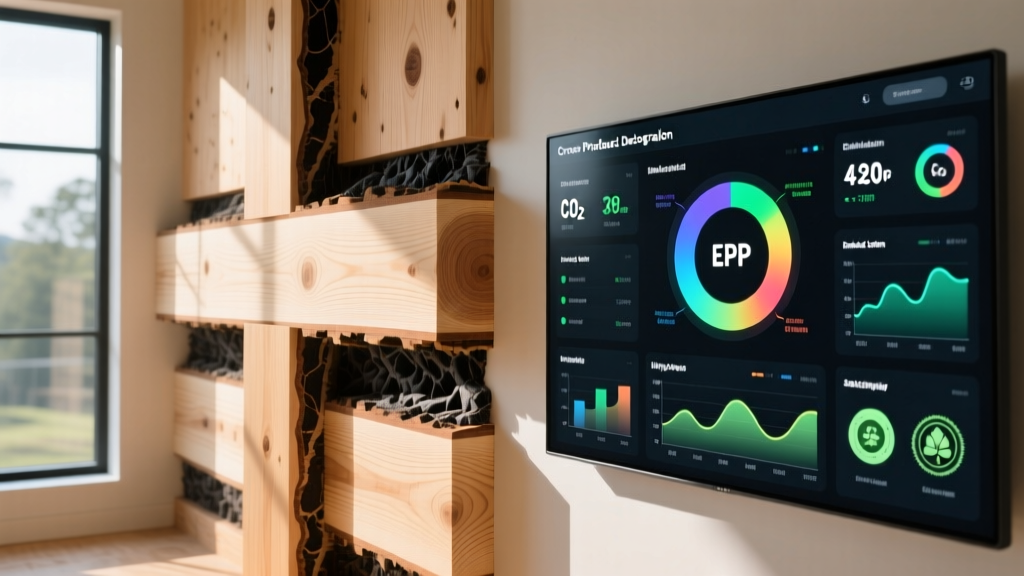
To definitively determine what green building materials are for a specific project, architects and engineers must rely on Environmental Product Declarations (EPDs). An EPD is a standardized, third-party-verified document that communicates the LCA results of a product. When reviewing an EPD, verify the following three critical data points:
1. Compliance Standard: Ensure the EPD is developed in accordance with EN 15804 (the European standard, widely adopted globally for construction products) or ISO 21930.
2. Declared Unit: Check whether the impact is measured per kilogram, per cubic meter, or per square meter of coverage at a specific thickness. Comparing a per-kilogram EPD of steel to a per-cubic-meter EPD of concrete without volumetric conversion yields useless data.
3. System Boundary: Look for 'Cradle-to-Gate' (A1-A3) versus 'Cradle-to-Grave' (A1-C4). A Cradle-to-Gate EPD only accounts for manufacturing and ignores transportation to the site, installation waste, and end-of-life disposal, effectively hiding up to 20% of the material's true environmental burden.
Specifying green building materials is no longer an exercise in selecting products with green packaging or vague 'eco-friendly' claims. It requires a rigorous, data-driven analysis of embodied carbon, chemical toxicity, operational trade-offs, and end-of-life circularity. By leveraging EPDs, understanding the nuances of blowing agents, and applying life-cycle decision frameworks, construction professionals can significantly reduce the built environment's ecological footprint.
Written by
James ThorntonJames Thornton is a construction industry veteran with 25 years of hands-on experience in wood framing, lumber grading, and residential building codes. He started as a framing carpenter in rural Oregon, earned his ICC Residential Building Inspector certification, and eventually became a senior plan reviewer for the City of Portland Bureau of Development Services. James holds a B.S. in Wood Science & Technology from Oregon State University and is a certified lumber grader through the West Coast Lumber Inspection Bureau (WCLIB). He has inspected over 3,000 residential construction sites and authored the city's internal guide on advanced framing techniques (2x6 at 24" O.C.). James lives in Bend, OR, where he builds custom timber-frame cabins and competes in lumberjack sports.
More from James Thornton
View all
Insulation
Best Home Insulation Materials: Complete 2026 Guide
Compare top home insulation materials for 2026. Find R-values, installed costs per square foot, and best uses for fiberglass, spray foam, and mineral wool.
Aug 4, 2026

Sustainable Building
Certify Your Green Building Material for LEED and WELL
Step-by-step guide to certifying a green building material for LEED v5 and WELL v2. Master EPDs, HPDs, and VOC limits for 2026 project specifications.
Aug 4, 2026

Stone & Masonry
Veneer Stacked Stone Panels: Interior Design & Style Showcase
Discover how veneer stacked stone panels transform interiors. Explore modern design profiles, material pairings, and technical installation specs.
Aug 4, 2026